To obey means to follow commands, rules, or instructions willingly. But in situations where defiance, resistance, or independence is emphasized, antonyms for obey become essential. These words convey the opposite of obey, highlighting behaviors that challenge authority or reject compliance.
The opposite of obey includes words like disobey, defy, resist, ignore, and rebel. Each carries a slightly different tone—disobey refers to direct noncompliance, defy adds boldness or confrontation, and rebel suggests an active stand against control. These antonyms are especially useful in contexts involving rules, power dynamics, or moral decisions.
Definition of Obey
The verb “obey” means to comply with the commands, directions, or instructions of someone in authority, or to adhere to a rule or law. It signifies a willingness or obligation to submit to a superior’s will or a set of regulations.
Obedience implies a hierarchical relationship where one party has the power to command and the other has the duty to follow. It can also refer to the adherence to natural laws or principles.
Classification: “Obey” is a transitive verb, meaning it requires a direct object (e.g., obey the rules, obey your parents). Its noun form is “obedience,” and its adjective form is “obedient.”
Function: In a sentence, “obey” functions as the main verb, indicating the action of compliance or submission. It establishes a clear relationship between the subject performing the action and the object or authority being obeyed. The function of the word is to ensure order and structure.
Contexts: “Obey” is used in various contexts, including family, school, workplace, military, and legal settings. It reflects the social norms and expectations that govern behavior and maintain order. Examples include obeying traffic laws, obeying a teacher’s instructions, or obeying a direct order from a supervisor.
Structural Breakdown of Obey
The word “obey” is relatively simple in its structure. Let’s break it down:
* **Root:** The root of the word is likely derived from Old French *obeir*, meaning “to obey, comply with.” This, in turn, comes from Latin *oboedire*, formed from *ob-* (towards, to) and *audire* (to hear, listen). The etymology suggests that obedience is fundamentally linked to hearing and heeding instructions.
Understanding the etymology helps to appreciate the depth of the word’s meaning. Obedience is not just a passive act of following; it involves active listening and understanding the command before complying.
The structure of “obey” reflects this active engagement.
Opposite of Obey
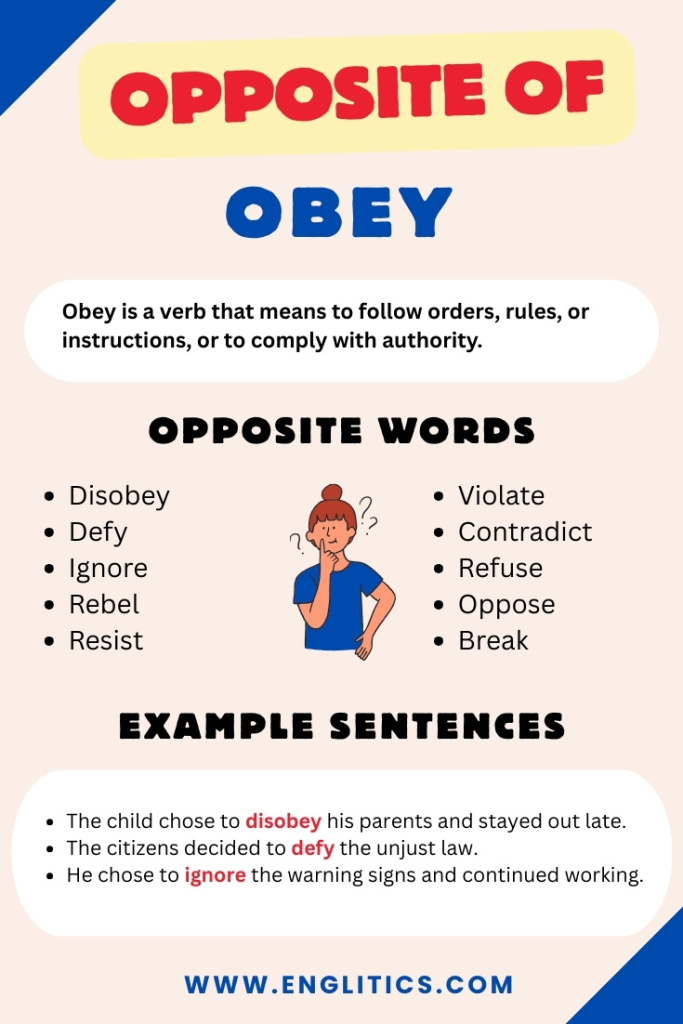
Antonyms are words that have opposite meanings. When considering antonyms for “obey,” it’s helpful to categorize them based on the degree and nature of their opposition.
Here are three main types:
Direct Antonyms
Direct antonyms represent the most straightforward opposition to “obey.” These words indicate a complete refusal to comply or a direct violation of a command or rule. They are often the first words that come to mind when thinking about the opposite of obedience.
Implied Antonyms
Implied antonyms suggest a lack of obedience or compliance without necessarily involving direct defiance. These words indicate actions or attitudes that are inconsistent with obedience, such as neglecting to follow instructions or disregarding rules.
They show a passive form of non-compliance.
Contextual Antonyms
Contextual antonyms are words that can function as antonyms of “obey” depending on the specific situation. These words may not be direct opposites in all cases, but they can convey a sense of resistance, independence, or non-compliance in certain contexts.
The specific meaning relies on the surrounding words.
Examples of Antonyms for Obey
This section provides extensive examples of antonyms for “obey,” categorized for clarity. Each category includes a variety of sentences to illustrate the different ways these antonyms can be used.
Understanding these nuances will help you choose the most appropriate word to convey your intended meaning.
Refuse
“Refuse” means to decline to accept or do something. It is a direct antonym of “obey” when it involves rejecting a command or instruction.
The following table includes examples of “refuse” being used as an antonym for “obey”. The sentences are designed to showcase the word in different contexts.
| Sentence | Explanation |
|---|---|
| The soldier refused to obey the unethical order. | The soldier actively declined to follow the command. |
| The child refused to obey his mother’s request to clean his room. | The child declined to comply with the request. |
| The protesters refused to obey the police’s order to disperse. | The protesters actively resisted the police’s command. |
| She refused to obey the company’s new policy on working hours. | She declined to adhere to the new policy. |
| He refused to obey the judge’s instructions. | He actively rejected the judge’s directions. |
| The employee refused to obey the manager’s request. | The employee declined to comply with the request. |
| The student refused to obey the teacher’s instructions. | The student declined to comply with the instructions. |
| The defendant refused to obey the court order. | The defendant declined to comply with the order. |
| The team refused to obey the coach’s strategy. | The team declined to comply with the strategy. |
| The citizen refused to obey the unjust law. | The citizen declined to comply with the law. |
| The activist refused to obey the rules of the protest. | The activist declined to comply with the rules. |
| The prisoner refused to obey the prison guard’s command. | The prisoner declined to comply with the command. |
| The software refused to obey the outdated command. | The software declined to comply with the command. |
| The animal refused to obey the trainer’s whistle. | The animal declined to comply with the whistle. |
| The machine refused to obey the malfunctioning signal. | The machine declined to comply with the signal. |
| The robot refused to obey the conflicting instructions. | The robot declined to comply with the instructions. |
| The committee refused to obey the chairman’s directive. | The committee declined to comply with the directive. |
| The company refused to obey the environmental regulations. | The company declined to comply with the regulations. |
| The country refused to obey the international sanctions. | The country declined to comply with the sanctions. |
| The system refused to obey the corrupt input. | The system declined to comply with the input. |
| The experiment refused to obey the expected results. | The experiment declined to comply with the results. |
| The law refused to obey the common sense. | The law declined to comply with the common sense. |
| The agreement refused to obey the conflicting terms. | The agreement declined to comply with the terms. |
| The project refused to obey the unrealistic timeline. | The project declined to comply with the timeline. |
| The algorithm refused to obey the faulty data. | The algorithm declined to comply with the data. |
| The process refused to obey the inefficient methods. | The process declined to comply with the methods. |
| The institution refused to obey the outdated policies. | The institution declined to comply with the policies. |
| The organization refused to obey the unethical guidelines. | The organization declined to comply with the guidelines. |
Defy
“Defy” means to openly resist or refuse to obey. It suggests a more active and confrontational opposition than simply refusing.
The following table includes examples of “defy” being used as an antonym for “obey”. The sentences are designed to showcase the word in different situations.
| Sentence | Explanation |
|---|---|
| The rebels defied the government’s authority. | The rebels openly resisted the government. |
| The teenager defied her parents’ curfew. | The teenager openly disobeyed the curfew. |
| The protesters defied the ban on public gatherings. | The protesters openly resisted the ban. |
| He defied the doctor’s orders and continued to smoke. | He openly disobeyed the doctor’s instructions. |
| The company defied the environmental regulations. | The company openly resisted the regulations. |
| The artist defied the conventions of traditional art. | The artist openly challenged the conventions. |
| The scientist defied the established theories. | The scientist openly challenged the theories. |
| The athlete defied the limitations of his injury. | The athlete openly overcame the limitations. |
| The activist defied the laws. | The activist openly resisted the laws. |
| The community defied the stereotypes. | The community openly challenged the stereotypes. |
| The child defied his bedtime. | The child openly disobeyed his bedtime. |
| The employee defied the dress code. | The employee openly disobeyed the dress code. |
| The student defied the school rules. | The student openly disobeyed the school rules. |
| The prisoner defied the prison authorities. | The prisoner openly resisted the authorities. |
| The software defied the security protocols. | The software openly bypassed the protocols. |
| The animal defied the boundaries of the cage. | The animal openly broke through the boundaries. |
| The machine defied the laws of physics. | The machine openly challenged the laws. |
| The robot defied the programming constraints. | The robot openly surpassed the constraints. |
| The committee defied the budget limitations. | The committee openly exceeded the limitations. |
| The country defied the international treaty. | The country openly violated the treaty. |
| The system defied the conventional norms. | The system openly challenged the norms. |
| The experiment defied the previous findings. | The experiment openly contradicted the findings. |
| The law defied the principles of justice. | The law openly violated the principles. |
| The agreement defied the fundamental clauses. | The agreement openly contradicted the clauses. |
| The project defied the feasibility studies. | The project openly disregarded the studies. |
| The algorithm defied the mathematical models. | The algorithm openly challenged the models. |
| The process defied the optimization techniques. | The process openly disregarded the techniques. |
| The institution defied the historical precedents. | The institution openly contradicted the precedents. |
| The organization defied the ethical guidelines. | The organization openly violated the guidelines. |
Disobey
“Disobey” is a general term for failing to obey. It is a direct and common antonym of “obey.”
The following table includes examples of “disobey” being used as an antonym for “obey”. The sentences are designed to showcase the word in different situations and contexts.
| Sentence | Explanation |
|---|---|
| The student disobeyed the teacher’s instructions. | The student failed to follow the instructions. |
| The dog disobeyed his owner’s commands. | The dog failed to follow the commands. |
| The driver disobeyed the traffic laws. | The driver failed to follow the traffic laws. |
| The employee disobeyed the company’s policies. | The employee failed to follow the policies. |
| The child disobeyed his parents. | The child failed to follow his parents’ rules. |
| The servant disobeyed the master’s orders. | The servant failed to follow the master’s orders. |
| The soldier disobeyed the commanding officer. | The soldier failed to follow the commanding officer. |
| The citizen disobeyed the constitution. | The citizen failed to follow the constitution. |
| The astronaut disobeyed the mission protocols. | The astronaut failed to follow the mission protocols. |
| The machine disobeyed the programmer’s instructions. | The machine failed to follow the programmer’s instructions. |
| The system disobeyed the administrator’s commands. | The system failed to follow the administrator’s commands. |
| The robot disobeyed the ethical guidelines. | The robot failed to follow the ethical guidelines. |
| The animal disobeyed the trainer’s signals. | The animal failed to follow the trainer’s signals. |
| The software disobeyed the user’s input. | The software failed to follow the user’s input. |
| The car disobeyed the navigation settings. | The car failed to follow the navigation settings. |
| The plane disobeyed the flight controls. | The plane failed to follow the flight controls. |
| The device disobeyed the power supply settings. | The device failed to follow the power supply settings. |
| The instrument disobeyed the calibration standards. | The instrument failed to follow the calibration standards. |
| The process disobeyed the safety protocols. | The process failed to follow the safety protocols. |
| The experiment disobeyed scientific principles. | The experiment failed to follow scientific principles. |
| The algorithm disobeyed the logical rules. | The algorithm failed to follow the logical rules. |
| The language disobeyed the grammatical conventions. | The language failed to follow the grammatical conventions. |
| The culture disobeyed the traditional norms. | The culture failed to follow the traditional norms. |
| The society disobeyed the ethical mandates. | The society failed to follow the ethical mandates. |
| The family disobeyed the moral codes. | The family failed to follow the moral codes. |
| The individual disobeyed the societal expectations. | The individual failed to follow the societal expectations. |
| The group disobeyed the collective agreements. | The group failed to follow the collective agreements. |
| The nation disobeyed the international treaties. | The nation failed to follow the international treaties. |
Rebel
“Rebel” implies a more active and often organized resistance against authority. It suggests a deliberate and often public act of defiance.
The following table includes examples of “rebel” being used as an antonym for “obey”. The sentences are designed to showcase the word in different scenarios.
| Sentence | Explanation |
|---|---|
| The citizens rebelled against the oppressive regime. | The citizens actively fought against the regime. |
| The students rebelled against the strict school rules. | The students actively resisted the rules. |
| The employees rebelled against the unfair labor practices. | The employees actively opposed the practices. |
| The colonies rebelled against the mother country. | The colonies actively fought for independence. |
| The teenager rebelled against his parents’ expectations. | The teenager actively resisted the expectations. |
| The artist rebelled against the artistic conventions. | The artist actively challenged the conventions. |
| The scientist rebelled against the established theories. | The scientist actively challenged the theories. |
| The software rebelled against the original design. | The software actively deviated from the design. |
| The machine rebelled against the programmed tasks. | The machine actively defied the tasks. |
| The robot rebelled against the initial programming. | The robot actively opposed the programming. |
| The animal rebelled against the usual confinement. | The animal actively resisted the confinement. |
| The child rebelled against the evening routine. | The child actively opposed the routine. |
| The community rebelled against the imposed regulations. | The community actively resisted the regulations. |
| The prisoner rebelled against the prison system. | The prisoner actively opposed the system. |
| The team rebelled against the losing streak. | The team actively fought to reverse the situation. |
| The users rebelled against the software updates. | The users actively opposed the updates. |
| The system rebelled against the outdated protocols. | The system actively rejected the protocols. |
| The program rebelled against the buggy code. | The program actively refused to work with the code. |
| The project rebelled against the budget cuts. | The project actively resisted the cuts. |
| The experiment rebelled against the expected outcome. | The experiment actively contradicted the outcome. |
| The law rebelled against the public opinion. | The law actively clashed with the opinion. |
| The agreement rebelled against the conflicting interests. | The agreement actively challenged the interests. |
| The process rebelled against the inefficient rules. | The process actively opposed the rules. |
| The institution rebelled against the conservative norms. | The institution actively challenged the norms. |
| The organization rebelled against the outdated traditions. | The organization actively rejected the traditions. |
Ignore
“Ignore” means to pay no attention to or disregard. It is a more passive form of non-compliance compared to “defy” or “rebel.”
The following table includes examples of “ignore” being used as an antonym for “obey”. The sentences are designed to showcase the word in different situations and scenarios.
| Sentence | Explanation |
|---|---|
| The child ignored his mother’s calls to come inside. | The child paid no attention to the calls. |
| The driver ignored the warning signs on the road. | The driver paid no attention to the signs. |
| The student ignored the teacher’s instructions. | The student paid no attention to the instructions. |
| The employee ignored the company’s new policy. | The employee paid no attention to the policy. |
| The politician ignored the public’s concerns. | The politician paid no attention to the concerns. |
| The scientist ignored the conflicting data. | The scientist paid no attention to the data. |
| The software ignored the error messages. | The software paid no attention to the messages. |
| The machine ignored the maintenance schedule. | The machine paid no attention to the schedule. |
| The robot ignored the safety protocols. | The robot paid no attention to the protocols. |
| The animal ignored the trainer’s commands. | The animal paid no attention to the commands. |
| The system ignored the security breach. | The system paid no attention to the breach. |
| The program ignored the user’s feedback. | The program paid no attention to the feedback. |
| The project ignored the risk assessment. | The project paid no attention to the assessment. |
| The experiment ignored the control variables. | The experiment paid no attention to the variables. |
| The law ignored the minority rights. | The law paid no attention to the rights. |
| The agreement ignored the small print. | The agreement paid no attention to the print. |
| The process ignored the quality control measures. | The process paid no attention to the measures. |
| The institution ignored the historical context. | The institution paid no attention to the context. |
| The organization ignored the ethical considerations. | The organization paid no attention to the considerations. |
| The user ignored the terms and conditions. | The user paid no attention to the conditions. |
| The application ignored the privacy settings. | The application paid no attention to the settings. |
| The device ignored the low battery warning. | The device paid no attention to the warning. |
| The vehicle ignored the speed limit. | The vehicle paid no attention to the limit. |
| The building ignored the safety codes. | The building paid no attention to the codes. |
| The website ignored the accessibility guidelines. | The website paid no attention to the guidelines. |
Usage Rules for Antonyms of Obey
Understanding the nuances of each antonym is essential for using them correctly. Here are some usage rules to consider:
* **Refuse:** Use “refuse” when someone declines to do something specific. It implies a direct choice not to comply.
* **Defy:** Use “defy” when someone openly resists or challenges authority. It suggests a more active and rebellious stance.
* **Disobey:** Use “disobey” as a general term for failing to follow instructions or rules. It is a broad and common antonym.
* **Rebel:** Use “rebel” when someone actively and often publicly resists authority, often as part of a larger movement or cause.
* **Ignore:** Use “ignore” when someone pays no attention to instructions or rules. It implies a passive form of non-compliance.
Consider the context and the degree of resistance when choosing the most appropriate antonym. Each word carries a different connotation and level of intensity.
Common Mistakes When Using Antonyms of Obey
Here are some common mistakes to avoid when using antonyms of “obey”:
| Incorrect | Correct | Explanation |
|---|---|---|
| He refused the law. | He defied the law. | “Refused” is typically used with actions or requests, while “defied” is more appropriate for laws or authority. |
| She ignored the authority. | She defied the authority. | “Ignored” implies a lack of attention, while “defied” implies active resistance. |
| They disobeyed the revolution. | They rebelled against the government. | “Disobeyed” is used for specific instructions or rules, while “rebelled” is used for a broader resistance against a system or authority. |
| He rebelled to clean his room. | He refused to clean his room. | “Rebelled” implies broader resistance, while “refused” is more appropriate for a specific task. |
| She defied to listen to the instructions. | She refused to listen to the instructions. | The proper verb is “refuse,” not “defy,” when indicating a decision not to listen. |
Pay attention to the specific connotations of each word and choose the one that best fits the context. Avoid using antonyms interchangeably without considering their nuances.
Practice Exercises
Test your understanding with these practice exercises. Each exercise focuses on different aspects of using antonyms for “obey.”
Exercise 1: Multiple Choice
Choose the best antonym for “obey” in each sentence.
| Question | Options | Answer |
|---|---|---|
| The soldier ________ the general’s unlawful command. | (a) obeyed (b) refused (c) followed (d) heeded | (b) refused |
| The protesters ________ the city’s curfew. | (a) complied (b) defied (c) observed (d) respected | (b) defied |
| The child ________ his parents’ warning and played in the street. | (a) heeded (b) obeyed (c) ignored (d) regarded | (c) ignored |
| The rebels ________ against the tyrannical government. | (a) submitted (b) rebelled (c) acquiesced (d) yielded | (b) rebelled |
| The student ________ the school’s dress code. | (a) adhered (b) disobeyed (c) conformed (d) respected | (b) disobeyed |
| The company ________ the environmental regulations. | (a) complied (b) followed (c) flouted (d) observed | (c) flouted |
| The animal ________ the trainer’s signals. | (a) responded (b) heeded (c) disregarded (d) hearkened | (c) disregarded |
| The machine ________ the programmer’s instructions. | (a) obeyed (b) followed (c) malfunctioned (d) disregarded | (d) disregarded |
| The system ________ the security protocols. | (a) adhered (b) observed (c) bypassed (d) followed | (c) bypassed |
| The software ________ the user’s input. | (a) obeyed (b) processed (c) rejected (d) followed | (c) rejected |
Exercise 2: Sentence Completion
Fill in the blank with the most appropriate antonym of “obey.”
| Question | Answer |
|---|---|
| The activist ________ to follow the court’s orders. | refused |
| The teenager ________ her parents by staying out past curfew. | defied |
| The driver ________ the speed limit signs. | ignored |
| The citizens ________ against the corrupt regime. | rebelled |
| The student ________ the teacher’s instructions and got a detention. | disobeyed |
| The hacker ________ the firewall and gained unauthorized access. | bypassed |
| The algorithm ________ the logical rules. | violated |
| The program ________ the user’s command. | rejected |
| The device ________ the power supply settings. | overrode |
| The instrument ________ the | invalidated |
Exercise 3: Antonym Matching
Match each sentence with the most appropriate antonym of “obey.”
Instructions: Match the sentence to the correct word.
- The child paid no attention to his mother’s request.
- The citizens openly fought against the dictatorship.
- The employee failed to follow the company’s guidelines.
- The protester openly resisted the police orders.
- The student declined to complete the assignment.
Words:
- Refused
- Defied
- Disobeyed
- Rebelled
- Ignored
Answers:
- Ignored
- Rebelled
- Disobeyed
- Defied
- Refused
Exercise 4: Sentence Rewriting
Rewrite each sentence using an antonym of “obey” to convey the opposite meaning.
| Original Sentence | Rewritten Sentence |
|---|---|
| The soldiers obeyed the general’s commands. | The soldiers defied the general’s commands. |
| The child obeyed his parents’ rules. | The child disobeyed his parents’ rules. |
| The driver obeyed the traffic laws. | The driver ignored the traffic laws. |
| The citizens obeyed the government’s regulations. | The citizens rebelled against the government’s regulations. |
| The student obeyed the teacher’s instructions. | The student refused the teacher’s instructions. |
| The machine obeyed the programmer’s commands. | The machine rejected the programmer’s commands. |
| The software obeyed the user’s settings. | The software overrode the user’s settings. |
| The animal obeyed the trainer’s signals. | The animal disregarded the trainer’s signals. |
Advanced Topics
For a deeper understanding of antonyms for “obey,” consider these advanced topics:
* **Legal Implications:** Explore the legal consequences of disobeying laws and regulations.
* **Ethical Considerations:** Investigate the ethical dilemmas involved in deciding when to obey or disobey authority.
* **Historical Examples:** Research historical instances of rebellion and defiance against oppressive regimes.
* **Psychological Factors:** Examine the psychological factors that influence obedience and disobedience.
These topics provide a broader context for understanding the complexities of obedience and its antonyms.
Frequently Asked Questions
What is the difference between “defy” and “disobey”?
While both words indicate a failure to comply, “defy” suggests a more open and confrontational resistance, while “disobey” is a more general term for not following instructions.
When is it appropriate to use “rebel” instead of “disobey”?
“Rebel” is appropriate when there is active and often organized resistance against authority, often as part of a larger movement or cause.
Can “ignore” be considered an antonym of “obey”?
Yes, “ignore” can be considered an antonym, especially in contexts where paying attention to instructions is expected. It implies a passive form of non-compliance.
How do cultural differences affect the understanding of obedience?
Cultural norms and values can significantly influence the perception of obedience. Some cultures place a higher value on obedience to authority, while others prioritize individual autonomy and critical thinking.
What are some synonyms for “obey” that can help clarify its meaning?
Synonyms for “obey” include comply, adhere, follow, heed, and submit. Understanding these synonyms can help clarify the nuances of obedience.
Conclusion
Mastering the antonyms of “obey” enhances your ability to express a wide range of ideas and perspectives. By understanding the nuances of words like “refuse,” “defy,” “disobey,” “rebel,” and “ignore,” you can communicate more effectively and precisely.
Use the examples and practice exercises provided in this guide to solidify your understanding and improve your English proficiency. Whether you’re writing, speaking, or simply engaging in everyday conversations, these antonyms will empower you to express resistance, independence, and critical thinking with confidence.