Antonyms for “obvious” include words like unclear, subtle, hidden, ambiguous, and obscure. These words describe things that are not immediately noticeable, easily understood, or openly expressed.
Using the opposite of obvious allows you to describe situations, meanings, or details that require interpretation, deeper thought, or closer observation. Whether you’re writing analytically or narrating events, these antonyms help convey complexity, nuance, or uncertainty.
Defining “Obvious”
The word “obvious” describes something that is easily perceived or understood; it’s readily apparent and requires little to no explanation. Synonyms include evident, clear, plain, apparent, and manifest.
The term often implies a lack of ambiguity or complexity. Something that is obvious is immediately recognizable without the need for deeper analysis or investigation.
In essence, “obvious” signifies a state of being easily discernible to the senses or intellect. It suggests a direct and unambiguous pathway to understanding, leaving little room for doubt or misinterpretation.
The context in which “obvious” is used often emphasizes the simplicity and straightforwardness of the information being conveyed.
Structural Breakdown of “Obvious”
“Obvious” is an adjective derived from the Latin word “obvius,” meaning “that lies in the way, easily found.” Its structure is relatively simple, consisting of the root word “obvi-” and the suffix “-ous,” which transforms it into an adjective. Understanding its etymology helps to appreciate its core meaning of something being readily accessible or apparent.
The word’s grammatical function is primarily adjectival, modifying nouns to describe their readily apparent qualities. For instance, in the phrase “the obvious solution,” the adjective “obvious” modifies the noun “solution,” indicating that the solution is easily identifiable.
The simplicity of its structure belies the complexity of its antonyms, which often involve varying degrees of obscurity and ambiguity.
Opposite of Obvious
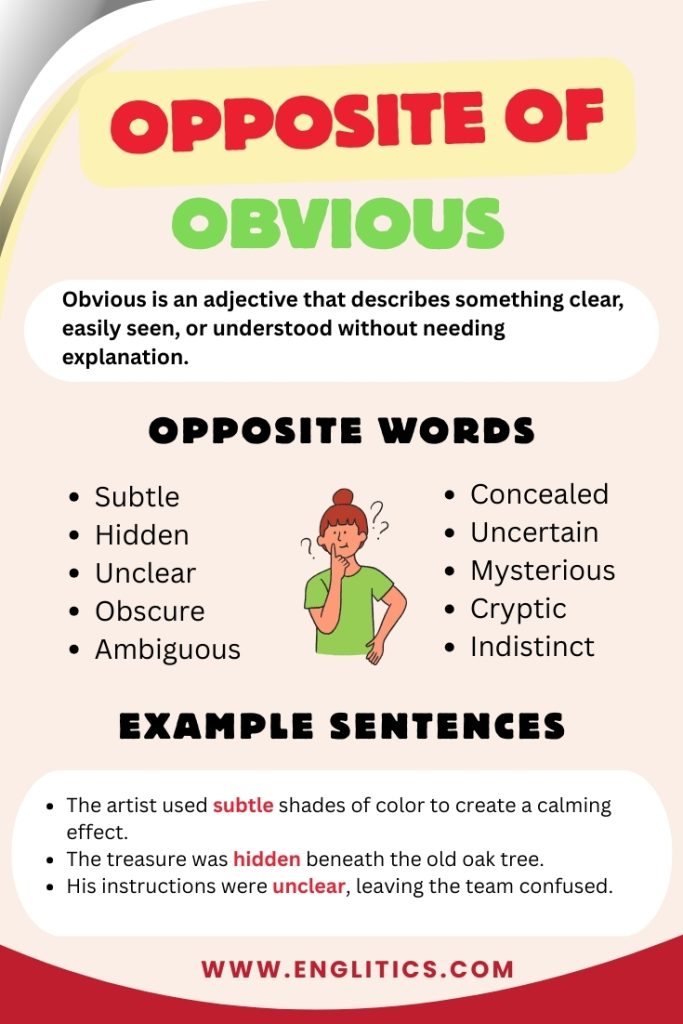
Antonyms for “obvious” can be categorized into several types, each representing a different degree of opposition in meaning. These categories help to refine your understanding and selection of the most appropriate antonym for a given context.
1. Direct Opposites
These antonyms represent the most direct contrast to “obvious,” indicating something that is not at all apparent or easily understood. Examples include:
- Unclear: Lacking clarity; not easily understood.
- Ambiguous: Open to more than one interpretation; having a double meaning.
- Obscure: Not discovered or known about; uncertain.
- Hidden: Kept out of sight; concealed.
2. Subtle Opposites
These antonyms suggest a lack of overtness or a need for careful discernment. They don’t necessarily imply complete incomprehensibility but rather a requirement for deeper analysis.
Examples include:
- Subtle: So delicate or precise as to be difficult to analyze or describe.
- Implicit: Implied though not plainly expressed.
- Understated: Presented or expressed in a subtle and effective way.
- Nuanced: Characterized by subtle shades of meaning or expression.
3. Misleading Opposites
These antonyms suggest that something appears obvious but is, in fact, deceptive or incorrect. They highlight the potential for misinterpretation or false assumptions.
Examples include:
- Deceptive: Giving an appearance or impression different from the true one; misleading.
- Misleading: Giving the wrong idea or impression.
- Superficial: Appearing to be true or real only until examined more closely.
4. Complex Opposites
These antonyms emphasize the intricate and multifaceted nature of something, making it difficult to grasp immediately. They suggest a level of depth that requires extensive exploration and understanding.
Examples include:
- Complex: Consisting of many different and connected parts.
- Intricate: Very complicated or detailed.
- Convoluted: Extremely complex and difficult to follow.
Examples of Antonyms in Use
To illustrate the usage of these antonyms, consider the following examples, categorized by the type of opposition they represent. These tables demonstrate how different antonyms can be used in various contexts to convey specific meanings.
Table 1: Direct Opposites of “Obvious”
This table provides examples of direct opposites of “obvious,” showing how they are used to indicate a lack of clarity or understanding.
| Sentence with “Obvious” | Sentence with Antonym | Antonym |
|---|---|---|
| It was obvious that he was lying. | It was unclear whether he was telling the truth. | Unclear |
| The answer was obvious from the start. | The answer remained ambiguous, even after careful consideration. | Ambiguous |
| The solution to the problem was obvious. | The solution to the problem remained obscure, despite numerous attempts. | Obscure |
| The treasure’s location was obvious on the map. | The treasure’s location was hidden, requiring a complex search. | Hidden |
| Her intentions were obvious to everyone. | Her intentions remained unclear, leaving everyone guessing. | Unclear |
| The connection between the events was obvious. | The connection between the events was ambiguous and open to interpretation. | Ambiguous |
| The cause of the accident was obvious. | The cause of the accident remained obscure, even after the investigation. | Obscure |
| The evidence was obvious and undeniable. | The evidence was hidden, requiring diligent detective work to uncover. | Hidden |
| The meaning of the poem was obvious. | The meaning of the poem was unclear and subject to interpretation. | Unclear |
| The purpose of the meeting was obvious to all attendees. | The purpose of the meeting remained ambiguous, causing confusion. | Ambiguous |
| The source of the rumor was obvious. | The source of the rumor was obscure and difficult to trace. | Obscure |
| The truth was obvious, staring them in the face. | The truth was hidden, requiring a long and arduous search. | Hidden |
| It was obvious that he was nervous. | It was unclear if he was nervous or simply tired. | Unclear |
| The rules of the game were obvious. | The rules of the game were ambiguous, leading to disputes. | Ambiguous |
| The origins of the tradition were obvious. | The origins of the tradition were obscure, lost in the mists of time. | Obscure |
| The secret was obvious to anyone who looked closely. | The secret was carefully hidden, requiring expert knowledge to uncover. | Hidden |
| The problem’s solution was obvious. | The problem’s solution was unclear, requiring extensive research. | Unclear |
| The artist’s message was obvious in the painting. | The artist’s message was ambiguous, open to various interpretations. | Ambiguous |
| The identity of the culprit was obvious. | The identity of the culprit was obscure, making the investigation difficult. | Obscure |
| The path to success was obvious. | The path to success was carefully hidden, making it a challenge to find. | Hidden |
Table 2: Subtle Opposites of “Obvious”
This table showcases examples of subtle opposites of “obvious,” focusing on nuances and implied meanings.
| Sentence with “Obvious” | Sentence with Antonym | Antonym |
|---|---|---|
| The connection was obvious. | The connection was subtle, requiring careful observation. | Subtle |
| The agreement was obvious in their behavior. | The agreement was implicit, never explicitly stated. | Implicit |
| The importance of the event was obvious. | The importance of the event was understated, but deeply felt. | Understated |
| The difference between the two options was obvious. | The difference between the two options was nuanced, requiring careful consideration. | Nuanced |
| His feelings were obvious to everyone. | His feelings were subtle, only discernible to those who knew him well. | Subtle |
| The message of the film was obvious. | The message of the film was implicit, conveyed through symbolism. | Implicit |
| The significance of her contribution was obvious. | The significance of her contribution was understated, but immense. | Understated |
| The complexity of the issue was not obvious. | The complexity of the issue was nuanced, with layers of meaning. | Nuanced |
| Her talent was obvious from the start. | Her talent was subtle, gradually revealing itself over time. | Subtle |
| The threat was obvious and immediate. | The threat was implicit, a silent undercurrent of danger. | Implicit |
| The value of their work was obvious. | The value of their work was understated, but profoundly impactful. | Understated |
| The differences in their approaches were obvious. | The differences in their approaches were nuanced, reflecting different philosophies. | Nuanced |
| The change in her attitude was obvious. | The change in her attitude was subtle, almost imperceptible. | Subtle |
| The criticism was obvious and direct. | The criticism was implicit, conveyed through gestures and tone. | Implicit |
| The beauty of the landscape was obvious. | The beauty of the landscape was understated, a quiet and serene presence. | Understated |
| The layers of meaning in the text were obvious. | The layers of meaning in the text were nuanced, rewarding close reading. | Nuanced |
| The impact of the decision was obvious. | The impact of the decision was subtle, but far-reaching. | Subtle |
| The warning was obvious and clear. | The warning was implicit, a subtle hint of danger. | Implicit |
| The importance of the tradition was obvious. | The importance of the tradition was understated, but deeply ingrained in their culture. | Understated |
| The complexity of the situation was not obvious at first glance. | The complexity of the situation was nuanced, requiring a deep understanding of the context. | Nuanced |
Table 3: Misleading Opposites of “Obvious”
This table provides examples where something appears obvious but is, in fact, deceptive or incorrect.
| Sentence with “Obvious” | Sentence with Antonym | Antonym |
|---|---|---|
| The answer seemed obvious, but it was a trap. | The answer was deceptive, leading many astray. | Deceptive |
| The solution appeared obvious, but it was flawed. | The solution was misleading, causing further problems. | Misleading |
| The truth seemed obvious on the surface. | The truth was superficial, hiding a deeper reality. | Superficial |
| It was obvious who was to blame, or so it seemed. | It was deceptive to assume blame without further investigation. | Deceptive |
| The path forward seemed obvious, but it was a dead end. | The path forward was misleading, leading to disappointment. | Misleading |
| The explanation seemed obvious, but it was incomplete. | The explanation was superficial, lacking depth and detail. | Superficial |
| The connection was obvious at first glance, but it was false. | The connection was deceptive, designed to mislead. | Deceptive |
| The quick fix seemed obvious, but it had long-term consequences. | The quick fix was misleading, offering a temporary solution only. | Misleading |
| The evidence seemed obvious, but it was circumstantial. | The evidence was superficial, lacking concrete proof. | Superficial |
| The motive was obvious, or so everyone thought. | The motive was deceptive, hiding a more complex agenda. | Deceptive |
| The easy route seemed obvious, but it was dangerous. | The easy route was misleading, luring travelers into peril. | Misleading |
| The story seemed obvious, but it was a fabrication. | The story was superficial, lacking any real substance. | Superficial |
| The solution looked obvious on paper, but it failed in practice. | The solution was deceptive, appearing promising but ultimately ineffective. | Deceptive |
| The answer appeared obvious to the untrained eye. | The answer was misleading until thoroughly analyzed. | Misleading |
| The initial impression was obvious, but wrong. | The initial impression was superficial and incomplete. | Superficial |
| The pattern seemed obvious at first, but it was a coincidence. | The pattern was deceptive, suggesting a connection that didn’t exist. | Deceptive |
| The conclusion was obvious based on the limited information. | The conclusion was misleading due to the lack of complete data. | Misleading |
| The simple explanation seemed obvious enough. | The simple explanation was superficial and ignored the underlying issues. | Superficial |
| The intent seemed obvious, but it was a smokescreen. | The intent was deceptive, masking the real purpose. | Deceptive |
| The first impression was obvious, but appearances can be deceiving. | The first impression was misleading, as things were not as they seemed. | Misleading |
Table 4: Complex Opposites of “Obvious”
This table demonstrates examples where something is intricate and multifaceted, making it difficult to grasp immediately.
| Sentence with “Obvious” | Sentence with Antonym | Antonym |
|---|---|---|
| The process was not obvious, requiring multiple steps. | The process was complex, involving numerous interconnected stages. | Complex |
| The design was not obvious, revealing hidden patterns. | The design was intricate, with a labyrinth of details. | Intricate |
| The argument was not obvious, needing careful dissection. | The argument was convoluted, difficult to follow and understand. | Convoluted |
| The solution was not obvious, needing extensive research. | The solution was complex, involving multiple variables and considerations. | Complex |
| The structure of the novel was not obvious at first. | The structure of the novel was intricate, with interwoven plotlines. | Intricate |
| The reasoning behind the decision was not obvious. | The reasoning behind the decision was convoluted and hard to decipher. | Convoluted |
| The relationship between the characters was not obvious. | The relationship between the characters was complex, with layers of history. | Complex |
| The pattern in the data was not obvious. | The pattern in the data was intricate, requiring statistical analysis. | Intricate |
| The explanation was not obvious, demanding careful study. | The explanation was convoluted, full of jargon and technical terms. | Convoluted |
| The impact of the policy was not obvious. | The impact of the policy was complex, affecting various sectors differently. | Complex |
| The artwork was not obvious in its meaning. | The artwork was intricate, filled with symbolic representations. | Intricate |
| The plot of the film was not obvious. | The plot of the film was convoluted, with multiple twists and turns. | Convoluted |
| The design of the machine was not obvious. | The design of the machine was complex, with numerous interconnected parts. | Complex |
| The network of relationships was not obvious. | The network of relationships was intricate, resembling a tangled web. | Intricate |
| The line of reasoning was not obvious. | The line of reasoning was convoluted, making it difficult to understand the conclusion. | Convoluted |
| The structure of the organization was not obvious. | The structure of the organization was complex, with multiple levels of hierarchy. | Complex |
| The details in the painting were not obvious. | The details in the painting were intricate, rewarding close inspection. | Intricate |
| The development of the character was not obvious. | The development of the character was convoluted, with many internal conflicts. | Convoluted |
| The system of checks and balances was not obvious. | The system of checks and balances was complex, designed to prevent abuse of power. | Complex |
| The narrative structure was not obvious throughout the series. | The narrative structure was intricate, with flashbacks and parallel storylines. | Intricate |
Usage Rules and Considerations
When selecting an antonym for “obvious,” it’s crucial to consider the context and the specific nuance you wish to convey. Here are some guidelines:
- Specificity: Choose an antonym that accurately reflects the degree of obscurity or ambiguity you intend to express. “Unclear” might be suitable for something simply lacking clarity, while “obscure” might be more appropriate for something deliberately hidden.
- Connotation: Be mindful of the connotations associated with each antonym. “Deceptive” carries a negative connotation, implying intentional misleading, while “subtle” suggests a more delicate or nuanced quality.
- Formality: Consider the level of formality required by the context. Some antonyms, such as “convoluted,” might be more suitable for formal writing, while others, like “unclear,” are more versatile.
Understanding these considerations will enable you to choose the most fitting antonym, enhancing the precision and impact of your writing.
Common Mistakes to Avoid
One common mistake is using an antonym that is too strong or too weak for the intended meaning. For example, using “hidden” when “unclear” would be more accurate.
Another error is overlooking the connotations of the antonym, leading to unintended implications.
Here are some examples of common mistakes and their corrections:
| Incorrect | Correct | Explanation |
|---|---|---|
| The answer was obvious, so it must be hidden. | The answer was obvious, so it shouldn’t be unclear. | “Hidden” implies deliberate concealment, while “unclear” simply suggests a lack of clarity. |
| His intentions were obvious, therefore they were complex. | His intentions were obvious, therefore they weren’t complex. | “Complex” implies intricacy, while the opposite of “obvious” in this context is simplicity or straightforwardness. |
| The solution was obvious, demonstrating it was deceptive. | The solution seemed obvious, but it was deceptive. | “Deceptive” implies a misleading appearance, not a direct opposite of “obvious.” |
Practice Exercises
Test your understanding with these practice exercises. Choose the best antonym for “obvious” in each sentence.
Exercise 1
- The meaning of the symbol was anything but __________.
- a) clear
- b) obvious
- c) obscure
- d) apparent
- The solution to the puzzle was surprisingly __________.
- a) straightforward
- b) complex
- c) evident
- d) plain
- Her motives were far from __________.
- a) transparent
- b) hidden
- c) manifest
- d) clear
- The connection between the two events was __________.
- a) plain
- b) ambiguous
- c) evident
- d) transparent
- It was not __________ what he intended to do.
- a) apparent
- b) unclear
- c) obvious
- d) manifest
- The subtle hints were not __________ to everyone.
- a) clear
- b) obvious
- c) subtle
- d) hidden
- The problem’s origins were quite __________.
- a) obvious
- b) obscure
- c) evident
- d) known
- The answer was designed to be __________.
- a) obvious
- b) misleading
- c) clear
- d) apparent
- His feelings were __________, requiring careful interpretation.
- a) obvious
- b) nuanced
- c) clear
- d) transparent
- The details were intentionally __________.
- a) obvious
- b) understated
- c) hidden
- d) clear
Answer Key: 1: c, 2: b, 3: b, 4: b, 5: b, 6: b, 7: b, 8: b, 9: b, 10: c
Exercise 2
Fill in the blank with the most appropriate antonym of “obvious” from the list: subtle, deceptive, intricate, unclear, implicit.
- The details of the plan were intentionally __________.
- The true meaning of the poem remained __________, open to interpretation.
- The agreement was __________, never explicitly stated but understood by all parties.
- The path to success was not __________, requiring careful navigation.
- The solution presented was __________, designed to mislead those who didn’t look closely.
- The real problem was __________, demanding careful observation.
- The rules were __________, and caused confusion.
- His feelings were __________, but with some care they could be figured out.
- The meaning of the art was __________, and it was up to the individual to perceive.
- The correct answer was __________, but a trick question.
Answer Key: 1: unclear, 2: unclear, 3: implicit, 4: subtle, 5: deceptive, 6: subtle, 7: unclear, 8: subtle, 9: unclear, 10: deceptive
Advanced Topics
For advanced learners, exploring the philosophical implications of “obviousness” can be enriching. Consider the concept of “obvious” truths and how they can be culturally or historically contingent.
Delve into the role of “obvious” assumptions in shaping our understanding of the world.
Furthermore, examine how antonyms of “obvious” are used in literature to create suspense, ambiguity, or dramatic irony. Analyze how authors strategically employ these words to manipulate the reader’s perception and challenge their assumptions.
Study the use of “obvious” and its antonyms in rhetoric and argumentation to understand how speakers and writers persuade their audiences.
Frequently Asked Questions
- What is the main difference between “unclear” and “obscure” as antonyms of “obvious”?While both “unclear” and “obscure” suggest a lack of clarity, “unclear” generally implies a simpler lack of understanding, while “obscure” often suggests that something is deliberately hidden or difficult to find out due to its complexity or lack of visibility. Think of “unclear” as a foggy window and “obscure” as a hidden room.
- Can “complicated” be considered an antonym of “obvious”?Yes, “complicated” can be an antonym of “obvious,” especially when “obvious” implies simplicity. However, “complicated” emphasizes the intricate and complex nature of something, making it not easily understood, whereas “obvious” implies ease of understanding and simplicity.
- How does context affect the best choice of antonym for “obvious”?Context is crucial. If you want to emphasize a lack of clarity, “unclear” or “ambiguous” might be best. If you want to suggest something is intentionally hidden, “hidden” or “obscure” are more appropriate. If you want to highlight misleading appearances, “deceptive” or “misleading” are suitable. The specific nuance you wish to convey should guide your choice.
- Is “subtle” always a good antonym for “obvious”?Not always. “Subtle” works well when you want to emphasize a delicate or nuanced quality that is not immediately apparent. However, if you want to convey complete incomprehensibility, “unclear” or “obscure” might be more fitting. “Subtle” suggests that something requires careful discernment, not that it’s impossible to understand.
- How can I improve my ability to choose the right antonym for “obvious”?Read widely and pay attention to how different antonyms are used in various contexts. Practice using these words in your own writing and speaking. Consult a thesaurus or dictionary to explore the nuances of different words. The more you expose yourself to language, the better you’ll become at selecting the most appropriate word.
- Are there any regional differences in the usage of these antonyms?While the core meanings of these antonyms are generally consistent across different English-speaking regions, there might be subtle variations in usage or frequency. Pay attention to the specific conventions of the region you’re writing for, if applicable. Consulting a style guide specific to that region can be helpful.
- What is the difference between “implicit” and “implied” as antonyms of obvious?“Implicit” and “implied” are closely related and can sometimes be used interchangeably, but there’s a subtle distinction. “Implicit” means something is suggested or understood though not plainly expressed. It refers to something that is inherent or contained within something else. “Implied” means suggested but not directly expressed; it’s the act of suggesting something indirectly. As antonyms of obvious, both suggest the opposite of clarity, but “implicit” focuses on the inherent suggestion, while “implied” focuses on the act of suggesting.
- How can understanding antonyms of ‘obvious’ help in critical thinking?Understanding antonyms of ‘obvious’ enhances critical thinking by prompting you to question what seems readily apparent. It encourages you to consider alternative perspectives, recognize hidden assumptions, and appreciate the complexity of situations. By exploring what isn’t obvious, you develop a more nuanced and comprehensive understanding of the world around you.
Conclusion
Mastering the antonyms of “obvious” is an essential step in refining your communication skills. By understanding the subtle differences between words like “unclear,” “obscure,” “subtle,” “deceptive,” and “complex,” you can express yourself with greater precision and nuance.
Remember to consider the context, connotation, and formality when selecting the most appropriate antonym.
Continue to practice using these words in your writing and speaking, and don’t be afraid to experiment with different options. The more you engage with language, the more confident and articulate you will become.
Embrace the challenge of expressing what isn’t immediately apparent, and you’ll unlock new levels of understanding and communication.
Ultimately, the ability to articulate the non-obvious is a hallmark of sophisticated communication and critical thinking. By continually expanding your vocabulary and honing
your linguistic skills, you’ll be well-equipped to navigate the complexities of language and thought.