The Opposite of Occasionally refers to something that happens often, regularly, or all the time. While “occasionally” means something occurs once in a while or not very often, its opposite suggests frequent or constant repetition.
Antonyms for Occasionally include frequently, regularly, and constantly. For example, instead of exercising occasionally, someone who works out regularly follows a weekly routine. A person who frequently checks their phone stays updated all the time. Constantly getting up during class can be distracting to others.
Definition of “Occasionally”
“Occasionally” is an adverb that means “at infrequent or irregular intervals; now and then.” It describes actions or events that happen sometimes, but not on a regular basis. The word suggests a degree of infrequency, implying that the occurrence is not a common or predictable event. Its core meaning revolves around the concept of something happening sporadically or intermittently.
In terms of grammatical classification, “occasionally” functions as an adverb of frequency. Adverbs of frequency modify verbs, indicating how often an action takes place. These adverbs provide crucial information about the regularity or irregularity of events. Understanding the nuances of adverbs of frequency is essential for constructing clear and accurate sentences.
The context in which “occasionally” is used can significantly impact the overall meaning of a sentence. For instance, saying “I occasionally visit my grandmother” conveys a different sense of frequency than saying “I rarely visit my grandmother.” The specific choice of adverb shapes the reader’s or listener’s understanding of how often the action occurs.
Therefore, grasping the precise meaning of “occasionally” and its antonyms is essential for effective communication.
Structural Breakdown of “Occasionally”
The word “occasionally” is derived from the noun “occasion” with the addition of the suffix “-ally,” which transforms it into an adverb. Breaking down its structure helps understand its function and meaning.
Root Word: Occasion – This refers to a particular time or event, often one that is special or significant.
Suffix: -ally – This suffix is commonly used to convert nouns into adverbs. It indicates that the word describes how something is done or happens.
Therefore, “occasionally” literally means “in a way that relates to an occasion” or “happening at specific times or events, but not regularly.” This structural understanding reinforces the word’s meaning of infrequent or irregular occurrence. Recognizing this structure can also aid in understanding and remembering other adverbs formed with the “-ally” suffix.
Understanding the etymology and structure of “occasionally” provides a deeper appreciation for its meaning. By recognizing the relationship between “occasion” and “occasionally,” learners can better grasp the nuances of the word and its appropriate usage.
Furthermore, this knowledge can be applied to deciphering the meanings of other related words and expanding one’s overall vocabulary.
Opposite of Occasionally
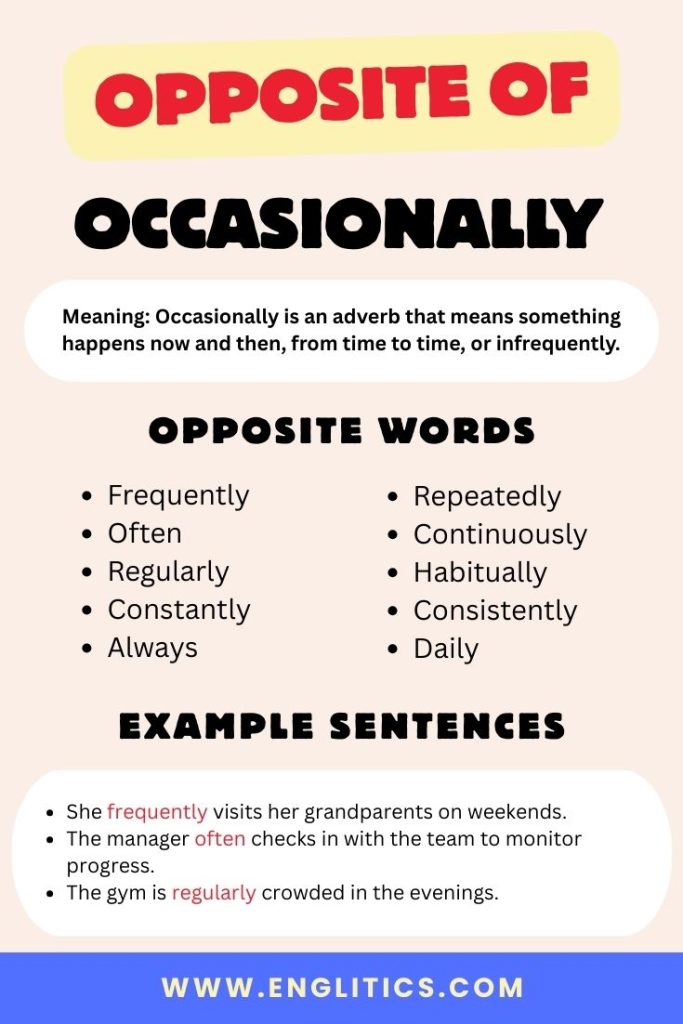
Antonyms are words with opposite meanings. Identifying antonyms for “occasionally” allows for a more nuanced and precise expression of frequency.
Here are several antonyms, each with slightly different connotations:
Always
Definition: At all times; on all occasions.
Connotation: Implies a constant and uninterrupted occurrence.
Frequently
Definition: Regularly or habitually; often.
Connotation: Suggests a high rate of occurrence, but not necessarily every time.
Constantly
Definition: Continuously over a period of time; always.
Connotation: Emphasizes the uninterrupted nature of the action or event.
Regularly
Definition: At uniform intervals; habitually.
Connotation: Indicates a predictable and consistent pattern of occurrence.
Usually
Definition: Under normal conditions; generally.
Connotation: Suggests that something happens most of the time, but not necessarily always.
Invariably
Definition: In every case or on every occasion; always.
Connotation: Emphasizes the lack of exceptions; something happens without fail.
Continually
Definition: Recurring at intervals; repeatedly.
Connotation: Highlights the repetitive nature of an action, possibly with short breaks.
Ceaselessly
Definition: Without stopping; continuously.
Connotation: Implies an unending and relentless occurrence.
Perpetually
Definition: In a way that never ends or changes; constantly.
Connotation: Suggests a seemingly permanent and unchanging occurrence.
Never
Definition: At no time in the past or future; not ever.
Connotation: Indicates a complete absence of occurrence.
Examples
The following examples illustrate the use of “occasionally” and its antonyms in various contexts. Pay close attention to how the choice of adverb affects the meaning of each sentence.
Examples with “Always”
The antonym “always” indicates that something happens at all times, without exception. The table below provides examples.
| Sentence with “Occasionally” | Sentence with “Always” (Antonym) |
|---|---|
| I occasionally drink coffee. | I always drink coffee. |
| She occasionally visits her parents. | She always visits her parents. |
| He occasionally forgets his keys. | He always forgets his keys. |
| They occasionally go to the beach. | They always go to the beach. |
| We occasionally eat out at restaurants. | We always eat out at restaurants. |
| The sun occasionally shines through the clouds. | The sun always shines (in this fictional setting). |
| I occasionally feel tired after work. | I always feel tired after work. |
| She occasionally calls me on Sundays. | She always calls me on Sundays. |
| He occasionally watches the news. | He always watches the news. |
| They occasionally play tennis. | They always play tennis. |
| We occasionally listen to classical music. | We always listen to classical music. |
| The train occasionally arrives late. | The train always arrives late. |
| I occasionally check my email in the evening. | I always check my email in the evening. |
| She occasionally exercises in the morning. | She always exercises in the morning. |
| He occasionally reads before bed. | He always reads before bed. |
| They occasionally argue about politics. | They always argue about politics. |
| We occasionally have pizza for dinner. | We always have pizza for dinner. |
| The birds occasionally sing in the garden. | The birds always sing in the garden. |
| I occasionally lose my temper. | I always lose my temper. |
| She occasionally wears a hat. | She always wears a hat. |
Examples with “Frequently”
The antonym “frequently” indicates that something happens often, but not necessarily all the time. The table below provides examples.
| Sentence with “Occasionally” | Sentence with “Frequently” (Antonym) |
|---|---|
| I occasionally go to the gym. | I frequently go to the gym. |
| She occasionally cooks Italian food. | She frequently cooks Italian food. |
| He occasionally travels for work. | He frequently travels for work. |
| They occasionally visit museums. | They frequently visit museums. |
| We occasionally watch movies. | We frequently watch movies. |
| I occasionally crave sweets. | I frequently crave sweets. |
| She occasionally goes for a run. | She frequently goes for a run. |
| He occasionally helps with chores. | He frequently helps with chores. |
| They occasionally eat at that restaurant. | They frequently eat at that restaurant. |
| We occasionally have guests over. | We frequently have guests over. |
| I occasionally attend concerts. | I frequently attend concerts. |
| She occasionally buys new clothes. | She frequently buys new clothes. |
| He occasionally plays video games. | He frequently plays video games. |
| They occasionally go camping. | They frequently go camping. |
| We occasionally bake cookies. | We frequently bake cookies. |
| I occasionally feel stressed. | I frequently feel stressed. |
| She occasionally volunteers at the shelter. | She frequently volunteers at the shelter. |
| He occasionally forgets appointments. | He frequently forgets appointments. |
| They occasionally redecorate their house. | They frequently redecorate their house. |
| We occasionally visit the zoo. | We frequently visit the zoo. |
Examples with “Constantly”
The antonym “constantly” implies an uninterrupted action over a period of time. The table below provides examples.
| Sentence with “Occasionally” | Sentence with “Constantly” (Antonym) |
|---|---|
| The baby occasionally cries. | The baby constantly cries. |
| The phone occasionally rings. | The phone constantly rings. |
| He occasionally checks his watch. | He constantly checks his watch. |
| She occasionally worries about her health. | She constantly worries about her health. |
| They occasionally complain about the weather. | They constantly complain about the weather. |
| The dog occasionally barks at strangers. | The dog constantly barks at strangers. |
| The news occasionally reports on crime. | The news constantly reports on crime. |
| He occasionally taps his foot. | He constantly taps his foot. |
| She occasionally checks her social media. | She constantly checks her social media. |
| They occasionally argue about money. | They constantly argue about money. |
| The wind occasionally blows through the trees. | The wind constantly blows through the trees. |
| He occasionally adjusts his glasses. | He constantly adjusts his glasses. |
| She occasionally hums to herself. | She constantly hums to herself. |
| They occasionally interrupt each other. | They constantly interrupt each other. |
| The car occasionally makes a strange noise. | The car constantly makes a strange noise. |
| He occasionally asks for help. | He constantly asks for help. |
| She occasionally checks the time. | She constantly checks the time. |
| They occasionally change their minds. | They constantly change their minds. |
| The computer occasionally freezes. | The computer constantly freezes. |
| He occasionally fidgets in his seat. | He constantly fidgets in his seat. |
Examples with “Regularly”
The antonym “regularly” indicates something happens at consistent intervals. The table below provides examples.
| Sentence with “Occasionally” | Sentence with “Regularly” (Antonym) |
|---|---|
| I occasionally check my bank account. | I regularly check my bank account. |
| She occasionally attends yoga classes. | She regularly attends yoga classes. |
| He occasionally visits his doctor. | He regularly visits his doctor. |
| They occasionally clean their apartment. | They regularly clean their apartment. |
| We occasionally have team meetings. | We regularly have team meetings. |
| I occasionally water the plants. | I regularly water the plants. |
| She occasionally updates her blog. | She regularly updates her blog. |
| He occasionally exercises. | He regularly exercises. |
| They occasionally go grocery shopping. | They regularly go grocery shopping. |
| We occasionally review our budget. | We regularly review our budget. |
| I occasionally back up my computer files. | I regularly back up my computer files. |
| She occasionally meditates. | She regularly meditates. |
| He occasionally attends workshops. | He regularly attends workshops. |
| They occasionally have family dinners. | They regularly have family dinners. |
| We occasionally service our car. | We regularly service our car. |
| I occasionally read news articles. | I regularly read news articles. |
| She occasionally takes dance lessons. | She regularly takes dance lessons. |
| He occasionally attends church services. | He regularly attends church services. |
| They occasionally visit their grandparents. | They regularly visit their grandparents. |
| We occasionally check the weather forecast. | We regularly check the weather forecast. |
Examples with “Never”
The antonym “never” indicates that something doesn’t happen at any time. The table below provides examples.
| Sentence with “Occasionally” | Sentence with “Never” (Antonym) |
|---|---|
| I occasionally eat fast food. | I never eat fast food. |
| She occasionally smokes cigarettes. | She never smokes cigarettes. |
| He occasionally drinks alcohol. | He never drinks alcohol. |
| They occasionally lie. | They never lie. |
| We occasionally stay up late. | We never stay up late. |
| I occasionally forget names. | I never forget names. |
| She occasionally gets angry. | She never gets angry. |
| He occasionally watches reality TV. | He never watches reality TV. |
| They occasionally gossip. | They never gossip. |
| We occasionally disagree. | We never disagree. |
| I occasionally lose my keys. | I never lose my keys. |
| She occasionally feels lonely. | She never feels lonely. |
| He occasionally procrastinates. | He never procrastinates. |
| They occasionally complain. | They never complain. |
| We occasionally eat meat. | We never eat meat. |
| I occasionally skip breakfast. | I never skip breakfast. |
| She occasionally feels insecure. | She never feels insecure. |
| He occasionally drives without a seatbelt. | He never drives without a seatbelt. |
| They occasionally cheat on tests. | They never cheat on tests. |
| We occasionally forget anniversaries. | We never forget anniversaries. |
Usage Rules
When using antonyms for “occasionally,” it’s essential to consider the context and the specific nuance you want to convey. Here are some guidelines:
- “Always” and “Invariably”: Use these when the action happens without exception. Be careful, as using “always” when there are rare exceptions can be misleading.
- “Frequently” and “Regularly”: Use these when the action happens often, either with or without consistent intervals. “Frequently” implies a high rate of occurrence, while “regularly” implies a consistent schedule.
- “Constantly,” “Continually,” “Ceaselessly,” and “Perpetually”: These emphasize the ongoing nature of the action. “Constantly” suggests uninterrupted action, while “continually” may allow for brief pauses. “Ceaselessly” and “perpetually” emphasize the seemingly endless nature of the action.
- “Usually”: Use this when the action happens most of the time, but not every time.
- “Never”: Use “never” when the action does not occur at all.
Example:
Incorrect: “I occasionally eat pizza, so I am always on a diet.” (Contradictory)
Correct: “I frequently eat pizza, so I am always on a diet.” (More logical, though potentially hyperbolic)
Correct: “I occasionally eat pizza, but I regularly exercise.” (Contrasting infrequent action with a frequent one)
The choice of antonym depends on the degree of frequency or infrequency you wish to express. Consider the specific context and select the word that most accurately reflects the intended meaning.
Common Mistakes
Using antonyms incorrectly can lead to confusion and miscommunication. Here are some common mistakes to avoid:
| Incorrect | Correct | Explanation |
|---|---|---|
| I occasionally go to the gym, so I never exercise. | I rarely go to the gym, so I never exercise. | “Occasionally” implies some frequency, contradicting “never.” “Rarely” is a better fit. |
| She occasionally drinks water, so she always feels dehydrated. | She rarely drinks water, so she always feels dehydrated. | “Occasionally” is too frequent for someone who feels constantly dehydrated. |
| He occasionally works hard, so he constantly gets promoted. | He regularly works hard, so he constantly gets promoted. | “Occasionally” does not explain constant promotions. “Regularly” is a more likely cause. |
| They occasionally argue, therefore they always agree. | They occasionally argue, but they usually agree. | “Occasionally” and “always” are contradictory in this context. |
| We occasionally eat dinner, so we invariably go hungry. | We rarely eat dinner, so we invariably go hungry. | “Occasionally” suggests some dinners are eaten. “Rarely” better explains constant hunger. |
Pay attention to the logical relationship between the frequency adverb and the rest of the sentence. Ensure that the chosen adverb accurately reflects the intended meaning and avoids contradictions.
Practice Exercises
Test your understanding of antonyms for “occasionally” with these exercises.
Exercise 1: Fill in the Blanks
Choose the best antonym for “occasionally” from the list below to complete each sentence: always, frequently, never, regularly, constantly
| Question | Answer |
|---|---|
| 1. She ________ checks her email, so she never misses important messages. | always |
| 2. He ________ goes to the library to study, especially during exam season. | frequently |
| 3. They ________ eat meat, as they are strict vegetarians. | never |
| 4. I ________ exercise to stay healthy and fit. | regularly |
| 5. The baby ________ cries when he is hungry or tired. | constantly |
| 6. She ________ forgets her keys, which is quite annoying. | always |
| 7. He ________ visits his family, as they live far away. | regularly |
| 8. They ________ buy new clothes; they prefer to repair what they have. | never |
| 9. I ________ check the weather forecast before planning outdoor activities. | regularly |
| 10. The dog ________ barks at the mailman. | constantly |
Exercise 2: Rewrite the Sentences
Rewrite each sentence using an antonym for “occasionally” to change its meaning.
| Original Sentence | Rewritten Sentence |
|---|---|
| 1. I occasionally drink soda. | I never drink soda. |
| 2. She occasionally goes to the movies. | She frequently goes to the movies. |
| 3. He occasionally forgets his wife’s birthday. | He always forgets his wife’s birthday. |
| 4. They occasionally visit their hometown. | They regularly visit their hometown. |
| 5. We occasionally eat at that restaurant. | We constantly eat at that restaurant. |
| 6. I occasionally feel stressed at work. | I constantly feel stressed at work. |
| 7. She occasionally volunteers at the animal shelter. | She regularly volunteers at the animal shelter. |
| 8. He occasionally checks his social media accounts. | He always checks his social media accounts. |
| 9. They occasionally argue about politics. | They constantly argue about politics. |
| 10. We occasionally have pizza for dinner. | We always have pizza for dinner. |
Exercise 3: Multiple Choice
Choose the best antonym for “occasionally” in each sentence.
| Question | Options | Answer |
|---|---|---|
| 1. She occasionally exercises, so she is ________ fit. | a) always b) rarely c) frequently d) never | d) never |
| 2. He occasionally eats vegetables, but he ________ eats junk food. | a) always b) rarely c) frequently d) never | c) frequently |
| 3. They occasionally go to the beach, but they ________ go to the mountains. | a) always b) rarely c) frequently d) never | a) always |
| 4. We occasionally have team meetings, but we ________ communicate through email. | a) always b) rarely c) frequently d) never | c) frequently |
| 5. I occasionally drink coffee, but I ________ drink tea. | a) always b) rarely c) frequently d) never | d) never |
| 6. She occasionally feels sad, but she is ________ happy. | a) always b) rarely c) frequently d) usually | d) usually |
| 7. He occasionally forgets his wallet, so he ________ has cash on him. | a) always b) rarely c) frequently d) never | b) rarely |
| 8. They occasionally visit museums, but they ________ explore art galleries. | a) always b) rarely c) frequently d) usually | a) always |
| 9. We occasionally watch movies, but we ________ read books. | a) always b) rarely c) frequently d) usually | c) frequently |
| 10. I occasionally eat sweets, but I ________ eat healthy meals. | a) always b) rarely c) frequently d) never | a) always |
Advanced Topics
For advanced learners, consider the subtle differences between synonyms of the antonyms. For instance, instead of “frequently,” you could use “oftentimes” or “repeatedly.” Explore how these words add different shades of meaning.
Also, consider how the antonyms interact with other adverbs and modifiers in a sentence. For example, “He almost always arrives on time” is different from “He invariably arrives on time.” The addition of “almost” softens the absoluteness of “always.”
Another advanced topic is understanding how cultural contexts influence the perception of frequency. What is considered “frequent” in one culture might be considered “occasional” in another.
Pay attention to these nuances when communicating with people from diverse backgrounds.
Finally, explore the use of these adverbs in formal versus informal writing. In formal writing, precision is key, so choosing the most accurate antonym is crucial.
In informal writing, you might have more leeway to use less precise language.
FAQ
Q1: What is the difference between “frequently” and “regularly”?
A1: “Frequently” means “often,” implying something happens a lot, but not necessarily at set times. “Regularly” means “at uniform intervals,” implying a consistent schedule or pattern.
For example, “I frequently check my email” means I check it often, but not necessarily at the same times each day. “I regularly attend yoga classes” means I attend classes on a consistent schedule, like every Tuesday and Thursday.
Q2: Can “never” be considered an antonym for “occasionally”?
A2: Yes, “never” is a strong antonym for “occasionally.” “Occasionally” implies something happens at least some of the time, while “never” means it does not happen at any time. They represent opposite ends of the frequency spectrum.
Q3: Is “rarely” an antonym for “occasionally”?
A3: While not a direct antonym, “rarely” is closely related and can often function as one. “Rarely” means “not often,” which is the opposite of “occasionally” in the sense that it indicates a low frequency of occurrence.
However, “occasionally” suggests a slightly higher frequency than “rarely.”
Q4: How do I choose the right antonym for “occasionally”?
A4: Consider the context and the specific meaning you want to convey. If you want to emphasize that something happens without exception, use “always” or “invariably.” If you want to indicate a high frequency, use “frequently” or “regularly.” If you want to emphasize that something never happens, use “never.”
Q5: Can I use more than one antonym in a sentence to emphasize frequency?
A5: Yes, you can. For example, you could say, “He always and invariably arrives on time,” to emphasize the consistency of his punctuality.
However, be careful not to be redundant or sound unnatural.
Q6: Are there any regional differences in the usage of these antonyms?
A6: While the core meanings are generally consistent, there might be slight regional preferences for certain words. For example, some regions might favor “oftentimes” over “frequently.” Pay attention to the language used by native speakers in your region to get a sense of these preferences.
Q7: How can I improve my understanding of adverbs of frequency?
A7: Practice using them in sentences, read widely, and pay attention to how native speakers use them in conversation and writing. You can also create flashcards with definitions and examples to help you memorize the different adverbs and their meanings.
Q8: Is “sometimes” a synonym for “occasionally”?
A8: Yes, “sometimes” is a synonym for “occasionally.” They both indicate that something happens at irregular intervals.
Conclusion
Mastering antonyms for “occasionally” significantly enhances your ability to express frequency with precision and clarity. Understanding the nuances of words like “always,” “frequently,” “regularly,” and “never” empowers you to communicate more effectively and avoid misinterpretations.
By practicing with examples, exercises, and paying attention to context, you can confidently use these antonyms in your writing and speaking.
Remember that language learning is an ongoing process. Continue to expand your vocabulary, explore different grammatical structures, and seek opportunities to practice your skills.
The more you engage with the English language, the more fluent and confident you will become. Use these newly learned words and concepts in your daily conversations and writing to reinforce your understanding and improve your overall communication skills.
By mastering the use of antonyms, you gain a more nuanced understanding of the English language and improve your communication skills significantly. Keep practicing, and you’ll find yourself expressing yourself with greater accuracy and confidence.