The Opposite of Opponent refers to someone who is on your side—supportive, cooperative, or allied. While an “opponent” is a rival or someone you compete or disagree with, the antonyms describe individuals who share your goals or offer help.
Antonyms for Opponent include ally, supporter, and teammate. This guide uses real-life examples to show how these terms apply in sports, debates, or everyday situations. Whether you’re improving your vocabulary or writing with more precision, knowing these opposites helps you speak and write with greater clarity.
Definition of “Opponent” and the Importance of Antonyms
An opponent is a person or group that opposes another in a contest, battle, dispute, or debate. This opposition can be active, involving direct conflict, or passive, involving disagreement or resistance. Understanding the antonyms of “opponent” is crucial for expressing relationships of support, agreement, and collaboration, thereby enriching our vocabulary and communication skills.
Antonyms are words with opposite meanings. They are essential for providing contrast, clarity, and depth to our language.
By recognizing the antonyms of a word like “opponent,” we can more effectively convey different perspectives and relationships, enhancing the precision and impact of our communication. In the context of grammar, understanding antonyms helps to build a richer, more nuanced vocabulary, allowing for more expressive and accurate writing and speech.
Structural Breakdown: Understanding Word Relationships
The relationship between a word and its antonyms is fundamental to understanding semantics, the study of meaning in language. Antonyms provide a contrasting perspective that helps clarify the meaning of the original word.
This relationship is not always straightforward, as some words have multiple antonyms depending on the specific context.
Understanding the structural breakdown of word relationships involves recognizing different types of antonyms. These types include complementary antonyms (where one word implies the absence of the other, such as “alive” and “dead”), gradable antonyms (which exist on a scale, such as “hot” and “cold”), and relational antonyms (which describe a relationship from opposite perspectives, such as “teacher” and “student”).
In the case of “opponent,” the antonyms often fall into the category of relational or gradable antonyms, depending on the degree of support or agreement being expressed.
Opposite of Opponent
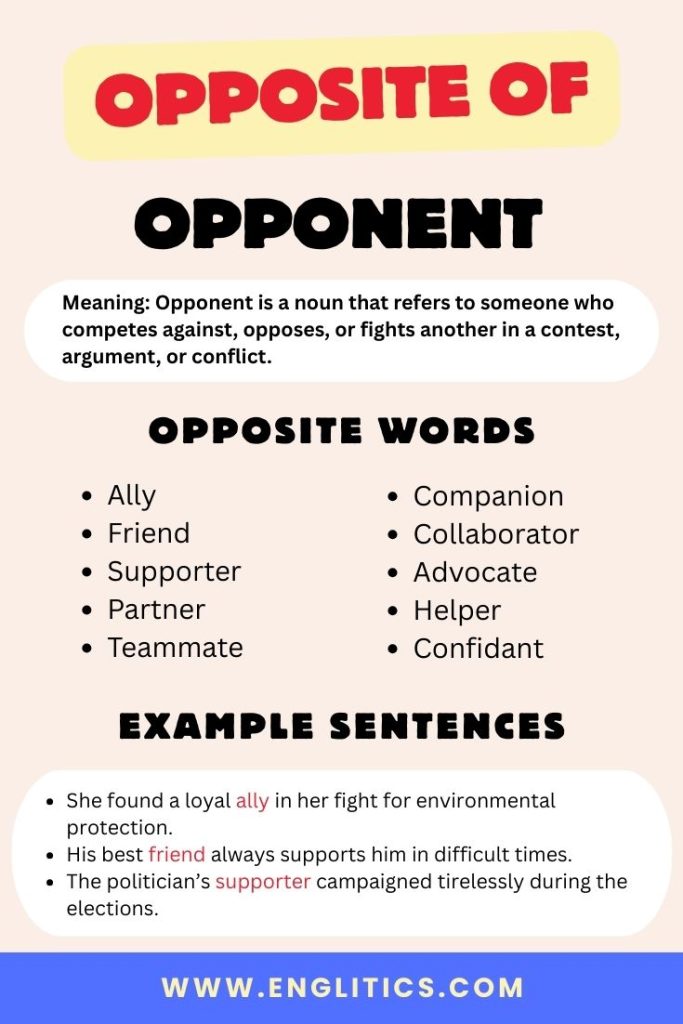
The antonyms for “opponent” can be categorized based on the degree and nature of the support or agreement they imply. Here are some key categories and examples:
Ally
An ally is someone who cooperates with another on a military or political level or in achieving a particular goal. An ally suggests a strong, active, and often formal relationship of support.
Supporter
A supporter is someone who approves of and encourages someone or something (typically a public figure, a movement or organisation). A supporter suggests backing a cause or person.
Advocate
An advocate is a person who publicly supports or recommends a particular cause or policy. An advocate is someone who speaks or writes in favor of something. This term suggests active and vocal support.
Friend
A friend is a person whom one knows and with whom one has a bond of mutual affection, typically exclusive of sexual or family relations. A friend may offer support, but the primary association is one of personal connection and goodwill.
Collaborator
A collaborator is a person who works jointly on an activity or project. This term emphasizes working together towards a common goal.
Teammate
A teammate is a fellow member of a team. This term implies cooperation within a structured group, often in sports or professional settings.
Proponent
A proponent is a person who advocates a theory, proposal, or project. Similar to an advocate, a proponent actively promotes an idea or plan.
Associate
An associate is a person with whom one works or does business. This term suggests a professional connection and potential for cooperation.
Partner
A partner is a person who shares a business or enterprise with another. This term implies a formal agreement and mutual investment in a common goal.
Confederate
A confederate is a person one is allied with or in league with; an accomplice. This term suggests a shared purpose, often in a secret or strategic alliance.
Examples
The following tables provide examples of how these antonyms can be used in sentences, highlighting their specific connotations and contexts. The goal is to illustrate the subtle differences between each word and how they contrast with the meaning of “opponent.”
Table 1: Examples Using “Ally” as an Antonym for “Opponent”
This table showcases how “ally” is used to describe someone who actively supports and cooperates with another, often in a strategic or political context.
| Sentence | Explanation |
|---|---|
| Instead of seeing her as an opponent, he recognized her as a valuable ally in the fight against injustice. | Highlights cooperation towards a common goal. |
| During the war, the two nations formed an alliance, becoming steadfast allies against their common enemy. | Emphasizes a formal, strategic partnership. |
| The CEO sought an ally within the company to help push through the new initiative. | Implies strategic support within an organization. |
| She became an ally to the marginalized community, using her platform to amplify their voices. | Indicates active support and advocacy. |
| The environmental group found an ally in the local government, which supported their conservation efforts. | Demonstrates a cooperative relationship between organizations. |
| He considered his business partner not just an associate, but a true ally in navigating the competitive market. | Shows deep, reliable support in a challenging environment. |
| The rebel forces found a powerful ally in the neighboring country, bolstering their resources and manpower. | Suggests significant and impactful support. |
| As the debate heated up, she realized she needed an ally to help her articulate her points effectively. | Highlights the need for support in a challenging situation. |
| The scientist found an unexpected ally in the journalist who helped expose the truth about the fraudulent research. | Indicates support from an unexpected source. |
| The activist saw every member of the organization as an ally in the struggle for social change. | Emphasizes unity and shared purpose. |
| The small startup considered the venture capitalist an ally, providing crucial funding and expertise. | Shows support in the form of resources and knowledge. |
| In the political arena, forging strong alliances is crucial for achieving legislative success. | Underlines the importance of strategic partnerships. |
| The teacher encouraged students to see each other as allies in their learning journey, not competitors. | Promotes a cooperative and supportive learning environment. |
| The whistleblower became a crucial ally in uncovering the corporate corruption. | Indicates significant support in exposing wrongdoing. |
| The community group found an ally in the local church, which offered its space for meetings and events. | Demonstrates support in the form of resources and facilities. |
| The artist considered the gallery owner an ally, providing a platform to showcase their work. | Shows support in the form of opportunities and exposure. |
| The coach emphasized the importance of teamwork, urging players to be allies on the field. | Highlights cooperation and mutual support in sports. |
| The two companies formed an alliance to develop innovative technologies, becoming strong allies in the industry. | Indicates a strategic partnership for innovation. |
| The author found an ally in the editor who helped refine their manuscript and bring their vision to life. | Shows support in the creative process. |
| The patient regarded their doctor as an ally, providing expert care and guidance throughout their recovery. | Emphasizes trust and support in a healthcare setting. |
| The union acted as an ally to the workers, advocating for fair wages and better working conditions. | Demonstrates support in labor rights and advocacy. |
| The non-profit organization saw the philanthropist as an important ally, providing crucial financial support for their programs. | Highlights the financial support in non-profit work. |
| The cybersecurity firm became an ally to the company, protecting their systems from cyber threats. | Shows support in the form of security and protection. |
Table 2: Examples Using “Supporter” as an Antonym for “Opponent”
This table focuses on the word “supporter,” illustrating how it describes someone who backs a cause, person, or idea, often without necessarily being actively involved in a strategic alliance.
| Sentence | Explanation |
|---|---|
| He was not an opponent of the new policy, but rather a strong supporter of its implementation. | Indicates approval and encouragement. |
| The candidate gained many supporters after her compelling speech on education reform. | Shows public backing for a political figure. |
| As a dedicated supporter of the arts, she regularly attended concerts and exhibitions. | Highlights consistent backing for a particular field. |
| The organization relies heavily on the financial contributions of its supporters. | Emphasizes the importance of financial backing. |
| Despite facing criticism, the project continued to move forward thanks to its unwavering supporters. | Indicates steadfast backing in the face of adversity. |
| She became a vocal supporter of the movement, using social media to spread awareness. | Shows active advocacy through online platforms. |
| The team’s success was attributed to the enthusiastic supporters who cheered them on at every game. | Highlights the positive impact of audience support. |
| He was a long-time supporter of the charity, donating regularly to help fund their programs. | Indicates sustained financial support for a charitable cause. |
| The artist was grateful for the supporters who believed in her vision and helped her realize her dreams. | Shows appreciation for those who provide encouragement and belief. |
| The community rallied together as supporters of the local school, raising funds for new equipment. | Emphasizes collective support for a community institution. |
| The politician thanked his supporters for their unwavering loyalty and commitment to his campaign. | Acknowledges the dedication of those who back a political effort. |
| As a passionate supporter of animal rights, she volunteered at the local shelter every week. | Highlights personal commitment to a cause. |
| The company’s success was due in part to its loyal customer base, who served as enthusiastic supporters of the brand. | Indicates the value of customer loyalty and advocacy. |
| He was a staunch supporter of free speech, defending the rights of others to express their opinions. | Shows strong advocacy for fundamental rights. |
| The research project received a significant boost from its supporters in the scientific community. | Emphasizes the importance of backing from experts in the field. |
| She became a dedicated supporter of sustainable practices, advocating for eco-friendly policies. | Highlights commitment to environmental responsibility. |
| The author was thrilled to see so many supporters at her book signing event. | Indicates public enthusiasm and support for an author. |
| He was a quiet supporter, offering encouragement and assistance behind the scenes. | Shows support without seeking public recognition. |
| The organization recognized its top supporters at the annual gala, honoring their contributions. | Acknowledges and celebrates the contributions of key backers. |
| As a supporter of local businesses, she made a point to shop at independent stores in her community. | Highlights commitment to supporting local economy. |
| The coach praised the team’s supporters for creating an electrifying atmosphere at the stadium. | Emphasizes the impact of audience support on team performance. |
| The innovative project attracted numerous supporters eager to see it succeed. | Indicates enthusiasm and optimism for a new initiative. |
| The community showed its strong support for the hospital with a large fundraising campaign. | Emphasizes collective action to support a vital institution. |
Table 3: Examples Using “Advocate” as an Antonym for “Opponent”
This table illustrates the use of “advocate” to describe someone who actively and publicly supports a cause or policy, often through speaking or writing.
| Sentence | Explanation |
|---|---|
| Far from being an opponent, she was a passionate advocate for environmental protection. | Indicates strong, active support for a cause. |
| As an advocate for human rights, he dedicated his life to fighting injustice and inequality. | Highlights a lifelong commitment to a cause. |
| The organization serves as an advocate for children’s rights, working to ensure their well-being and safety. | Emphasizes the role of an organization in promoting rights. |
| She became a leading advocate for education reform, speaking at conferences and publishing articles on the topic. | Shows active promotion of a cause through public speaking and writing. |
| The lawyer acted as an advocate for his client, presenting a compelling defense in court. | Indicates professional representation and support. |
| He is a strong advocate for renewable energy, promoting its adoption as a solution to climate change. | Highlights support for a specific solution to a global issue. |
| The patient advocate helped navigate the complex healthcare system, ensuring access to necessary treatments. | Shows support in navigating complex systems. |
| As an advocate for mental health awareness, she shared her personal experiences to reduce stigma. | Emphasizes personal involvement in promoting awareness. |
| The group serves as an advocate for small businesses, lobbying for policies that support their growth. | Indicates active lobbying for policy changes. |
| She became a vocal advocate for women’s rights, participating in protests and advocating for equal opportunities. | Shows active participation in advocacy efforts. |
| The non-profit organization operates as an advocate for the homeless, providing resources and support. | Emphasizes the provision of resources and support. |
| He is a dedicated advocate for animal welfare, working to protect animals from abuse and neglect. | Highlights commitment to protecting animals. |
| The organization serves as an advocate for the environment, promoting sustainable practices and conservation efforts. | Indicates active promotion of environmental sustainability. |
| She became a leading advocate for social justice, fighting against discrimination and inequality. | Shows commitment to fighting against injustice. |
| The lawyer acted as an advocate for the accused, ensuring their rights were protected throughout the legal process. | Emphasizes protection of legal rights. |
| He is a strong advocate for education, believing that it is the key to unlocking individual potential. | Highlights the belief in the power of education. |
| The patient advocate helped them understand their treatment options and make informed decisions. | Shows support in making informed healthcare decisions. |
| As an advocate for peace, she worked to promote dialogue and understanding between different cultures. | Emphasizes the promotion of peace and understanding. |
| The group serves as an advocate for the elderly, ensuring they have access to the resources they need. | Indicates the provision of resources for the elderly. |
| She became a vocal advocate for disability rights, working to create a more inclusive society. | Shows commitment to creating an inclusive society. |
| The non-profit organization operates as an advocate for refugees, providing assistance and support. | Emphasizes the provision of assistance to refugees. |
| He is a dedicated advocate for children, working to protect them from harm and exploitation. | Highlights commitment to protecting children. |
| The organization serves as an advocate for the environment, preserving natural resources for future generations. | Indicates active preservation of natural resources. |
Table 4: Examples Using “Friend,” “Collaborator,” and “Teammate” as Antonyms for “Opponent”
This table combines examples of “friend,” “collaborator,” and “teammate” to show how personal relationships, cooperative efforts, and teamwork contrast with the idea of being an opponent.
| Sentence | Explanation |
|---|---|
| Instead of treating him as an opponent, she saw him as a valued friend. | Highlights a personal connection and goodwill. |
| They weren’t opponents in the project; they were collaborators working towards a common goal. | Emphasizes joint effort and shared objectives. |
| On the field, they were not opponents but dedicated teammates striving for victory together. | Indicates cooperation within a structured group. |
| She found a true friend in her colleague, someone she could always rely on for support. | Shows a personal bond providing reliable support. |
| The two researchers became collaborators, combining their expertise to make a groundbreaking discovery. | Highlights the synergy of combined knowledge and skills. |
| The players worked together as teammates, supporting each other and overcoming challenges as a unit. | Emphasizes mutual support and collective effort. |
| He considered his mentor a friend, someone who offered guidance and encouragement throughout his career. | Indicates a supportive relationship offering guidance. |
| The artists were collaborators, blending their unique styles to create a stunning masterpiece. | Shows the fusion of different artistic styles. |
| The members of the band functioned as teammates, each contributing their talent to create harmonious music. | Emphasizes the contribution of individual talents to a collective outcome. |
| She valued her friend‘s advice, knowing that it came from a place of genuine care and concern. | Highlights the value of advice from a caring friend. |
| They were collaborators in the truest sense, pushing each other to achieve their full potential. | Indicates a relationship that fosters personal growth. |
| The members of the team celebrated their victory as teammates, acknowledging each other’s contributions. | Emphasizes mutual recognition and celebration. |
| He cherished his friend‘s loyalty, knowing that he could always count on him in times of need. | Shows the importance of loyalty in a friendship. |
| The two writers became collaborators, co-authoring a novel that captivated readers worldwide. | Highlights a successful collaborative writing effort. |
| The players trained together as teammates, building trust and camaraderie that translated to success on the field. | Emphasizes the importance of trust and camaraderie in teamwork. |
| She confided in her friend, sharing her hopes and fears without hesitation. | Indicates a relationship built on trust and openness. |
| The architects were collaborators, designing a building that blended functionality with aesthetics. | Shows the integration of different design elements. |
| The members of the crew worked together as teammates, ensuring the safety and success of the mission. | Emphasizes the importance of teamwork for safety and success. |
| He appreciated his friend‘s sense of humor, which always managed to lighten the mood. | Highlights the positive impact of humor in a friendship. |
| The two scientists became collaborators, conducting research that advanced their field of study. | Shows the contribution of collaborative research to scientific advancement. |
| The players supported each other as teammates, cheering each other on and celebrating each other’s achievements. | Emphasizes mutual support and celebration of success. |
| She valued her friend‘s honesty, knowing that she could always count on her for truthful feedback. | Indicates the importance of honesty in a friendship. |
| The two chefs were collaborators, creating innovative dishes that delighted diners. | Shows the creation of innovative dishes through collaboration. |
Usage Rules
Using antonyms correctly requires understanding the context and the specific nuance you want to convey. Here are some guidelines:
- Context Matters: The best antonym depends on the specific situation. For example, in a political context, “ally” might be appropriate, while in a personal context, “friend” might be more suitable.
- Degree of Opposition: Consider the degree of support or agreement. “Supporter” implies a general backing, while “advocate” suggests active promotion.
- Formal vs. Informal: Some antonyms are more formal than others. “Ally” and “proponent” are generally more formal than “friend” or “teammate.”
- Positive Connotation: All the terms listed are generally positive, indicating support, agreement, or cooperation.
Common Mistakes
Here are some common mistakes to avoid when using antonyms for “opponent”:
Mistake 1: Using “enemy” as an antonym. “Enemy” is a stronger term than “opponent” and implies active hostility. The antonyms listed here suggest support or cooperation, not active animosity.
Example:
- Incorrect: He was not his opponent, but his enemy.
- Correct: He was not his opponent, but his ally.
Mistake 2: Using “neutral” or “indifferent.” These terms indicate a lack of opposition but do not imply support or agreement.
Example:
- Incorrect: He was not an opponent, but neutral.
- Correct: He was not an opponent, but a supporter.
Mistake 3: Using terms that are too weak or vague to convey meaningful support.
Example:
- Incorrect: He was not an opponent, but an acquaintance.
- Correct: He was not an opponent, but a collaborator.
Practice Exercises
Test your understanding with these practice exercises. Choose the best antonym for “opponent” in each sentence.
Exercise 1: Fill in the Blanks
Choose the best word from the list to fill in the blank: ally, supporter, advocate, friend, collaborator
| Question | Answer |
|---|---|
| 1. Instead of viewing her as an opponent, he saw her as a valuable ____ in achieving their shared goal. | ally |
| 2. He was not an opponent of the project, but a strong ____ of its implementation. | supporter |
| 3. As an ____ for human rights, she dedicated her life to fighting injustice. | advocate |
| 4. She considered her colleague not as an opponent, but as a trusted ____. | friend |
| 5. The two scientists were ____ on the research project, combining their expertise. | collaborator |
| 6. The local community became a ____ for the cause, helping to raise money and awareness. | supporter |
| 7. The lawyer acted as an ____ for his client, ensuring his rights were protected. | advocate |
| 8. The two businesses became ____ on the new venture, sharing resources and expertise. | collaborator |
| 9. He regarded his mentor as a true ____, providing guidance and support throughout his career. | friend |
| 10. During the debate, she found an ____ in the audience who helped her articulate her points. | ally |
Exercise 2: Sentence Completion
Complete the following sentences with an appropriate antonym for “opponent” from the list: teammate, partner, proponent, associate, confederate
| Question | Answer |
|---|---|
| 1. On the sports field, they were not opponents but dedicated ____ working together to win the game. | teammate |
| 2. He wasn’t just a business rival; he was a trusted ____ in their joint venture. | partner |
| 3. She was not an opponent of the proposal, but a strong ____ who actively promoted it. | proponent |
| 4. He considered his colleague not an opponent, but a valuable ____ in the firm. | associate |
| 5. In their covert operation, they worked together as ____ to achieve their shared objective. | confederate |
| 6. She saw the company as a ____, one she could rely on for growth and support. | partner |
| 7. The group was a ____ for the movement, helping to push for change. | proponent |
| 8. The members of the team were ____, working together toward a common goal. | teammate |
| 9. He was a trusted ____, someone who would always have his back. | confederate |
| 10. She valued her ____’s opinion, knowing it was always well-informed and considered. | associate |
Exercise 3: Multiple Choice
Choose the best antonym for “opponent” from the options provided.
| Question | Options | Answer |
|---|---|---|
| 1. Instead of being an opponent, she was a ____ of the new policy. | (a) critic (b) supporter (c) neutral observer (d) detractor | (b) supporter |
| 2. He was not an opponent, but a valuable ____ in the project. | (a) hindrance (b) obstacle (c) collaborator (d) adversary | (c) collaborator |
| 3. Rather than an opponent, she was a ____ who championed the cause. | (a) challenger (b) rival (c) advocate (d) competitor | (c) advocate |
| 4. They were not opponents on the field, but ____ working towards a common victory. | (a) adversaries (b) teammates (c) rivals (d) competitors | (b) teammates |
| 5. Instead of seeing him as an opponent, she considered him a trusted ____. | (a) foe (b) enemy (c) friend (d) antagonist | (c) friend |
| 6. He was a key ____ of the proposal, pushing for its approval. | (a) opponent (b) detractor (c) proponent (d) challenger | (c) proponent |
| 7. Instead of an opponent, she became a strategic ____ to help achieve the goal. | (a) competitor (b) rival (c) ally (d) detractor | (c) ally |
| 8. She saw him not as an opponent, but as a valued ____ within the company. | (a) adversary (b) associate (c) rival (d) competitor | (b) associate |
| 9. The company viewed the other not as an opponent, but as a potential ____ for growth. | (a) rival (b) partner (c) competitor (d) enemy | (b) partner |
| 10. He worked with them as a ____, helping to achieve the shared objectives. | (a) combatant (b) challenger (c) confederate (d) antagonist | (c) confederate |
Advanced Topics
For advanced learners, exploring the nuances of synonyms for these antonyms can further enrich vocabulary and understanding. For example, synonyms for “ally” include “confederate,” “associate,” and “collaborator,” each with slightly different connotations.
Similarly, “champion” and “backer” can be used as synonyms for “supporter,” while “spokesperson” and “promoter” can be used as synonyms for “advocate.”
Additionally, understanding the etymology of these words can provide deeper insights into their meanings and usage. For instance, “ally” comes from the Latin word “alligare,” meaning “to bind together,” highlighting the
connection and mutual support inherent in the term.
“Advocate” comes from the Latin “advocare,” meaning “to call to one’s aid,” emphasizing the role of someone who speaks in favor of another. Exploring these origins can help learners appreciate the depth and history of these words.
Furthermore, analyzing literary and historical texts can provide practical examples of how these antonyms are used in context. Examining speeches, essays, and novels can reveal the subtle differences in meaning and the impact of word choice on the overall message.
This analysis can enhance comprehension and improve the ability to use these words effectively in one’s own writing and speech.
FAQ
Q: What is the difference between an ally and a supporter?
A: An ally is someone who actively cooperates with another to achieve a common goal, often in a strategic or political context. A supporter is someone who approves of and encourages someone or something, typically without being actively involved in a strategic alliance.
Q: Can “friend” always be used as an antonym for “opponent”?
A: While “friend” can indicate a lack of opposition and a positive relationship, it is more about personal connection and goodwill than active support towards a specific goal. Therefore, it may not always be the most appropriate antonym, depending on the context.
Q: How does “advocate” differ from “proponent”?
A: Both terms refer to someone who supports a cause or idea. “Advocate” often implies speaking or writing in favor of something, while “proponent” simply means someone who puts forward a proposal or theory.
Q: Is “collaborator” always a positive term?
A: Generally, “collaborator” is a positive term, indicating joint effort towards a common goal. However, in certain historical contexts, such as during wartime, “collaborator” can have negative connotations, referring to someone who cooperates with an enemy.
Q: How can understanding antonyms improve my writing?
A: Understanding antonyms allows you to provide contrast, clarity, and depth to your writing. By recognizing the opposite of a word like “opponent,” you can more effectively convey different perspectives and relationships, enhancing the precision and impact of your communication.
Conclusion
Mastering the antonyms for “opponent” is a valuable exercise in expanding your vocabulary and enhancing your communication skills. By understanding the nuances of words like “ally,” “supporter,” “advocate,” “friend,” “collaborator,” and others, you can more precisely express relationships of support, agreement, and cooperation.
Avoiding common mistakes and practicing usage through exercises will further solidify your understanding. Whether you are a student, writer, or simply someone looking to improve your language skills, a strong grasp of antonyms will undoubtedly enrich your ability to communicate effectively and with greater precision.