Not everyone who lives in a country feels a strong connection to it. While a patriot is someone proud to stand by their nation—defending its values, symbols, and history—there are also those who challenge, reject, or even act against their homeland. In those cases, the opposite of patriot helps describe an entirely different kind of loyalty—or lack of it.
Antonyms for patriot include words like traitor, defector, rebel, dissenter, and subversive. Each carries a unique tone, from betrayal (traitor) to peaceful disagreement (dissenter). In the sections below, we’ll break down these opposite terms, explain how they’re used in different contexts, and show how word choice can reflect deep political and cultural meanings.
Definition of Patriot
A patriot is a person who vigorously supports their country and is prepared to defend it against enemies or detractors. Patriotism involves a sense of national pride, loyalty, and a willingness to prioritize the interests of one’s nation. A patriot may express their love for their country through various means, including military service, civic engagement, and advocating for policies that benefit the nation.
Patriotism is often viewed as a positive trait, but it can also be a complex and controversial concept. It’s important to distinguish between healthy patriotism, which promotes national unity and progress, and blind nationalism, which can lead to intolerance and aggression towards other nations.
Understanding the nuances of patriotism is crucial for appreciating the diverse perspectives and values that exist within and across societies.
Classification
“Patriot” is classified as a noun. It describes a person who embodies the qualities of patriotism.
Understanding its grammatical classification helps in using the word correctly in sentences.
Function
The function of “patriot” in a sentence is to identify or describe an individual who demonstrates devotion and loyalty to their country. It often carries a connotation of respect and admiration.
Contexts
“Patriot” is used in various contexts, including political discourse, historical narratives, and personal expressions of national identity. It can be used to describe individuals who fought for their country’s independence, those who actively participate in civic life, or those who simply express their love for their nation through symbolic gestures.
Structural Considerations
Understanding the structure of related words can provide a deeper insight into the meaning of “patriot.” The root word is derived from the Greek word “patrios,” meaning “of one’s fathers.” This etymological connection highlights the historical and cultural significance of patriotism, linking it to ancestral heritage and national identity.
Related terms include “patriotism,” which is the abstract noun referring to the feeling of love and devotion to one’s country; “patriotic,” which is the adjective describing something that expresses patriotism; and “patriotically,” which is the adverb describing how something is done in a patriotic manner. Analyzing these related terms can help to clarify the meaning of “patriot” and its various connotations.
Opposite of Patriot
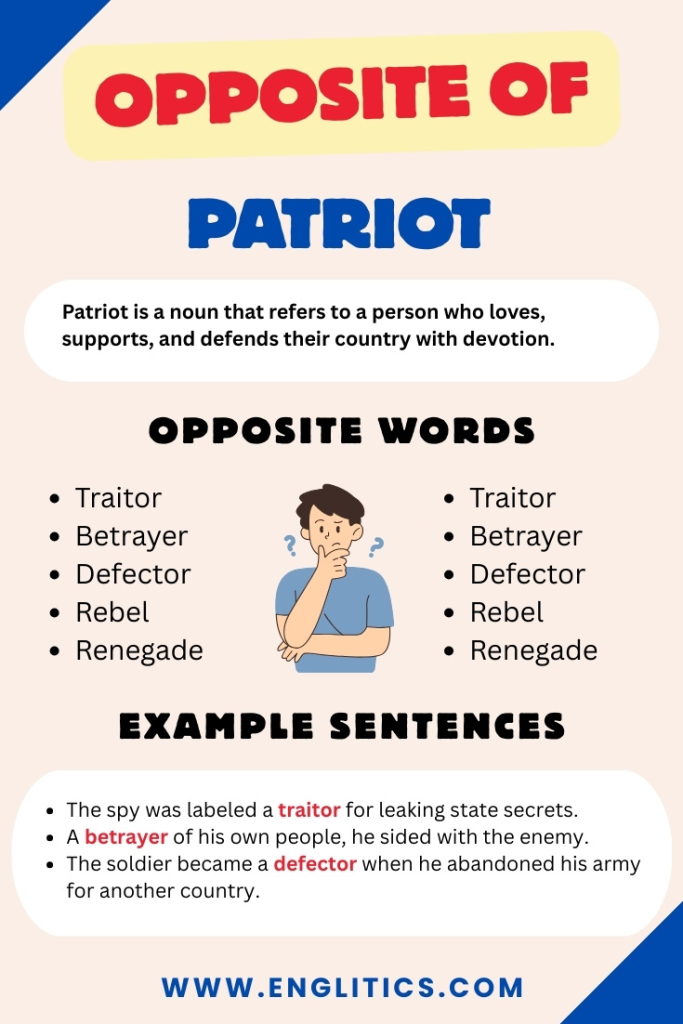
Antonyms are words that have opposite meanings. When considering antonyms for “patriot,” it’s important to recognize that the opposite of loving one’s country can manifest in different ways.
Here, we’ll explore three main categories: direct opposites, those indicating disloyalty, and those indicating opposition to the government.
Direct Opposites
Direct opposites represent a complete rejection of patriotic ideals. These antonyms suggest a lack of love for one’s country or even active dislike.
Indicating Disloyalty
These antonyms suggest a betrayal of one’s country or a lack of allegiance. They often imply actions that undermine national interests.
Indicating Opposition to the Government
These antonyms refer to individuals who oppose the current government or political system, even if they still hold a sense of national identity. It’s important to note that opposing the government doesn’t necessarily mean disliking the country itself.
Examples of Antonyms
To fully grasp the concept of antonyms for “patriot,” let’s explore specific examples categorized by the types discussed above. Each category will be illustrated with multiple examples in table format.
These examples will provide context and demonstrate how these antonyms are used in sentences.
Direct Opposites Examples
Below is a table showcasing antonyms that represent a direct opposite of “patriot,” indicating a lack of love or even dislike for one’s country. These examples illustrate the stark contrast in sentiment.
| Antonym | Definition | Example Sentence |
|---|---|---|
| Traitor | A person who betrays their country. | Benedict Arnold is considered a traitor to the United States. |
| Enemy | A person who is actively hostile to someone or something. | The invading army was seen as the enemy of the nation. |
| Hater | A person who expresses strong dislike or hatred. | Some labeled him a hater because he constantly criticized the country’s policies. |
| Deserter | A soldier who illegally leaves the military. | The deserter fled to another country to avoid military service. |
| Defector | A person who abandons their country for another. | The defector provided valuable information to the opposing side. |
| Fifth columnist | A person who secretly undermines a nation from within. | During the war, there were concerns about fifth columnists spreading propaganda. |
| Disloyalist | A person not loyal to their country. | He was branded as a disloyalist for his controversial statements. |
| Recreant | Cowardly or disloyal person. | The recreant abandoned his post during the battle. |
| Turncoat | A person who switches to an opposing side or party. | The politician was accused of being a turncoat after changing his political affiliation. |
| Saboteur | A person who deliberately damages or destroys something. | The saboteur damaged the factory equipment to disrupt production. |
| Subversive | A person who seeks to undermine an established system or institution. | The government accused the activist group of being subversive. |
| Insurrectionist | A person who participates in an uprising against authority. | The insurrectionist was arrested for their role in the rebellion. |
| Revolutionary | A person who advocates or engages in revolution. | While some view him as a patriot, others see him as a dangerous revolutionary. |
| Rebel | A person who resists authority or control. | The rebel refused to conform to the established norms. |
| Mutineer | A person who revolts against authority, especially in the military. | The mutineer led the crew in a revolt against the captain. |
| Dissident | A person who opposes official policy, especially that of an authoritarian state. | The dissident was persecuted for speaking out against the government. |
| Objector | A person who expresses opposition to something, especially on moral or conscientious grounds. | He was a conscientious objector during the war. |
| Apostate | A person who renounces a religious or political belief or principle. | The apostate abandoned his former faith and embraced a new ideology. |
| Heretic | A person believing in or practicing religious heresy. | The church condemned the heretic for his unorthodox beliefs. |
| Seditious | Conduct or speech inciting people to rebel against the authority of a state. | His seditious speech was seen as a threat to national security. |
| Anarchist | A person who believes in or tries to bring about anarchy. | The anarchist advocated for the abolition of all forms of government. |
| Nihilist | A person who believes that life is meaningless and rejects all religious and moral principles. | The nihilist rejected all established values and beliefs. |
| Malcontent | A person who is dissatisfied and rebellious. | The malcontent constantly complained about the state of the nation. |
Indicating Disloyalty Examples
This table presents antonyms that suggest disloyalty to one’s country, often implying actions that undermine national interests. These terms highlight the betrayal of trust and allegiance.
| Antonym | Definition | Example Sentence |
|---|---|---|
| Betrayer | A person who betrays someone or something. | He felt like a betrayer when he revealed the secret information. |
| Double-crosser | A person who deceives or betrays someone. | The double-crosser profited from his treachery. |
| Informant | A person who gives information to another. | The informant provided crucial evidence to the authorities. |
| Spy | A person employed by a government to gather secret information. | The spy infiltrated the enemy organization to gather intelligence. |
| Agent | A person who acts on behalf of another person or group. | The secret agent carried out his mission with precision. |
| Mercenary | A professional soldier hired to serve in a foreign army. | The mercenary fought for whoever paid the most. |
| Quisling | A traitor who collaborates with an enemy occupying force. | The quisling assisted the enemy in controlling the country. |
| Colluders | People who cooperate in a secret or unlawful way in order to deceive or gain an advantage over others. | The colluders worked together to undermine the company. |
| Conspirator | A person who takes part in a conspiracy. | The conspirator plotted to overthrow the government. |
| Compromiser | A person who settles a dispute by mutual concession. | The compromiser tried to find a middle ground between the two sides. |
| Appeaser | Someone who gives in to the demands of others in order to avoid conflict. | The appeaser made concessions to the aggressor in hopes of preventing war. |
| Collaborator | A person who cooperates traitorously with an enemy. | The collaborator worked with the occupying forces during the war. |
| Defeatist | A person who expects or is excessively ready to accept failure. | The defeatist attitude demoralized the team. |
| Cynic | A person who believes that people are motivated purely by self-interest. | The cynic doubted the sincerity of the politician’s promises. |
| Skeptic | A person inclined to question or doubt accepted opinions. | The skeptic questioned the validity of the scientific claims. |
| Critic | A person who expresses an unfavorable opinion of something. | The critic offered constructive feedback on the performance. |
| Detractor | A person who disparages someone or something. | The detractor constantly criticized the artist’s work. |
| Underminer | A person who weakens or damages something. | The underminer secretly sabotaged the project. |
| Backstabber | A person who betrays someone’s trust. | The backstabber spread rumors behind his colleague’s back. |
| Double-dealer | A person who acts in bad faith or treacherously. | The double-dealer made promises he never intended to keep. |
| Deceiver | A person who causes someone to believe something that is not true. | The deceiver tricked his victims out of their money. |
| Hypocrite | A person who claims to have moral standards but behaves otherwise. | The hypocrite preached honesty but engaged in corrupt practices. |
| Prevaricator | A person who speaks evasively or misleadingly. | The prevaricator avoided answering the question directly. |
Indicating Opposition to the Government Examples
This table provides antonyms that describe individuals who oppose the current government or political system. It’s important to remember that opposition doesn’t always equate to disloyalty to the country itself.
| Antonym | Definition | Example Sentence |
|---|---|---|
| Protester | A person who publicly demonstrates their objection to something. | The protester held a sign advocating for social change. |
| Activist | A person who campaigns for political or social change. | The activist organized a rally to raise awareness about environmental issues. |
| Reformist | A person who advocates gradual reform rather than revolution. | The reformist sought to improve the system through incremental changes. |
| Revolutionary | A person who advocates or engages in revolution. | The revolutionary called for a complete overthrow of the government. |
| Rioter | A person who takes part in a violent public disturbance. | The rioter was arrested for vandalizing property during the protest. |
| Agitator | A person who stirs up public opinion about a controversial issue. | The agitator incited the crowd with his fiery speech. |
| Radical | A person who advocates thorough or complete political or social reform. | The radical proposed sweeping changes to the economic system. |
| Dissenter | A person who disagrees with the established church, political party, or majority opinion. | The dissenter voiced his objections to the new policy. |
| Rebel | A person who resists authority or control. | The rebel refused to obey the new law. |
| Nonconformist | A person who does not conform to prevailing ideas or practices. | The nonconformist challenged the traditional norms of society. |
| Maverick | An unorthodox or independent-minded person. | The maverick politician often voted against his own party. |
| Independent | A person who is free from outside control; not depending on another’s authority. | The independent thinker formed his own opinions based on evidence. |
| Objector | A person who expresses opposition to something, especially on moral or conscientious grounds. | The conscientious objector refused to participate in the war. |
| Challenger | A person who disputes the correctness or validity of something. | The challenger questioned the accuracy of the official data. |
| Opponent | Someone who competes against or opposes another in a contest, game, or argument. | The political opponent criticized the incumbent’s policies. |
| Contrarian | A person who opposes or rejects popular opinion. | The contrarian often took the unpopular side of the argument. |
| Iconoclast | A person who attacks cherished beliefs or institutions. | The iconoclast challenged the established norms of the art world. |
| Renegade | A person who deserts and betrays an organization, country, or set of principles. | The renegade abandoned his former allies and joined the enemy. |
| Heretic | A person holding an opinion at odds with what is generally accepted. | The heretic challenged the accepted dogma of the church. |
| Skeptic | A person inclined to question or doubt accepted opinions. | The skeptic questioned the government’s claims about the economy. |
| Cynic | A person who believes that people are motivated purely by self-interest. | The cynic doubted the sincerity of the politician’s promises. |
| Critic | A person who expresses an unfavorable opinion of something. | The critic offered a scathing review of the new legislation. |
| Detractor | A person who disparages someone or something. | The detractor constantly attacked the president’s policies. |
Usage Rules
Understanding the nuances of usage is essential when employing antonyms for “patriot.” Context plays a vital role in choosing the appropriate word. The specific situation, the intended meaning, and the overall tone of the communication should all be considered.
Here we will consider some general guidelines.
Consider the context: The most suitable antonym will depend heavily on the specific context. Are you describing someone who actively betrays their country, or simply someone who disagrees with the government’s policies?
Be mindful of connotations: Some antonyms, like “traitor,” carry strong negative connotations. Others, like “dissenter,” are more neutral. Choose words that accurately reflect the intended meaning and avoid unnecessary offense.
Avoid generalizations: It’s important to avoid making sweeping generalizations about individuals or groups based on their perceived lack of patriotism. Disagreement with government policies does not automatically equate to disloyalty to the country.
Common Mistakes
One common mistake is using “dissenter” or “critic” when “traitor” is more appropriate, or vice-versa. “Dissenter” simply means someone who disagrees, while “traitor” implies active betrayal.
Another frequent error is equating opposition to the government with disloyalty to the country. These are distinct concepts, and the language used should reflect that distinction.
It’s also important to avoid using overly broad or inflammatory language when discussing sensitive topics like patriotism and disloyalty. Using precise and nuanced language can help to avoid misunderstandings and promote respectful dialogue.
Here is a table showing common mistakes and corrections:
| Incorrect | Correct | Explanation |
|---|---|---|
| He was a patriot because he criticized the government. | He was a dissenter because he criticized the government. | “Patriot” is the opposite of what is meant here. |
| She was a traitor for protesting the war. | She was a protester for protesting the war. | Protesting does not automatically make someone a traitor. |
| All rebels are traitors. | Some rebels may be considered traitors, but not all. | Rebellion does not always equate to betrayal. |
| He is a patriot, so he must support everything the government does. | He is a patriot, but he may still disagree with some of the government’s actions. | Patriotism does not require blind obedience. |
| She’s a disloyalist for not singing the national anthem. | She’s not singing the national anthem. | Not participating in a patriotic ritual doesn’t automatically mean disloyalty. |
| The critic is a traitor to the nation. | The critic is offering a counterpoint to the nation. | Criticism is not treasonous. |
| He is a betrayer because he questions the leader. | He is a protestor because he questions the leader. | Questioning a leader is not necessarily betrayal. |
| They are all traitors for disagreeing. | They are all dissenters for disagreeing. | Disagreement is not inherently treason. |
| Only patriots can love this country. | People who are not patriots can still love this country. | Patriotism is not a requirement for loving one’s country. |
Practice Exercises
Test your understanding of antonyms for “patriot” with these exercises. Choose the best antonym for “patriot” in each sentence.
Exercise 1: Multiple Choice
| Question | Options | Answer |
|---|---|---|
| 1. The _______ leaked classified information to the press. | a) patriot b) traitor c) supporter d) ally | b) traitor |
| 2. The _______ refused to conform to the society’s expectations. | a) patriot b) loyalist c) nonconformist d) nationalist | c) nonconformist |
| 3. The _______ was accused of undermining the government from within. | a) patriot b) subversive c) defender d) advocate | b) subversive |
| 4. The _______ led the revolt against the oppressive regime. | a) patriot b) loyalist c) rebel d) supporter | c) rebel |
| 5. The _______ provided intelligence to the enemy. | a) patriot b) spy c) defender d) ally | b) spy |
| 6. He was labelled as a _______ for speaking out against the war. | a) patriot b) supporter c) dissident d) nationalist | c) dissident |
| 7. The _______ caused chaos during the protest. | a) patriot b) rioter c) supporter d) advocate | b) rioter |
| 8. The _______ betrayed his comrades in arms. | a) patriot b) betrayer c) defender d) ally | b) betrayer |
| 9. The _______ was known for his unorthodox views. | a) patriot b) conformist c) maverick d) loyalist | c) maverick |
| 10. The _______ was critical of the country’s leadership. | a) patriot b) supporter c) critic d) nationalist | c) critic |
Exercise 2: Fill in the Blanks
Fill in the blanks with the most appropriate antonym for “patriot” from the list below. (traitor, dissenter, agitator, defector, conspirator)
- The _______ plotted to overthrow the government in a secret meeting.
- The _______ abandoned his country and sought asylum elsewhere.
- The _______ stirred up unrest among the workers with his inflammatory speeches.
- The _______ was condemned for betraying his nation’s secrets to the enemy.
- The _______ voiced his opposition to the government’s policies at the public forum.
Answers:
- conspirator
- defector
- agitator
- traitor
- dissenter
Exercise 3: True or False
Determine whether each statement is true or false.
- A dissenter is always a traitor. (False)
- A rebel cannot be a patriot. (False)
- A critic is always disloyal. (False)
- A traitor always acts against their country’s interests. (True)
- A revolutionary is always a traitor. (False)
- A nonconformist cannot be a patriot. (False)
- An activist is always agitating. (False)
- Protesting is the same as treason. (False)
- A skeptic cannot be a patriot. (False)
- Betrayers can be patriots. (False)
Advanced Topics
For advanced learners, exploring the philosophical and historical contexts of patriotism and its antonyms can provide a deeper understanding. Consider the works of philosophers who have debated the merits and dangers of patriotism, such as Machiavelli, Rousseau, and Habermas.
Examine historical examples of individuals who were considered both patriots and traitors, depending on the perspective. This exploration will enhance your critical thinking skills and your ability to engage in nuanced discussions about complex political and social issues.
Another advanced topic to consider is the evolving nature of patriotism in a globalized world. As national borders become increasingly porous and interconnected, the concept of national identity is becoming more fluid and complex.
Exploring the challenges and opportunities that globalization presents for patriotism can provide valuable insights into the future of national identity and international relations.
FAQ
- Is it possible to be both a patriot and a critic of one’s country?Yes, it is absolutely possible. Constructive criticism, aimed at improving the country, can be a form of patriotism. A true patriot cares deeply about their country and wants to see it thrive, which may involve pointing out flaws and advocating for change.
- Does disagreeing with the government make someone a traitor?No, disagreeing with the government does not automatically make someone a traitor. A traitor is someone who actively betrays their country, often by aiding its enemies. Disagreement is a fundamental aspect of democracy and does not constitute treason.
- Can someone be considered a patriot if they break the law?This is a complex question with no easy answer. It depends on the specific law, the motivation behind breaking it, and the context in which it occurs. Some acts of civil disobedience, aimed at challenging unjust laws, may be considered patriotic by some, while others may view them as illegal and harmful.
- What is the difference between patriotism and nationalism?Patriotism is generally defined as love and devotion to one’s country, while nationalism is a more aggressive and exclusionary ideology that emphasizes the superiority of one’s nation over others. Nationalism can often lead to intolerance and conflict, while patriotism is generally seen as a more benign sentiment.
- How has the meaning of “patriot” changed over time?The meaning of “patriot” has evolved over time, reflecting changing social and political contexts. In the past, it often referred to someone who fought for their country’s independence or defended it against foreign invaders. Today, the term is often used more broadly to describe anyone who demonstrates love and loyalty to their country, regardless of their actions.
- Is it possible to be a “global patriot”?The concept of a “global patriot” is a relatively new one, but it suggests a sense of loyalty and responsibility to the entire world, rather than just one’s own nation. A global patriot might prioritize global issues like climate change, human rights, and poverty reduction, even if it means challenging their own country’s policies.
- What are some examples of actions that might be considered unpatriotic?Actions that might be considered unpatriotic include betraying national secrets to foreign powers, actively undermining the country’s interests, or advocating for its destruction. However, it’s important to remember that opinions on what constitutes unpatriotic behavior can vary widely.
- How can one express patriotism in a constructive way?One can express patriotism in a constructive way through civic engagement, volunteering, supporting local businesses, advocating for positive change, and promoting national unity. Constructive patriotism focuses on building a better future for the country, rather than simply celebrating its past.
Conclusion
Understanding antonyms for “patriot” is crucial for developing a nuanced understanding of loyalty, dissent, and the complex relationship between individuals and their nations. By exploring words that contrast with “patriot,” we gain a more comprehensive perspective on diverse viewpoints and values.
This knowledge enhances our ability to communicate effectively and analyze various arguments critically.
Remember that context is key when choosing the appropriate antonym for “patriot.” Be mindful of the connotations of different words and avoid generalizations. Use precise and nuanced language to avoid misunderstandings and promote respectful dialogue.
By mastering these concepts, you can expand your vocabulary, improve your communication skills, and engage in more informed discussions about important political and social issues.
Continue to practice using these antonyms in different contexts to solidify your understanding. Pay attention to how they are used in news articles, opinion pieces, and other forms of communication.
By actively engaging with the language, you can further refine your skills and become a more effective communicator.