Rhetoric refers to the art of persuasive speaking or writing—often rich in style, emotion, or argument. But when you’re aiming for plain speech, factual communication, or action over words, antonyms for rhetoric help shift the tone. The opposite of rhetoric reflects straightforwardness, simplicity, or even silence in communication.
The opposite of rhetoric includes words like plain speech, silence, action, fact, and truth. While plain speech and fact emphasize clear, unembellished expression, action stands in contrast to talking without doing. These antonyms are useful in discussions about authenticity, political discourse, or when contrasting words with deeds.
Definition of Rhetoric
Rhetoric is the art of effective or persuasive speaking or writing, especially the use of figures of speech and other compositional techniques. It’s a method of employing language in a strategic way to achieve a specific effect, often to persuade or influence an audience. Rhetoric can be found in political speeches, advertising, legal arguments, and even everyday conversations.
At its core, rhetoric involves understanding your audience, crafting a message that resonates with them, and delivering that message in a compelling manner. While not inherently negative, rhetoric can sometimes be associated with manipulation or deception if used unethically.
The study of rhetoric dates back to ancient Greece, where it was considered a fundamental skill for citizens.
Structural Breakdown of Rhetoric
Rhetoric is built upon several key structural elements that contribute to its effectiveness. These elements include:
- Ethos: Establishing credibility and authority. This involves demonstrating expertise, trustworthiness, and goodwill.
- Pathos: Appealing to the emotions of the audience. This can involve using stories, imagery, and language that evokes feelings such as sympathy, anger, or joy.
- Logos: Using logic and reason to support an argument. This involves providing evidence, facts, and statistics to persuade the audience.
- Kairos: The opportune moment or timing. Knowing when and how to deliver a message for maximum impact.
- Figures of Speech: Utilizing techniques like metaphors, similes, and analogies to make language more vivid and memorable.
- Arrangement: Structuring the argument effectively, typically with an introduction, body, and conclusion.
By mastering these elements, a speaker or writer can craft a powerful and persuasive message. The interplay between these components is what defines the structure and impact of rhetoric.
Types of Rhetoric
Rhetoric can be categorized into different types based on its purpose and context. Here are some common types:
- Deliberative Rhetoric: Used in political assemblies to persuade audiences about future courses of action.
- Forensic Rhetoric: Employed in legal settings to argue about past events and determine guilt or innocence.
- Epideictic Rhetoric: Used for ceremonial occasions to praise or blame individuals or events.
- Argumentative Rhetoric: Focused on constructing logical arguments to persuade an audience of a particular viewpoint.
- Narrative Rhetoric: Using storytelling to engage and persuade an audience.
Each type of rhetoric has its own specific conventions and techniques. Understanding these different types can help you analyze and appreciate the diverse ways in which language can be used to persuade.
Opposite of Rhetoric
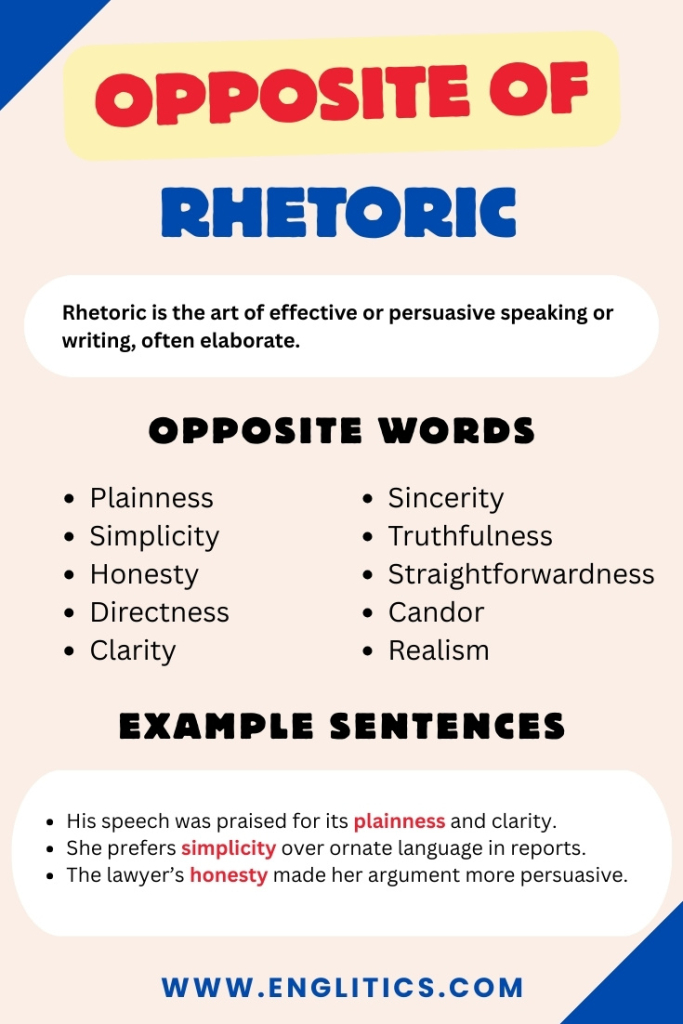
While rhetoric emphasizes persuasion and stylistic flair, its antonyms highlight clarity, honesty, and directness. These words represent a commitment to conveying information in a straightforward and unbiased manner.
Plain Speaking
Plain speaking refers to clear, direct, and easily understandable language. It avoids jargon, complex sentence structures, and ambiguous phrasing. The goal of plain speaking is to communicate information in the most accessible way possible.
Plain speaking is especially important in situations where clarity is paramount, such as giving instructions, explaining technical concepts, or communicating important information to a diverse audience. It prioritizes understanding over eloquence.
Candor
Candor is the quality of being open and honest in expression; frankness. It involves speaking one’s mind truthfully and without reservation, even if the truth is uncomfortable or unpopular. Candor is often valued in relationships and professional settings where trust and transparency are essential.
While candor is generally positive, it’s important to balance it with tact and sensitivity. Being candid doesn’t mean being rude or insensitive to other people’s feelings.
It means being honest while still being respectful.
Honesty
Honesty is the quality of being truthful and sincere. It involves avoiding deception, misrepresentation, and falsehoods. Honesty is a fundamental virtue that is valued in all aspects of life.
Honesty in communication means presenting information accurately and without bias. It also means being transparent about your intentions and motivations.
A commitment to honesty builds trust and credibility.
Directness
Directness is the quality of being straightforward and unambiguous in communication. It involves getting to the point quickly and avoiding unnecessary detours or embellishments. Directness is often appreciated in busy or formal settings where time is limited.
Direct communication is efficient and effective. It minimizes the risk of misunderstanding and ensures that the message is received clearly.
However, like candor, directness should be tempered with tact and consideration for the audience.
Simplicity
Simplicity is the quality of being easy to understand or do. In language, simplicity involves using clear and concise vocabulary, avoiding complex sentence structures, and focusing on the essential information. Simplicity makes communication more accessible and effective.
Simplicity is not the same as being simplistic. It means presenting complex ideas in a clear and understandable way, rather than dumbing them down.
Achieving simplicity requires careful thought and planning.
Truthfulness
Truthfulness is the quality of being in accordance with fact or reality. It involves presenting information accurately and avoiding exaggeration or distortion. Truthfulness is essential for building trust and maintaining credibility.
Truthfulness in communication means doing your due diligence to ensure that the information you are sharing is accurate and reliable. It also means being transparent about the sources of your information.
Forthrightness
Forthrightness is the quality of being direct and outspoken. It involves expressing your opinions and feelings openly and honestly, without being evasive or ambiguous. Forthrightness is often valued in leadership and decision-making roles.
Forthright communication can be assertive and empowering. It allows you to express your needs and boundaries clearly.
However, it’s important to be mindful of the impact of your words on others and to avoid being unnecessarily confrontational.
Bluntness
Bluntness is the quality of expressing something directly and without trying to be polite or considerate. While it shares similarities with candor and directness, bluntness often lacks the tact and sensitivity that are important for effective communication. Bluntness can be perceived as rude or insensitive, even if the intention is to be honest.
While there are situations where bluntness may be necessary, such as in emergency situations or when dealing with someone who is being dishonest, it’s generally best to avoid being overly blunt. Aim for honesty and directness, but always be mindful of the impact of your words on others.
Examples of Antonyms in Use
To illustrate how these antonyms of rhetoric can be used in practice, let’s examine some examples in different contexts.
Table 1: Plain Speaking vs. Rhetoric
This table compares examples of rhetorical language with plain speaking alternatives. Notice how the plain speaking examples are more direct and easier to understand.
| Rhetorical Language | Plain Speaking |
|---|---|
| “It is imperative that we synergize our efforts to optimize paradigm shifts.” | “We need to work together to make these changes successful.” |
| “The aforementioned situation necessitates a proactive and holistic approach.” | “We need to deal with this problem quickly and completely.” |
| “We must leverage our core competencies to achieve synergistic outcomes.” | “We need to use our strengths to get better results.” |
| “The strategic imperative calls for a recalibration of our resource allocation.” | “We need to change how we spend our money.” |
| “We are endeavoring to facilitate a seamless transition.” | “We are trying to make the change easy.” |
| “The confluence of events has precipitated an unprecedented challenge.” | “These events have created a new problem.” |
| “We are committed to fostering a culture of innovation and collaboration.” | “We want to encourage new ideas and teamwork.” |
| “The paradigm shift necessitates a fundamental rethinking of our business model.” | “We need to completely change how we do business.” |
| “We must embrace a data-driven approach to optimize our decision-making processes.” | “We need to use data to make better decisions.” |
| “It is incumbent upon us to ensure the sustainability of our initiatives.” | “We need to make sure our projects can continue long-term.” |
| “The challenges that lie ahead require a concerted effort from all stakeholders.” | “We all need to work together to solve these problems.” |
| “We are dedicated to enhancing the customer experience through innovative solutions.” | “We want to make our customers happier with new products.” |
| “The current economic climate necessitates a period of fiscal austerity.” | “We need to spend less money because of the economy.” |
| “We must strive to create a more inclusive and equitable environment for all.” | “We need to make things fairer for everyone.” |
| “The implementation of this new policy will require a significant shift in mindset.” | “We need to think differently about this new policy.” |
| “Our mission is to empower individuals to achieve their full potential through education.” | “We want to help people learn and succeed.” |
| “We are committed to providing unparalleled service and exceeding customer expectations.” | “We want to give our customers the best service possible.” |
| “The aforementioned concerns warrant a thorough investigation and comprehensive analysis.” | “We need to look into these problems carefully.” |
| “We must foster a culture of continuous improvement and ongoing development.” | “We need to always be trying to get better.” |
| “The ultimate goal is to maximize shareholder value and ensure long-term profitability.” | “We want to make the company more profitable for our investors.” |
| “The synergistic integration of these technologies will revolutionize the industry.” | “Combining these technologies will change the industry.” |
| “We are dedicated to providing innovative solutions that address the evolving needs of our clients.” | “We want to provide new solutions that meet our clients’ changing needs.” |
| “The strategic alignment of our business units will drive growth and create new opportunities.” | “Working together will help us grow and find new opportunities.” |
| “We must embrace a culture of transparency and accountability in all our operations.” | “We need to be open and responsible in everything we do.” |
Table 2: Candor vs. Evasiveness
This table illustrates the difference between candor and evasive language. Candor involves being direct and honest, while evasiveness involves avoiding the truth.
| Evasive Language | Candor |
|---|---|
| “That’s a complex issue with many facets.” | “I don’t know the answer.” |
| “We’re still exploring all the options.” | “We haven’t made a decision yet.” |
| “I’ll have to get back to you on that.” | “I need to find out more information.” |
| “There may be some challenges to overcome.” | “This will be difficult.” |
| “We’re working on improving that.” | “We know there’s a problem, and we’re trying to fix it.” |
| “That’s not my area of expertise.” | “I can’t help you with that.” |
| “We’re taking that under advisement.” | “We’re considering that.” |
| “Let’s circle back on that later.” | “We’ll discuss that again soon.” |
| “It’s a work in progress.” | “It’s not finished yet.” |
| “We’re managing expectations.” | “We’re trying to lower expectations.” |
| “We’re facing some headwinds.” | “We’re having some problems.” |
| “It’s a fluid situation.” | “Things are changing quickly.” |
| “We’re running lean.” | “We’re understaffed.” |
| “We’re rightsizing.” | “We’re laying people off.” |
| “We’re reorginizing.” | “We’re changing the structure of the company.” |
| “We’re pivoting.” | “We’re changing direction.” |
| “We’re doubling down.” | “We’re investing more in this.” |
| “We’re exploring synergies.” | “We’re looking for ways to work together.” |
| “We’re leveraging our assets.” | “We’re using what we have.” |
| “We’re optimizing our processes.” | “We’re trying to make things more efficient.” |
| “We’re streamlining our operations.” | “We’re simplifying things.” |
| “We’re rightsizing our workforce.” | “We’re reducing the number of employees.” |
| “We’re restructuring our organization.” | “We’re changing the way we’re organized.” |
| “We’re re-engineering our processes.” | “We’re redesigning our processes.” |
| “We’re innovating our products.” | “We’re creating new products.” |
Table 3: Directness vs. Indirectness
This table highlights the contrast between direct and indirect communication styles. Directness involves getting straight to the point, while indirectness involves hinting or implying.
| Indirect Language | Direct Language |
|---|---|
| “It might be helpful if we considered…” | “We should consider…” |
| “Perhaps we could explore some other options.” | “Let’s look at other options.” |
| “I was wondering if you could possibly…” | “Can you…” |
| “It would be great if you could…” | “Please…” |
| “Are you sure you can handle that?” | “Can you do that?” |
| “I’m not sure that’s the best approach.” | “I don’t think that’s a good idea.” |
| “Maybe we should think about…” | “We should think about…” |
| “It’s just a thought, but…” | “I think…” |
| “I’m just throwing it out there…” | “Here’s an idea…” |
| “I don’t want to put you on the spot, but…” | “I need to ask you…” |
| “I was hoping you could…” | “I need you to…” |
| “It would be really helpful if…” | “It would help if…” |
| “I’m just spitballing here…” | “Here’s a suggestion…” |
| “Please feel free to correct me if I’m wrong, but…” | “I think…” |
| “I’m not sure if this is the right time, but…” | “I need to say something…” |
| “I was thinking maybe we could…” | “Let’s…” |
| “I’m just brainstorming here…” | “Here’s an idea…” |
| “I don’t know if this is possible, but…” | “Can we…” |
| “I’m just wondering if…” | “I’m asking if…” |
| “I was just curious about…” | “I’m asking about…” |
| “I’m just checking in on…” | “I’m asking about…” |
| “I’m just touching base on…” | “I’m asking about…” |
| “I’m just following up on…” | “I’m asking about…” |
| “I’m just reaching out about…” | “I’m asking about…” |
| “I’m just getting back to you about…” | “I’m answering about…” |
These examples demonstrate how the antonyms of rhetoric can be applied to create clearer, more honest, and more direct communication.
Usage Rules for Antonyms of Rhetoric
While the antonyms of rhetoric emphasize clarity and honesty, it’s important to use them appropriately. Here are some guidelines to keep in mind:
- Context is key: The appropriate level of directness and candor depends on the context of the communication. In some situations, a more formal or polite approach may be necessary.
- Consider your audience: Be mindful of your audience’s cultural background, personality, and level of understanding. Adjust your communication style accordingly.
- Balance honesty with tact: While honesty is important, it’s also important to be sensitive to other people’s feelings. Avoid being unnecessarily blunt or critical.
- Be clear and concise: Use simple language, avoid jargon, and get to the point quickly.
- Be specific: Provide concrete details and examples to support your message.
- Be truthful: Always present information accurately and avoid exaggeration or misrepresentation.
By following these guidelines, you can use the antonyms of rhetoric effectively to communicate with clarity, honesty, and directness.
Common Mistakes
Here are some common mistakes to avoid when using the antonyms of rhetoric:
- Being too blunt: While directness is important, being overly blunt can be perceived as rude or insensitive.
- Over-simplifying: Simplicity is important, but avoid over-simplifying complex issues.
- Lacking context: Failing to consider the context of the communication can lead to misunderstandings.
- Being dishonest: Honesty is essential, but some people may be tempted to distort the truth to achieve their goals.
- Using jargon: Jargon can be confusing and alienating to people who are not familiar with it.
Here are some examples of common mistakes:
| Incorrect | Correct |
|---|---|
| “That’s a load of rubbish!” (Too blunt) | “I disagree with that statement.” |
| “Just do it!” (Over-simplified) | “Follow these steps to complete the task.” |
| “We need to synergize our core competencies.” (Using jargon) | “We need to work together and use our strengths.” |
| “Everything is fine.” (Dishonest, when it’s not) | “There are some challenges, but we’re working on them.” |
By avoiding these common mistakes, you can communicate more effectively and build stronger relationships.
Practice Exercises
Test your understanding of the antonyms of rhetoric with these practice exercises.
Exercise 1: Identifying Antonyms
Choose the word that is most nearly an antonym of the given word.
| Question | Options | Answer |
|---|---|---|
| 1. Rhetoric | a) Eloquence b) Persuasion c) Candor d) Oratory | c) Candor |
| 2. Evasiveness | a) Directness b) Ambiguity c) Deceit d) Subtlety | a) Directness |
| 3. Articulation | a) Clarity b) Mumbling c) Fluency d) Expression | b) Mumbling |
| 4. Verbosity | a) Conciseness b) Loquacity c) Garrulity d) Prolixity | a) Conciseness |
| 5. Circumlocution | a) Directness b) Indirectness c) Redundancy d) Digression | a) Directness |
| 6. Sophistry | a) Truthfulness b) Deception c) Fallacy d) Illusion | a) Truthfulness |
| 7. Obfuscation | a) Clarity b) Confusion c) Ambiguity d) Vagueness | a) Clarity |
| 8. Grandiloquence | a) Simplicity b) Pomposity c) Magniloquence d) Bombast | a) Simplicity |
| 9. Dissembling | a) Honesty b) Pretending c) Concealing d) Deceiving | a) Honesty |
| 10. Prevarication | a) Truthfulness b) Equivocation c) Evasion d) Deception | a) Truthfulness |
Exercise 2: Rewriting Rhetorical Sentences
Rewrite the following sentences using plain speaking.
- The synergistic alignment of our core competencies will facilitate optimal growth. (Answer: Working together and using our strengths will help us grow.)
- We must leverage our intellectual capital to achieve paradigm shifts. (Answer: We need to use our knowledge to make important changes.)
- It is imperative that we proactively address the challenges that lie ahead. (Answer: We need to deal with these problems quickly.)
- The implementation of this strategic initiative will require a significant recalibration of our resources. (Answer: This new project will require us to change how we use our resources.)
- We are committed to fostering a culture of innovation and collaboration to drive sustainable growth. (Answer: We want to encourage new ideas and teamwork to grow the company.)
- The confluence of market forces has precipitated an unprecedented opportunity for expansion. (Answer: These market changes have created a new opportunity for us to grow.)
- We must embrace a data-driven approach to optimize our decision-making processes. (Answer: We need to use data to make better decisions.)
- The aforementioned situation necessitates a comprehensive and holistic assessment of our current processes. (Answer: We need to carefully examine our current processes.)
- We are dedicated to enhancing the customer experience through the implementation of innovative solutions. (Answer: We want to make our customers happier by providing new solutions.)
- The strategic imperatives of the current economic climate necessitate a period of fiscal austerity. (Answer: We need to spend less money because of the economy.)
Advanced Topics
For advanced learners, here are some more complex aspects of rhetoric and its antonyms to consider:
- Ethical considerations: Explore the ethical implications of using rhetoric, and the importance of using it responsibly.
- Cultural differences: Investigate how cultural differences can affect the perception and effectiveness of different communication styles.
- The role of emotion: Analyze the role of emotion in both rhetoric and plain speaking, and how to use it effectively.
- The power of silence: Consider the power of silence as an alternative to both rhetoric and plain speaking.
- The interplay of rhetoric and its antonyms: Examine how rhetoric and its antonyms can be used together to create a balanced and effective communication strategy.
FAQ
Here are some frequently asked questions about rhetoric and its antonyms:
- Is rhetoric always bad? No, rhetoric is not inherently bad. It is a tool that can be used for both good and bad purposes. When used ethically and responsibly, rhetoric can be a powerful tool for persuasion and communication.
- What’s the difference between plain speaking and being simplistic? Plain speaking involves using clear and concise language to communicate complex ideas in an accessible way. Being simplistic, on the other hand, involves over-simplifying complex issues and ignoring important details.
- How can I improve my plain speaking skills? Practice using simple language, avoiding jargon, and getting to the point quickly. Ask for feedback from others and be willing to revise your communication based on their suggestions.
- When is it appropriate to be blunt? Bluntness may be necessary in emergency situations or when dealing with someone who is being dishonest. However, it’s generally best to avoid being overly blunt and to aim for honesty and directness with tact and sensitivity.
- How can I balance honesty with tact? Be mindful of the impact of your words on others and avoid being unnecessarily critical or judgmental. Focus on providing constructive feedback and offering solutions rather than simply pointing out problems.
- What role does emotion play in plain speaking? While plain speaking emphasizes clarity and directness, it’s important to acknowledge and address the emotions of your audience. Empathy and understanding can help you communicate more effectively, even when delivering difficult or unwelcome news.
- How do cultural differences affect communication styles? Different cultures have different norms and expectations regarding communication styles. Be aware of these differences and adjust your communication accordingly. For example, some cultures value directness and assertiveness, while others prefer a more indirect and subtle approach.
- Can rhetoric and plain speaking be used together effectively? Yes, rhetoric and plain speaking can be used together effectively to create a balanced and persuasive communication strategy. Use plain speaking to convey factual information and use rhetoric to engage your audience emotionally and persuade them to take action.
Conclusion
Understanding the antonyms of rhetoric – plain speaking, candor, honesty, directness, simplicity, truthfulness, forthrightness, and knowing when *not* to be blunt – is crucial for effective and ethical communication. While rhetoric has its place, prioritizing clarity and honesty in your interactions builds trust, fosters understanding, and promotes meaningful connections.
By mastering the art of plain speaking, you can communicate your ideas with confidence and integrity.
Remember to consider your audience, the context, and your own intentions when choosing your words. Strive for clarity, be truthful, and always be mindful of the impact of your communication on others.
By embracing these principles, you can become a more effective and ethical communicator in all aspects of your life.