The opposite of salutation is a gesture or expression that shows dismissal, indifference, or even disrespect instead of a polite greeting. While a salutation is a friendly way to begin communication—like saying “hello” or offering a handshake—its opposites suggest disconnection or refusal to engage.
Antonyms for salutation include words like farewell, dismissal, snub, ignorance, and coldness. These terms are used when someone ends a conversation, avoids interaction, or responds without warmth. In this article, you’ll see how to use these opposite words in real-life situations, along with simple examples.
Definition of Salutation
A salutation is an expression of greeting or goodwill. It is a formal acknowledgement of someone’s presence or arrival, typically used at the beginning of a conversation, letter, or speech. Salutations serve to establish a connection, show respect, and set the tone for the interaction that follows. They can range from simple greetings like “Hello” and “Hi” to more formal expressions like “Dear Mr. Smith” or “Good morning.”
Salutations are a crucial element of communication because they establish the initial tone of the interaction. A well-chosen salutation can create a positive and welcoming atmosphere, while an inappropriate or absent salutation can lead to misunderstandings or offense.
Therefore, understanding the nuances of salutations and their antonyms is essential for effective communication.
Structural Breakdown of Salutations
Salutations typically consist of a greeting word or phrase followed by the recipient’s name or title. The structure can vary depending on the context and level of formality.
Here’s a breakdown of common structural elements:
- Greeting Word/Phrase: This can be a simple “Hello,” a time-specific greeting like “Good morning,” or a more formal expression like “Greetings.”
- Recipient’s Name/Title: This identifies the person being addressed. It can be a first name, last name, full name, or a title like “Mr.,” “Ms.,” or “Dr.”
- Punctuation: A comma or colon typically follows the salutation, depending on the level of formality. A comma is generally used for informal greetings, while a colon is used for formal greetings.
For example, in the salutation “Dear Mr. Jones,” “Dear” is the greeting word, “Mr.
Jones” is the recipient’s title and name, and a colon would typically follow. Understanding these structural elements helps in crafting appropriate salutations for various situations.
Opposite of Salutation
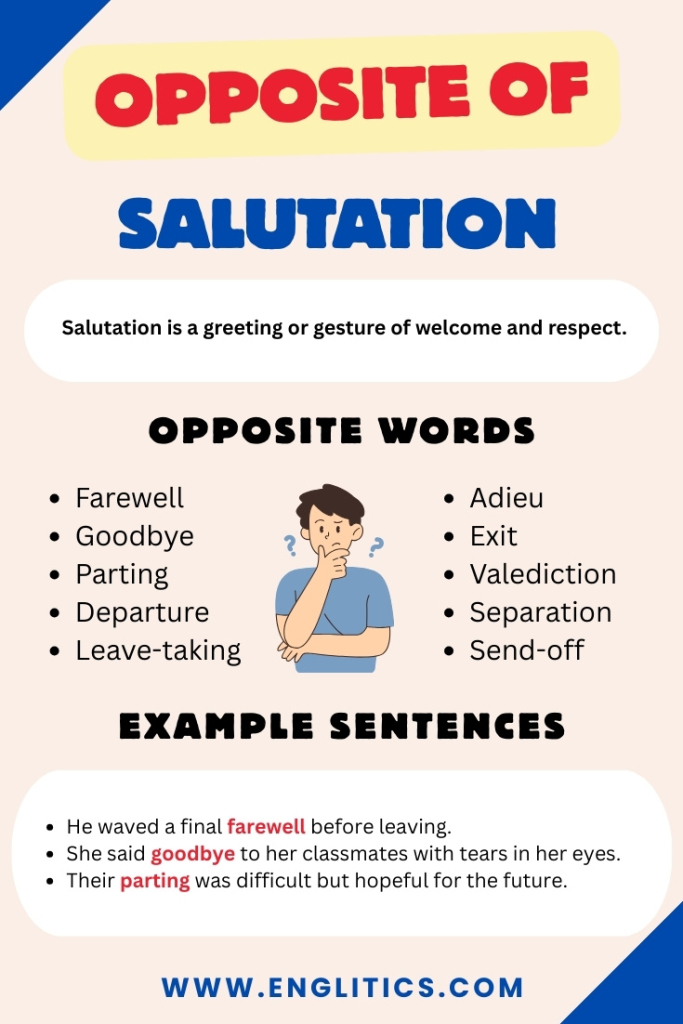
Antonyms for “salutation” can be categorized into several types, reflecting different ways of negating or opposing the act of greeting. These categories include:
- Farewells: Expressions used to say goodbye or indicate departure, marking the end of an interaction.
- Dismissals: Words or actions used to abruptly end a conversation or interaction, often indicating disinterest or disapproval.
- Ignoring: The act of deliberately not acknowledging someone’s presence or greeting, indicating a lack of interest or hostility.
- Formal Endings: Phrases used to conclude a written communication without a warm greeting.
- Rejections: Overt refusals to engage or acknowledge someone, signifying strong disapproval.
Each of these categories represents a different aspect of the opposite of a greeting, ranging from polite departures to outright rejection. Understanding these distinctions is crucial for choosing the appropriate response in various social situations.
Examples of Antonyms for Salutation
This section provides extensive examples of antonyms for “salutation,” organized by category. Each category includes a variety of expressions and scenarios to illustrate the different ways of opposing a greeting.
Farewells
Farewells are polite expressions used to say goodbye. They mark the end of an interaction and often include wishes for the other person’s well-being.
Unlike dismissals, farewells are generally positive and respectful.
The following table provides examples of farewells that act as antonyms to salutations, categorized by formality and context.
| Farewell | Context | Additional Notes |
|---|---|---|
| Goodbye | General | The most common and versatile farewell. |
| Farewell | Formal | A more formal and less frequently used farewell. |
| See you later | Informal | Implies a future meeting. |
| See you soon | Informal | Implies a meeting in the near future. |
| Take care | General | Expresses concern for the other person’s well-being. |
| Have a good day | General | Wishes the other person a pleasant day. |
| Have a good evening | General | Wishes the other person a pleasant evening. |
| Have a good weekend | General | Wishes the other person a pleasant weekend. |
| So long | Informal | An older, less common farewell. |
| Adieu | Formal/Literary | A French farewell, often used in literature. |
| Bye | Informal | A shortened version of “goodbye.” |
| Ciao | Informal | An Italian farewell, often used in casual settings. |
| Until next time | General | Indicates a future meeting. |
| Peace out | Informal/Slang | A very informal and casual farewell. |
| I’m off | Informal | Indicates that the speaker is leaving. |
| I must be going | Formal | A polite way to indicate departure. |
| It was nice seeing you | General | Expresses pleasure at the interaction. |
| It was good to see you | General | Similar to “It was nice seeing you.” |
| Catch you later | Informal | Similar to “See you later.” |
| Later | Informal | A shortened version of “See you later.” |
| All the best | General | Wishes the other person well. |
| Best wishes | Formal | A more formal version of “All the best.” |
| Godspeed | Formal/Archaic | Wishes the other person success and safety. |
| Have a safe trip | Specific | Used when the other person is traveling. |
Dismissals
Dismissals are abrupt or impolite ways of ending a conversation. They often indicate disinterest, impatience, or hostility.
Unlike farewells, dismissals are generally negative and disrespectful.
The following table provides examples of dismissals that act as antonyms to salutations, categorized by level of rudeness and context.
| Dismissal | Context | Additional Notes |
|---|---|---|
| Get lost | Rude | A very impolite way to tell someone to leave. |
| Leave me alone | Impatient/Angry | Indicates a strong desire for solitude. |
| Go away | Impatient | A direct and somewhat rude way to tell someone to leave. |
| I’m done with this | Frustrated | Indicates that the speaker is finished with the conversation. |
| I have no time for this | Impatient | Indicates that the speaker is too busy to continue the conversation. |
| Buzz off | Rude/Informal | A rude way to tell someone to leave. |
| Get out | Angry | An order to leave immediately. |
| That’s enough | Impatient | Indicates that the speaker has heard enough. |
| I’m out | Informal | Indicates that the speaker is leaving the conversation. |
| Whatever | Dismissive | Indicates disinterest or disagreement. |
| Don’t bother me | Impatient/Angry | Similar to “Leave me alone.” |
| I can’t be bothered | Dismissive | Indicates a lack of interest. |
| Not interested | Direct | A clear rejection of the conversation. |
| We’re done here | Authoritative | Indicates that the conversation is over. |
| End of discussion | Authoritative | Similar to “We’re done here.” |
| Goodbye (said abruptly) | Impatient | The tone of the goodbye indicates dismissal. |
| Silence (walking away) | Passive-Aggressive | Ending the conversation without a word. |
| Turning one’s back | Rude | A nonverbal dismissal. |
| Ignoring further communication | Passive | Refusing to respond to any further attempts to communicate. |
| Hanging up the phone | Rude | Abruptly ending a phone conversation. |
| Blocking someone online | Digital | Preventing someone from contacting you online. |
| Removing someone from a group chat | Digital | Removing someone from a digital conversation. |
| Telling someone to shut up | Extremely Rude | A very offensive way to end a conversation. |
| Telling someone to be quiet | Rude | A more polite, but still dismissive, way to end a conversation. |
Ignoring
Ignoring is the act of deliberately not acknowledging someone’s presence or greeting. It is a passive form of rejection that can be very hurtful.
Unlike dismissals, ignoring does not involve any direct interaction.
The following table provides examples of scenarios involving ignoring as an antonym to salutations, categorized by context and intent.
| Ignoring Scenario | Context | Additional Notes |
|---|---|---|
| Walking past someone without a nod | General | Deliberately avoiding eye contact and acknowledgment. |
| Not responding to a greeting | General | Ignoring a verbal greeting. |
| Looking through someone | General | Pretending not to see someone. |
| Not acknowledging a wave | General | Ignoring a physical greeting. |
| Avoiding eye contact | General | Deliberately preventing interaction. |
| Pretending to be busy | Social | Creating a false appearance of being occupied. |
| Turning away when someone approaches | Social | A clear indication of avoidance. |
| Not replying to a message | Digital | Ignoring a digital communication. |
| Leaving someone on read | Digital | Reading a message but not responding. |
| Not answering a phone call | Telephonic | Ignoring a phone call. |
| Rejecting a call | Telephonic | Actively refusing a phone call. |
| Deleting a message without reading | Digital | Ignoring a message completely. |
| Unfollowing someone on social media | Digital | Removing someone from your social media feed. |
| Muting someone on social media | Digital | Hiding someone’s posts without unfollowing them. |
| Not inviting someone to an event | Social | Excluding someone from a social gathering. |
| Deliberately excluding someone from a conversation | Social | Ignoring someone’s contributions to a conversation. |
| Talking about someone as if they aren’t there | Social | Ignoring someone’s presence in a conversation. |
| Giving someone the silent treatment | Relational | Deliberately refusing to speak to someone. |
| Cutting someone off completely | Relational | Ending all contact with someone. |
| Ghosting someone | Relational | Ending a relationship by suddenly ceasing all communication. |
| Not acknowledging someone’s achievements | Professional/Social | Ignoring someone’s success or accomplishments. |
| Not including someone in a group email | Professional | Deliberately excluding someone from a professional communication. |
| Ignoring someone’s request for help | General | Refusing to assist someone in need. |
| Not offering condolences | Social | Failing to express sympathy in a time of grief. |
Formal Endings
Formal endings are phrases used to conclude a written communication without a warm greeting. These serve as antonyms by providing closure without the friendliness of a salutation.
The following table provides examples of formal letter endings that act as antonyms to salutations, categorized by context and intent.
| Formal Ending | Context | Additional Notes |
|---|---|---|
| This letter serves as notice that… | Legal/Formal | Used to deliver formal notifications. |
| This letter is to inform you that… | Formal | Used to convey important information. |
| Please be advised that… | Formal/Legal | Often used in legal or advisory contexts. |
| The purpose of this letter is to… | Formal | Directly states the reason for the communication. |
| Effective immediately… | Formal/Administrative | Used to announce immediate changes or actions. |
| Without prejudice… | Legal | Used in legal documents to protect rights. |
| Under protest… | Legal | Indicates disagreement with a decision or action. |
| As per our agreement… | Formal/Contractual | Refers to a pre-existing agreement. |
| In accordance with… | Formal/Legal | Indicates compliance with regulations or laws. |
| It has come to our attention that… | Formal | Used to introduce a concern or issue. |
| We regret to inform you that… | Formal | Used to deliver bad news. |
| We are writing to notify you of… | Formal | Used to announce important information. |
| This is to confirm… | Formal | Used to verify a previous agreement or action. |
| This serves as a reminder that… | Formal | Used to remind someone of an obligation. |
| This letter is a formal request for… | Formal | Used to make a formal demand. |
| This letter is to demand… | Formal/Legal | Used to make a strong and urgent demand. |
| Failure to comply will result in… | Formal/Legal | Used to warn of consequences. |
| Please take notice that… | Formal/Legal | Used to draw attention to something important. |
| This is a final warning… | Formal | Used to issue a last chance before action is taken. |
| We have no further obligation… | Formal | Used to state that a responsibility has ended. |
| This concludes our business… | Formal | Used to signify the end of a transaction or relationship. |
| This matter is now closed… | Formal | Used to indicate that an issue has been resolved or dismissed. |
| No further action will be taken… | Formal | Used to assure that no additional steps will be pursued. |
| We will proceed without your consent… | Formal | Used to indicate that actions will continue regardless of agreement. |
Rejections
Rejections are overt refusals to engage or acknowledge someone, signifying strong disapproval. These are direct and often harsh ways to oppose a salutation.
The following table provides examples of rejections that act as antonyms to salutations, categorized by level of directness and context.
| Rejection | Context | Additional Notes |
|---|---|---|
| I refuse to acknowledge you | Direct/Hostile | A clear and aggressive statement. |
| I don’t want to talk to you | Direct | A direct refusal to communicate. |
| I have nothing to say to you | Direct | Indicates a lack of interest in communication. |
| Your presence is unwelcome | Hostile | A strong statement of rejection. |
| I reject your greeting | Formal/Hostile | A formal and aggressive rejection. |
| I disavow any connection with you | Formal/Hostile | A strong statement of severing ties. |
| I want nothing to do with you | Direct | A clear statement of disinterest. |
| I refuse to listen to you | Direct | A refusal to hear what someone has to say. |
| I will not engage with you | Formal | A formal refusal to interact. |
| I dismiss your attempts at communication | Formal/Hostile | A formal and aggressive dismissal. |
| I reject your advances | Social/Romantic | Refusing romantic or social overtures. |
| I am not interested in your opinion | Dismissive | Devaluing someone’s viewpoint. |
| Your words are meaningless to me | Hostile | Devaluing someone’s communication. |
| I do not recognize you | Formal/Hostile | A denial of recognition. |
| I refuse to give you the time of day | Informal/Hostile | A refusal to acknowledge someone’s existence. |
| Go bother someone else | Rude | Telling someone to seek attention elsewhere. |
| I’m not here for this | Impatient | Expressing disinterest in the current situation. |
| I’m not dealing with this | Impatient | Refusing to address a situation. |
| This is a waste of my time | Impatient | Expressing that the interaction is unproductive. |
| I’m done here | Impatient | Signifying the end of the interaction. |
| I’d rather be anywhere else | Dismissive | Expressing a strong desire to leave. |
| I regret ever meeting you | Hostile | A strong statement of regret. |
| You disgust me | Extremely Rude | A very offensive statement. |
| I can’t stand you | Hostile | Expressing strong dislike. |
Usage Rules for Antonyms of Salutation
The usage of antonyms for salutations is highly context-dependent. The choice of expression depends on the relationship between the speakers, the situation, and the desired tone.
Here are some general rules:
- Formality: Formal situations require formal farewells or endings, while informal situations allow for more casual expressions.
- Relationship: The closer the relationship, the more informal the language can be. Dismissals and rejections should be used with extreme caution, as they can damage relationships.
- Situation: The specific circumstances of the interaction will influence the appropriate expression. For example, a business meeting requires a different farewell than a casual encounter with a friend.
- Tone: The desired tone should guide the choice of expression. If you want to be polite and respectful, use a farewell. If you want to express disinterest or anger, use a dismissal or rejection (though these should be used sparingly).
Understanding these rules will help you choose the appropriate antonym for a salutation in any given situation. Misusing these expressions can lead to misunderstandings and social awkwardness.
Common Mistakes
One common mistake is using overly formal farewells in informal situations, which can sound stiff or unnatural. Another mistake is using dismissals or rejections inappropriately, which can be offensive.
Here are some examples of common mistakes and how to correct them:
| Incorrect | Correct | Explanation |
|---|---|---|
| “Adieu” to a friend at a casual gathering | “See you later” or “Bye” | “Adieu” is too formal for a casual setting. |
| “Get lost” to a colleague after a disagreement | “I need some time to think about this” or “Let’s discuss this later” | “Get lost” is too rude for a professional setting. |
| Ignoring a client’s greeting | “Good morning” or “Hello” | Ignoring a client is unprofessional and disrespectful. |
| Using “This letter serves as notice…” in a friendly email | “I’m writing to let you know…” | Too formal for a casual email. |
| Saying “I reject your greeting” to a family member | “I’m not in the mood to talk right now” | Too harsh for a family setting. |
Being aware of these common mistakes can help you avoid awkward or offensive situations. Always consider the context and your relationship with the other person before choosing an antonym for a salutation.
Practice Exercises
Test your understanding of antonyms for salutation with these practice exercises. Choose the most appropriate antonym for the given situation.
Exercise 1: Choose the best farewell for each scenario.
| Scenario | Possible Answers | Correct Answer |
|---|---|---|
| Leaving a formal business meeting | a) Bye b) See you later c) Have a good day d) Peace out | c) Have a good day |
| Saying goodbye to a close friend | a) Farewell b) Adieu c) Bye d) I must be going | c) Bye |
| Ending a phone call with a family member | a) Goodbye b) So long c) Catch you later d) I’m done with this | a) Goodbye |
| Leaving a casual gathering with colleagues | a) Have a good evening b) Godspeed c) I’m off d) Best wishes | a) Have a good evening |
| Ending a video call with an international business partner | a) Bye b) Ciao c) Until next time d) Get lost | c) Until next time |
| Leaving a friend who is about to embark on a long journey | a) Have a safe trip b) See you soon c) I’m out d) Whatever | a) Have a safe trip |
| Ending a conversation with a shop assistant | a) Take care b) Buzz off c) I have no time for this d) Get out | a) Take care |
| Leaving a meeting where you are running very late | a) I must be going b) All the best c) Peace out d) See you soon | a) I must be going |
| Saying goodbye to someone you expect to see again very soon | a) Goodbye b) See you soon c) Farewell d) Have a good weekend | b) See you soon |
| Ending a formal letter to a client | a) Best wishes b) Catch you later c) I’m off d) So long | a) Best wishes |
Exercise 2: Identify the most appropriate response in each scenario.
| Scenario | Possible Answers | Correct Answer |
|---|---|---|
| Someone you dislike greets you warmly | a) Ignore them b) “I reject your greeting” c) “Hello” (said coldly) d) “Go away” | c) “Hello” (said coldly) |
| You are in a hurry and someone starts a lengthy conversation | a) “I have no time for this” b) “So long” c) “Have a good day” d) Ignore them | a) “I have no time for this” |
| You are angry and someone tries to apologize | a) “I refuse to listen to you” b) “See you later” c) “All the best” d) “Ciao” | a) “I refuse to listen to you” |
| You want to end a conversation politely but firmly | a) “I’m done with this” b) “We’re done here” c) “Goodbye” (said abruptly) d) “Adieu” | c) “Goodbye” (said abruptly) |
| Someone online keeps sending you unwanted messages | a) “I want nothing to do with you” b) Block them c) “Peace out” d) “Have a good day” | b) Block them |
| Your boss is giving you an impossible task | a) “I reject your advances” b) “This is a waste of my time” c) “Under protest…” d) Ignore them | c) “Under protest…” |
| You are in court and disagree with the judge’s decision | a) “Get lost” b) “Without prejudice…” c) “Have a good day” d) Ignore them | b) “Without prejudice…” |
| You want to end all contact with someone who has hurt you | a) “I disavow any connection with you” b) “See you later” c) “Catch you later” d) “I’m off” | a) “I disavow any connection with you” |
| You are being harassed on the street | a) “I refuse to acknowledge you” b) “See you soon” c) “Leave me alone” d) Ignore them and walk away | d) Ignore them and walk away |
| You are running late for an important appointment | a) “I’m not dealing with this” b) “I must be going” c) “I’m done here” d) “I’d rather be anywhere else” | b) “I must be going” |
Advanced Topics
For advanced learners, understanding the nuances of implied antonyms and the cultural variations in salutations and their opposites can further enhance communication skills. Implied antonyms refer to situations where the absence of a salutation or a subtle change in tone can convey a negative message.
For instance, intentionally using a less formal greeting than expected can signal disapproval or distance.
Cultural variations are also significant. In some cultures, direct rejections are considered extremely rude, while in others, they are more acceptable.
Similarly, the level of formality expected in greetings and farewells can vary widely. For example, in some Asian cultures, a slight bow is a common greeting, and the absence of a bow can be seen as disrespectful.
Additionally, exploring the historical evolution of salutations and their antonyms can provide a deeper understanding of their social and cultural significance. For example, the use of “thou” versus “you” in Early Modern English indicated different levels of familiarity and respect.
Understanding these historical nuances can enrich your appreciation of the complexities of language and communication.
FAQ
Here are some frequently asked questions about antonyms for salutation:
- What is the difference between a farewell and a dismissal?A farewell is a polite expression used to say goodbye, while a dismissal is an abrupt or impolite way of ending a conversation. Farewells are generally positive and respectful, while dismissals are negative and disrespectful.
- When is it appropriate to ignore someone’s greeting?Ignoring someone’s greeting is generally considered rude, but it may be appropriate in situations where you feel threatened or harassed, or when you want to avoid engaging with someone who is being aggressive or inappropriate.
- How do I politely end a conversation when I’m busy?You can politely end a conversation by saying something like, “I’m sorry, but I’m a bit busy right now. Can we talk later?” or “It was nice talking to you, but I need to get back to work.”
- What is the most formal way to say goodbye?The most formal ways to say goodbye include “Farewell,” “Adieu,” and “I must be going.” These expressions are typically used in formal settings or in writing.
- What is the most informal way to saygoodbye?
The most informal ways to say goodbye include “Bye,” “See you later,” “Catch you later,” and “Peace out.” These expressions are commonly used in casual conversations with friends and family.
- How can I tell if someone is trying to dismiss me?Signs of dismissal include abrupt changes in tone, avoiding eye contact, turning away, and using short, dismissive phrases like “Whatever” or “I’m done with this.”
- Is it ever appropriate to use a rejection as an antonym for salutation?Rejections should be used sparingly and only in situations where you want to clearly and forcefully express disapproval or disinterest. They can be very hurtful and should be avoided unless absolutely necessary.
- How do cultural differences affect the use of antonyms for salutation?Cultural norms dictate the appropriate level of formality and directness in greetings and farewells. What is considered polite in one culture may be rude in another. It’s important to be aware of these differences and adapt your communication accordingly.
- What is the difference between ghosting and simply not responding to a message?Ghosting involves suddenly ceasing all communication with someone, often in a romantic or relational context, without explanation. Simply not responding to a message may be due to various reasons, such as being busy or forgetting to reply, and does not necessarily imply a deliberate intent to end the relationship.
- How do I handle a situation where someone is giving me the silent treatment?If someone is giving you the silent treatment, try to understand the reason for their behavior. If possible, calmly and respectfully ask them what’s wrong and express your willingness to listen. If they are unwilling to communicate, give them space and avoid pressuring them until they are ready to talk.
Conclusion
Understanding the antonyms for “salutation” is essential for effective communication and navigating social interactions. From polite farewells to abrupt dismissals and deliberate ignoring, the ways we choose to end or avoid interactions can significantly impact our relationships and professional success.
By mastering these concepts, you can enhance your linguistic abilities and ensure that your communication is appropriate, respectful, and well-received in any situation. Always consider the context, your relationship with the other person, and the desired tone when choosing an antonym for a salutation.