Antonyms for “sin” include words like virtue, goodness, righteousness, and morality. These represent the opposite of sin by conveying ethical behavior, moral excellence, or actions that align with accepted standards of right and wrong.
Knowing the opposite of sin is useful in religious, philosophical, or everyday contexts where moral choices are discussed. Whether you’re writing, debating, or reflecting on behavior, these antonyms help express ideas about integrity and upright conduct more effectively.
Defining Sin and Its Antonyms
Sin, in its broadest sense, refers to an act that violates a moral or religious principle. It implies a transgression against a divine or ethical code, often carrying connotations of guilt, shame, and spiritual impurity. The concept of sin varies across cultures and religions, but the underlying idea remains consistent: it represents a deviation from what is considered right or just.
Antonyms for ‘sin’ represent the opposite end of the moral spectrum. They encompass qualities, actions, and states that are considered morally good, righteous, or virtuous.
These antonyms not only negate the concept of sin but also affirm positive moral values. They include words like virtue, righteousness, goodness, morality, ethics, and innocence.
Each of these terms carries its own specific nuance and is used in different contexts.
Understanding the definition of ‘sin’, and the nuances of its various antonyms, is essential for effective communication about complex moral and ethical issues. It allows for a more precise and meaningful discourse on these important topics.
Structural Breakdown of Antonyms
The antonyms of ‘sin’ can be categorized based on their grammatical structure and function within a sentence. They primarily function as nouns, adjectives, and adverbs, each contributing differently to the overall meaning.
- Nouns: Words like virtue, righteousness, goodness, morality, ethics, and innocence are nouns that represent abstract concepts or qualities. They can function as subjects, objects, or complements within a sentence. For example: “Virtue is its own reward.”
- Adjectives: Adjectives derived from these nouns, such as virtuous, righteous, good, moral, ethical, and innocent, describe the qualities of a person, action, or thing. For example: “She is a virtuous woman.”
- Adverbs: Adverbs formed from these adjectives, such as virtuously, righteously, morally, and ethically, modify verbs, adjectives, or other adverbs, indicating the manner in which an action is performed. For example: “He acted righteously in the face of adversity.”
The structural flexibility of these antonyms allows them to be used in a variety of grammatical contexts, adding depth and precision to moral and ethical discussions.
Opposite of Sin
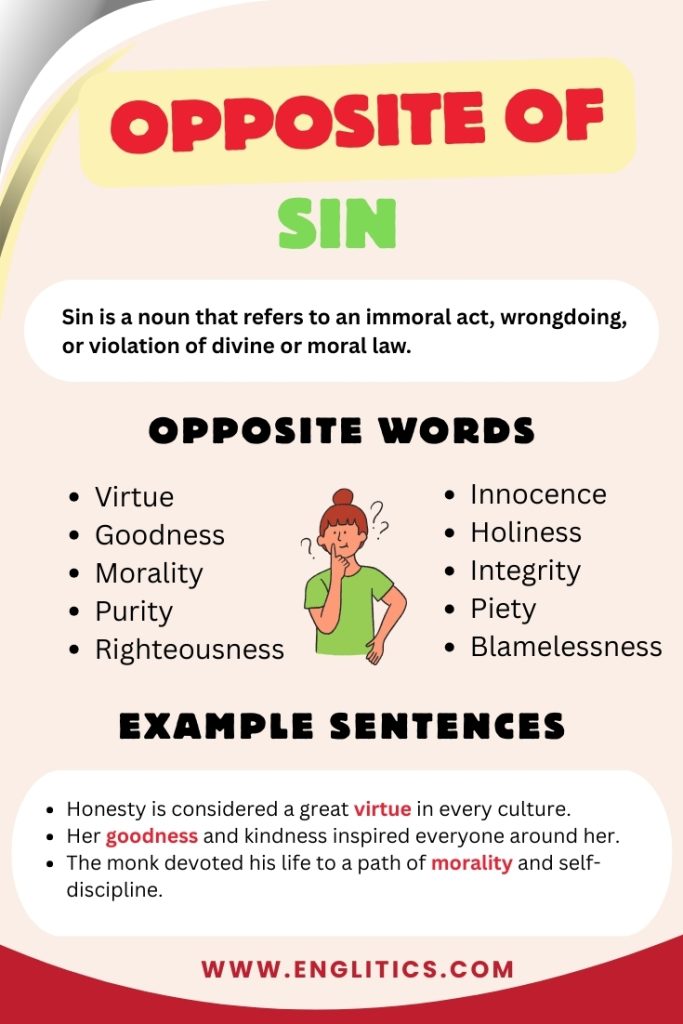
The antonyms for ‘sin’ can be further categorized based on the specific aspects of morality and ethics they represent. Understanding these categories can help you choose the most appropriate antonym for a given context.
Virtue
Virtue refers to moral excellence and righteousness. It encompasses a wide range of positive qualities, such as honesty, courage, kindness, and compassion. Virtue is often seen as the foundation of a good character.
Righteousness
Righteousness denotes moral uprightness and adherence to a moral or religious code. It emphasizes justice, fairness, and integrity in one’s actions and thoughts. Righteousness often carries a stronger religious connotation than virtue.
Goodness
Goodness is a general term for moral excellence and benevolence. It encompasses kindness, compassion, and a desire to do what is right. Goodness is often associated with a natural inclination towards positive actions.
Morality
Morality refers to a system of principles concerning the distinction between right and wrong or good and bad behavior. It provides a framework for ethical decision-making and guides individuals in their interactions with others.
Ethics
Ethics is a branch of philosophy that deals with moral principles. It involves the systematic study of moral values and the rules that govern human conduct. Ethics is often applied to specific professions or fields of activity.
Innocence
Innocence signifies freedom from guilt or wrongdoing. It implies a lack of involvement in sinful or immoral acts. Innocence can also refer to a childlike purity and lack of knowledge of evil.
Examples of Antonyms in Use
To illustrate the usage of these antonyms, here are several examples categorized by each term. These examples will help you understand how to use these words in different contexts and grammatical structures.
Virtue Examples
The following table provides examples of how the word “virtue” and its related forms are used in sentences.
| Sentence | Part of Speech |
|---|---|
| Her virtue was admired by all who knew her. | Noun |
| He lived a life of virtue and integrity. | Noun |
| She is a virtuous woman, known for her kindness and compassion. | Adjective |
| He acted virtuously, always putting others before himself. | Adverb |
| The virtue of patience is essential in this situation. | Noun |
| The ancient philosophers emphasized the importance of virtue. | Noun |
| Her virtuous behavior inspired others to follow her example. | Adjective |
| He approached the task virtuously, with honesty and diligence. | Adverb |
| Virtue is often seen as its own reward. | Noun |
| The virtue of forgiveness is a powerful force. | Noun |
| She was praised for her virtuous dedication to her family. | Adjective |
| He lived virtuously, avoiding any form of deceit or dishonesty. | Adverb |
| The virtue of courage is necessary to overcome challenges. | Noun |
| She embodied the virtue of temperance in all aspects of her life. | Noun |
| The king was known for his virtuous rule, marked by justice and fairness. | Adjective |
| She approached her work virtuously, always striving for excellence. | Adverb |
| Virtue requires constant effort and self-reflection. | Noun |
| The virtue of humility is often underestimated. | Noun |
| He was recognized for his virtuous commitment to public service. | Adjective |
| She conducted herself virtuously, even in difficult circumstances. | Adverb |
| The virtue of compassion is essential for a harmonious society. | Noun |
| His virtuous actions spoke louder than words. | Adjective |
| She lived virtuously, always adhering to her moral principles. | Adverb |
| Virtue is a cornerstone of ethical behavior. | Noun |
| The virtue of integrity is highly valued in leadership. | Noun |
| Her virtuous character shone through in every interaction. | Adjective |
| He approached his responsibilities virtuously, with dedication and care. | Adverb |
Righteousness Examples
The following table provides examples of how the word “righteousness” and its related forms are used in sentences.
| Sentence | Part of Speech |
|---|---|
| He lived his life in righteousness, always striving to do what was right. | Noun |
| The preacher spoke of the importance of righteousness and faith. | Noun |
| She is a righteous woman, devoted to her family and community. | Adjective |
| He acted righteously, defending the weak and oppressed. | Adverb |
| Righteousness is a key tenet of his religious beliefs. | Noun |
| The leader emphasized the need for righteousness in governance. | Noun |
| Her righteous indignation was palpable when she learned of the injustice. | Adjective |
| He approached the situation righteously, seeking a fair and just resolution. | Adverb |
| The pursuit of righteousness is a lifelong journey. | Noun |
| Righteousness demands honesty and integrity in all dealings. | Noun |
| She was admired for her righteous commitment to social justice. | Adjective |
| He spoke righteously against corruption and abuse of power. | Adverb |
| Righteousness requires courage to stand up for what is right. | Noun |
| The concept of righteousness is central to many religions. | Noun |
| He was known for his righteous anger against injustice. | Adjective |
| She acted righteously in defending the vulnerable. | Adverb |
| Righteousness is often associated with moral purity. | Noun |
| The search for righteousness is a common theme in literature. | Noun |
| He had a righteous disdain for hypocrisy. | Adjective |
| She judged the situation righteously, considering all the facts. | Adverb |
| The call for righteousness echoed throughout the land. | Noun |
| His righteous stance on environmental issues earned him respect. | Adjective |
| She lived righteously, according to the principles of her faith. | Adverb |
| Righteousness is a fundamental aspect of ethical behavior. | Noun |
| The pursuit of righteousness can be challenging but rewarding. | Noun |
| He was a righteous advocate for the poor and marginalized. | Adjective |
| She approached her work righteously, always striving for fairness. | Adverb |
Goodness Examples
The following table provides examples of how the word “goodness” and its related forms are used in sentences.
| Sentence | Part of Speech |
|---|---|
| Her goodness shone through in her acts of kindness. | Noun |
| He was known for his inherent goodness and generosity. | Noun |
| She is a good person, always willing to help others. | Adjective |
| He treated everyone goodly, with respect and compassion. | Adverb (archaic) |
| The goodness of her heart was evident to all. | Noun |
| The world needs more goodness and understanding. | Noun |
| He is a good leader, inspiring his team to achieve great things. | Adjective |
| She acted goodly, distributing food to the needy. | Adverb (archaic) |
| The goodness in his actions was undeniable. | Noun |
| Goodness is a quality to be admired and emulated. | Noun |
| She is a good friend, always there to offer support. | Adjective |
| He lived goodly, according to his moral principles. | Adverb (archaic) |
| The goodness of humanity can be seen in acts of charity. | Noun |
| His good intentions were clear, even if his actions were misguided. | Adjective |
| She approached the task with good spirits. | Adjective |
| He was known for his good humor and positive attitude. | Adjective |
| The goodness of her soul radiated from within. | Noun |
| He is a good influence on those around him. | Adjective |
| Her good deeds were remembered long after she was gone. | Adjective |
| The goodness of the community shone during the crisis. | Noun |
| She is a good example for young people. | Adjective |
| His good nature made him a beloved member of the community. | Adjective |
| The goodness of the earth provides for all. | Noun |
| He is a good listener, always attentive and empathetic. | Adjective |
| Her good advice was invaluable during the difficult time. | Adjective |
| The goodness of the product was reflected in its high quality. | Noun |
Morality Examples
The following table provides examples of how the word “morality” and its related forms are used in sentences.
| Sentence | Part of Speech |
|---|---|
| The study of morality is essential for understanding human behavior. | Noun |
| He adhered to a strict code of morality throughout his life. | Noun |
| She made a moral decision, choosing what was right over what was easy. | Adjective |
| He acted morally, always considering the consequences of his actions. | Adverb |
| Morality is a complex and multifaceted concept. | Noun |
| The principles of morality guide our interactions with others. | Noun |
| She has strong moral convictions that guide her actions. | Adjective |
| He behaved morally even under pressure. | Adverb |
| The debate on morality continues to this day. | Noun |
| Morality is often shaped by cultural and religious beliefs. | Noun |
| He faced a moral dilemma, unsure of the right course of action. | Adjective |
| She approached the situation morally, seeking a just outcome. | Adverb |
| Morality plays a crucial role in shaping society. | Noun |
| The concept of morality varies across different cultures. | Noun |
| He made a moral judgment based on his values. | Adjective |
| She acted morally, following her conscience. | Adverb |
| Morality is a foundation of ethical behavior. | Noun |
| The question of morality is central to many philosophical debates. | Noun |
| His moral compass guided him through difficult decisions. | Adjective |
| She lived morally, guided by her principles and beliefs. | Adverb |
| Morality influences our understanding of right and wrong. | Noun |
| His moral stance on the issue was clear and unwavering. | Adjective |
| She treated everyone morally, with fairness and respect. | Adverb |
| Morality is essential for a just and equitable society. | Noun |
| The study of morality helps us understand the complexities of human nature. | Noun |
| He made a moral choice, even though it was unpopular. | Adjective |
| She behaved morally, adhering to her values and beliefs. | Adverb |
Ethics Examples
The following table provides examples of how the word “ethics” and its related forms are used in sentences.
| Sentence | Part of Speech |
|---|---|
| The field of ethics explores the principles of right and wrong. | Noun |
| He studied ethics in college, focusing on moral philosophy. | Noun |
| She made an ethical decision, choosing the option that caused the least harm. | Adjective |
| He acted ethically, following the guidelines of his profession. | Adverb |
| Ethics are crucial in the field of medicine. | Noun |
| The company adheres to a strict code of ethics. | Noun |
| He faced an ethical dilemma when he discovered the fraud. | Adjective |
| She behaved ethically, even when faced with temptation. | Adverb |
| The study of ethics provides a framework for moral decision-making. | Noun |
| Ethics guide our actions in both personal and professional settings. | Noun |
| He made an ethical choice, prioritizing the well-being of others. | Adjective |
| She approached the negotiation ethically, ensuring fairness for all parties. | Adverb |
| Ethics are essential for maintaining trust in society. | Noun |
| The principles of ethics can vary across cultures and professions. | Noun |
| He made an ethical judgment based on his understanding of the situation. | Adjective |
| She acted ethically, ensuring that her actions aligned with her values. | Adverb |
| Ethics provide a framework for evaluating the consequences of our actions. | Noun |
| The application of ethics can be complex and challenging. | Noun |
| He sought ethical guidance from a trusted mentor. | Adjective |
| She conducted her research ethically, following all established guidelines. | Adverb |
| Ethics are essential for responsible leadership. | Noun |
| His ethical standards were unwavering, even in difficult times. | Adjective |
| She treated her clients ethically, with honesty and integrity. | Adverb |
| Ethics are a cornerstone of professional conduct. | Noun |
| The code of ethics provides a framework for resolving conflicts of interest. | Noun |
| His ethical behavior earned him the respect of his colleagues. | Adjective |
| She approached the problem ethically, seeking a solution that was fair to everyone involved. | Adverb |
Innocence Examples
The following table provides examples of how the word “innocence” and its related forms are used in sentences.
| Sentence | Part of Speech |
|---|---|
| The child’s innocence was evident in her wide-eyed wonder. | Noun |
| He maintained his innocence despite the accusations against him. | Noun |
| She is an innocent bystander, caught in the crossfire. | Adjective |
| He looked at the world innocently, unaware of the dangers. | Adverb |
| Innocence is a precious quality that should be protected. | Noun |
| The defendant pleaded innocence in court. | Noun |
| She has an innocent face that belies her sharp intelligence. | Adjective |
| He spoke innocently, not realizing the implications of his words. | Adverb |
| The loss of innocence is a common theme in literature. | Noun |
| Innocence can also refer to a lack of knowledge or experience. | Noun |
| He was declared innocent after a thorough investigation. | Adjective |
| She approached the situation innocently, without any ulterior motives. | Adverb |
| Innocence is often associated with purity and goodness. | Noun |
| The preservation of innocence is a concern for parents. | Noun |
| He had an innocent explanation for his actions. | Adjective |
| She smiled innocently, unaware of the controversy surrounding her. | Adverb |
| Innocence can be both a strength and a vulnerability. | Noun |
| The pursuit of innocence can be a lifelong quest. | Noun |
| He was found innocent of all charges. | Adjective |
| She looked at him innocently, with genuine curiosity. | Adverb |
| Innocence is a quality that is often lost with age. | Noun |
| His innocent eyes reflected a sense of wonder. | Adjective |
| She spoke innocently about the events of the day. | Adverb |
| Innocence is a state of being free from guilt or wrongdoing. | Noun |
| The trial aimed to prove his innocence. | Noun |
| He was an innocent victim of circumstance. | Adjective |
| She approached the matter innocently, with no hidden agenda. | Adverb |
Usage Rules for Antonyms of Sin
Using antonyms of ‘sin’ correctly requires understanding the specific connotations and contexts in which each word is appropriate. Here are some general rules to guide you:
- Choose the most specific word: Select the antonym that most accurately reflects the intended meaning. For example, if you want to emphasize adherence to a specific moral code, “righteousness” might be more appropriate than “goodness.”
- Consider the context: The context of the sentence or situation can influence the choice of antonym. For example, in a legal context, “innocence” is the most appropriate term to indicate freedom from guilt.
- Pay attention to connotations: Be aware of the emotional and cultural associations of each word. “Righteousness” can sometimes carry a judgmental connotation, while “virtue” is generally more positive and admired.
- Use the correct grammatical form: Ensure that you are using the correct form of the word (noun, adjective, or adverb) based on its function in the sentence.
- Avoid overuse: While these words are important, avoid using them excessively, as this can make your writing sound stilted or overly moralistic.
Understanding these rules will help you use antonyms of ‘sin’ effectively and appropriately in your writing and speech. Consider the subtle differences between each word to convey the most accurate and impactful meaning.
Common Mistakes When Using Antonyms
Even with a good understanding of the definitions and usage rules, it’s easy to make mistakes when using antonyms of ‘sin’. Here are some common errors to avoid:
- Confusing “morality” and “ethics”: While related, these terms are not interchangeable. Morality refers to personal principles, while ethics refers to a system of rules, often in a professional context.
- Incorrect: “His ethics prevented him from cheating on the test.”
- Correct: “His morality prevented him from cheating on the test.”
- Using “goodly” in modern English: “Goodly” is an archaic adverb that is rarely used in contemporary English. Use “well” or another appropriate adverb instead.
- Incorrect: “He treated everyone goodly.”
- Correct: “He treated everyone well.”
- Misusing “innocent” as a general term for goodness: “Innocent” specifically refers to freedom from guilt or wrongdoing, not general moral excellence.
- Incorrect: “She is an innocent person, always helping others.”
- Correct: “She is a good person, always helping others.”
- Overusing “righteous” in non-religious contexts: “Righteous” often has a strong religious connotation and may sound out of place in secular contexts.
- Incorrect: “He had a righteous anger towards the slow service at the restaurant.”
- Correct: “He was justifiably angry about the slow service at the restaurant.”
By being aware of these common mistakes, you can avoid errors and use antonyms of ‘sin’ more accurately and effectively.
Practice Exercises
Test your understanding of the antonyms of ‘sin’ with these practice exercises. Choose the best antonym to complete each sentence.
| Question | Answer |
|---|---|
| 1. Her ______ was admired by all who knew her. (virtue, sin, evil) | virtue |
| 2. He lived his life in ______, always striving to do what was right. (righteousness, wickedness, depravity) | righteousness |
| 3. The ______ of her heart was evident in her acts of kindness. (goodness, badness, malice) | goodness |
| 4. The study of ______ is essential for understanding human behavior. (morality, immorality, vice) | morality |
| 5. The field of ______ explores the principles of right and wrong. (ethics, unethical behavior, corruption) | ethics |
| 6. The child’s ______ was evident in her wide-eyed wonder. (innocence, guilt, culpability) | innocence |
| 7. He made an ______ decision, choosing the option that caused the least harm. (ethical, immoral, unscrupulous) | ethical |
| 8. She is a ______ person, always willing to help others. (good, evil, wicked) | good |
| 9. Her ______ shone through in her acts of compassion. (virtue, iniquity, transgression) | virtue |
| 10. He acted ______, defending the weak and oppressed. (righteously, wickedly, evilly) | righteously |
Exercise 2: Fill in the blanks with the appropriate antonym of “sin”
| Question | Answer |
|---|---|
| 1. He always tried to embody ______, treating everyone with respect and kindness. | virtue |
| 2. The judge was known for his ______ and fairness in the courtroom. | righteousness |
| 3. Her ______ was apparent in her willingness to forgive others. | goodness |
| 4. The company prided itself on its strong sense of ______ and ethical behavior. | morality |
| 5. The doctor took an oath to uphold the highest standards of medical ______. | ethics |
| 6. The young girl’s ______ was refreshing in a world filled with cynicism. | innocence |
| 7. He chose the ______ path, even though it was more difficult. | ethical |
| 8. She was a ______ influence on the children in her community. | good |
| 9. His ______ was a testament to his strong moral character. | virtue |
| 10. She acted ______ in all her dealings, never compromising her principles. | righteously |
Advanced Topics: Nuances and Context
Delving deeper into the antonyms of ‘sin’ reveals subtle nuances and contextual variations that advanced English learners should be aware of. These nuances can significantly impact the meaning and effectiveness of your communication.
- Cultural and Religious Context: The meaning of words like “righteousness” and “virtue” can vary depending on cultural and religious beliefs. In some contexts, “righteousness” might imply strict adherence to religious law, while in others, it might simply refer to moral integrity.
- Philosophical Perspectives: Different philosophical schools of thought may emphasize different aspects of morality and ethics. For example, utilitarianism focuses on maximizing overall happiness, while deontology emphasizes adherence to moral duties.
- Historical Usage: The meanings of certain words, such as “goodly,” have evolved over time. Understanding the historical context can help you appreciate the richness and complexity of the English language.
- Subjectivity of Morality: The concept of “sin” itself is subjective and can vary across cultures and individuals. Therefore, the choice of antonym should be carefully considered in light of the specific moral framework being discussed.
Exploring these advanced topics will enable you to use antonyms of ‘sin’ with greater precision and sensitivity, enhancing your ability to communicate about complex moral and ethical issues.
Frequently Asked Questions
Here are some frequently asked questions about the antonyms of ‘sin’:
Q: Are “morality” and “ethics” the same thing?
A: While related, “morality” and “ethics” are not interchangeable. Morality refers to personal principles concerning right and wrong, while ethics refers to a system of rules governing conduct, often in a professional context.
Q: Is “goodly” a commonly used word?
A: No, “goodly” is an archaic adverb that is rarely used in contemporary English. It is better to use “well” or another appropriate adverb.
Q: Can “innocence” be used to describe someone who is simply kind and helpful?
A: While an innocent person may also be kind and helpful, “innocence” specifically refers to freedom from guilt or wrongdoing, not general moral excellence.
Q: When is it appropriate to use “righteousness”?
A: “Righteousness” is most appropriate when emphasizing adherence to a moral or religious code. However, be aware that it can sometimes carry a judgmental connotation.
Q: How can I improve my understanding of the nuances of these words?
A: The best way to improve your understanding is to read widely, pay attention to the context in which these words are used, and consult dictionaries and other reference materials.
Conclusion
Exploring the antonyms of ‘sin’ provides a valuable opportunity to deepen your understanding of moral and ethical concepts in the English language. By mastering the nuances of words like virtue, righteousness, goodness, morality, ethics, and innocence, you can communicate more effectively and precisely about complex issues.
Remember to consider the specific context, connotations, and grammatical function of each word when choosing the most appropriate antonym. By avoiding common mistakes and continuing to expand your vocabulary, you can enhance your ability to express yourself with clarity and confidence.
This comprehensive guide has equipped you with the knowledge and tools to use antonyms of ‘sin’ effectively in your writing and speech. Continue to practice and explore the richness of the English language, and you will find yourself becoming a more skilled and nuanced communicator.