Understanding antonyms is crucial for enriching your vocabulary and enhancing your ability to express yourself with precision. The word “subtle” describes something delicate, understated, or difficult to perceive.
Knowing its antonyms allows you to articulate the opposite qualities – those that are obvious, blatant, or easily noticed. This article explores the various antonyms of “subtle,” providing definitions, examples, and practice exercises to help you master their usage.
Whether you’re an English language learner or a native speaker, this comprehensive guide will sharpen your communication skills and deepen your understanding of nuanced language.
This guide benefits learners of all levels by providing clear definitions, illustrative examples, and practical exercises. Mastering the antonyms of “subtle” will empower you to communicate more effectively, adding depth and precision to your writing and speech.
Definition of Subtle
The word “subtle” is an adjective that describes something delicate, fine, or difficult to perceive or understand. It implies a quality that is not immediately obvious and requires careful observation or thought to be appreciated.
Subtlety can be found in various contexts, including art, communication, and behavior.
Classification: Adjective
Function: To describe a quality or characteristic that is not immediately apparent.
Contexts: Art, literature, communication, behavior, changes, differences, flavors, and nuances.
Structural Breakdown
The word “subtle” comes from the Old French word “sotil,” which in turn comes from the Latin word “subtilis,” meaning “finely woven” or “thin.” Its structure doesn’t break down into smaller morphemes in modern English, but understanding its etymology helps to appreciate its original sense of something finely crafted and requiring close attention.
The adjective “subtle” can be modified by adverbs such as “very,” “quite,” “extremely,” or “barely” to indicate the degree of subtlety. For example, “very subtle difference” or “barely subtle hint.”
It often appears before nouns to describe their subtle qualities, such as “subtle flavor,” “subtle change,” or “subtle hint.”
Opposite of Subtle
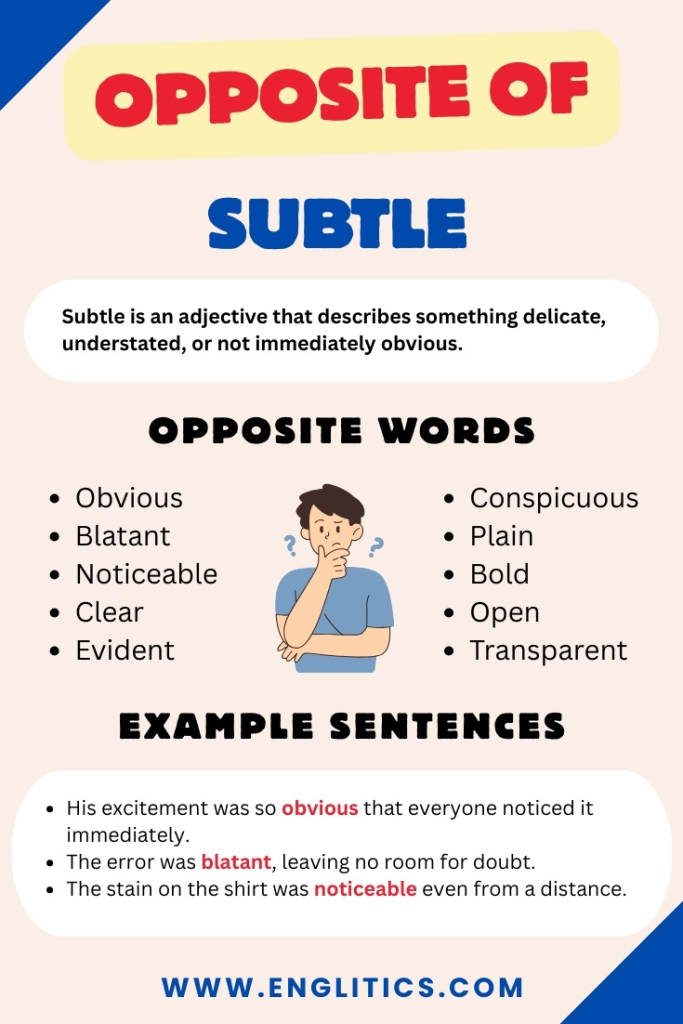
Antonyms are words that have opposite meanings. Understanding the antonyms of “subtle” allows you to express qualities that are easily perceived, obvious, or blatant.
Obvious
“Obvious” means easily perceived or understood; clear, self-evident, or apparent. It directly contrasts with “subtle,” which implies a quality that is not immediately noticeable.
Blatant
“Blatant” describes something that is offensively obvious or conspicuous, often in a vulgar or unsubtle way. It suggests a lack of attempt to conceal or disguise something.
Overt
“Overt” means done or shown openly; plainly or readily apparent, not secret or hidden. It emphasizes the openness and visibility of something.
Conspicuous
“Conspicuous” means easily seen or noticed; attracting attention. It suggests that something stands out and is hard to miss.
Pronounced
“Pronounced” means very noticeable or marked; emphatic. It indicates that something is strongly evident and easily observed.
Explicit
“Explicit” means stated clearly and in detail, leaving no room for confusion or doubt. It contrasts with “subtle” by emphasizing clarity and directness.
Flagrant
“Flagrant” describes something conspicuously or obviously offensive. It suggests a shocking or outrageous violation of rules or standards.
Gross
“Gross” can mean glaringly obvious or outrageous. It implies something that is crude, vulgar, or extremely noticeable.
Patent
“Patent” means easily recognizable; obvious. It suggests that something is clear and undeniable.
Noticeable
“Noticeable” means easily seen or detected; worthy of attention. It is a general term for something that is not subtle and readily apparent.
Examples
The following tables provide examples of “subtle” and its antonyms in different contexts. These examples will help you understand how to use these words correctly and effectively.
Table 1: Subtle vs. Obvious
This table contrasts ‘subtle’ with ‘obvious’, illustrating how these words represent opposite ends of the spectrum in terms of perceptibility and clarity.
| Subtle | Obvious |
|---|---|
| The difference in taste was subtle, almost imperceptible. | The difference in taste was obvious; one was sweet, the other sour. |
| She gave a subtle hint about her feelings. | She made her feelings obvious with a direct declaration. |
| The change in the painting was subtle, requiring close inspection. | The change in the painting was obvious; a whole figure was added. |
| His subtle sarcasm was often missed by those who didn’t know him well. | His sarcasm was obvious, dripping with irony. |
| The lighting in the room created a subtle ambiance. | The lighting in the room was obvious and harsh. |
| There was a subtle shift in her mood. | There was an obvious shift in her mood; she suddenly became angry. |
| The artist used subtle colors to create a calming effect. | The artist used obvious, bright colors to attract attention. |
| The politician made a subtle appeal to the voters’ emotions. | The politician made an obvious appeal to the voters’ fears. |
| The security measures were subtle but effective. | The security measures were obvious and intimidating. |
| The perfume had a subtle floral scent. | The perfume had an obvious, overpowering fragrance. |
| The movie’s message was subtle and thought-provoking. | The movie’s message was obvious and preachy. |
| The music had a subtle rhythm that was easy to overlook. | The music had an obvious, driving beat. |
| The spy used subtle techniques to gather information. | The spy used obvious methods that risked exposure. |
| The comedian used subtle humor that only some understood. | The comedian used obvious jokes that everyone laughed at. |
| The teacher gave a subtle correction to the student’s grammar. | The teacher gave an obvious reprimand for the student’s error. |
| The car’s design included subtle aerodynamic improvements. | The car’s design featured obvious, large spoilers. |
| The flavor of the spice was subtle in the dish. | The flavor of the spice was obvious and dominant. |
| The change in policy was subtle, but it had a big impact. | The change in policy was obvious and caused immediate reactions. |
| The politician made a subtle dig at his opponent during the debate. | The politician made an obvious attack on his opponent’s character. |
| The painting contained subtle symbolism. | The painting’s symbolism was obvious and straightforward. |
| The warning was subtle, almost like a suggestion. | The warning was obvious and direct. |
| Her disappointment was subtle; only her close friends noticed. | Her disappointment was obvious; she burst into tears. |
Table 2: Subtle vs. Blatant
This table contrasts ‘subtle’ with ‘blatant’, highlighting the difference between understated nuances and offensively obvious displays.
| Subtle | Blatant |
|---|---|
| The advertising campaign used subtle messaging to attract customers. | The advertising campaign used blatant lies to deceive customers. |
| She gave a subtle hint that she wanted a promotion. | She made a blatant demand for a promotion. |
| The politician used subtle tactics to undermine his opponent. | The politician used blatant attacks to discredit his opponent. |
| The artist’s skill was evident in the subtle details of the painting. | The artist’s lack of skill was blatant in the poorly executed painting. |
| The company made a subtle effort to improve its image. | The company engaged in blatant bribery to secure the contract. |
| The chef used subtle spices to enhance the flavor of the dish. | The chef used blatant amounts of salt to mask the poor quality of the ingredients. |
| The movie contained subtle social commentary. | The movie featured blatant propaganda. |
| He made a subtle attempt to flirt with her. | He made a blatant pass at her in front of everyone. |
| The design change was so subtle that few people noticed it. | The design change was blatant and immediately obvious. |
| She used subtle makeup to enhance her natural features. | She wore blatant makeup that looked unnatural. |
| The security guard watched the suspect with subtle vigilance. | The security guard displayed blatant disregard for safety protocols. |
| The comedian delivered a subtle joke that went over some heads. | The comedian told a blatant joke that was offensive to many. |
| The teacher offered subtle guidance to the struggling student. | The teacher showed blatant favoritism towards certain students. |
| The company made a subtle effort to reduce its carbon footprint. | The company engaged in blatant pollution of the local environment. |
| The diplomat negotiated with subtle diplomacy. | The diplomat made blatant threats during the negotiation. |
| The spy used subtle methods to gather intelligence. | The spy employed blatant tactics that risked exposure. |
| The athlete made subtle adjustments to improve his performance. | The athlete used blatant performance-enhancing drugs. |
| The writer used subtle symbolism throughout the novel. | The writer included blatant stereotypes in the story. |
| The manager gave subtle feedback to the employee. | The manager delivered blatant criticism in front of the team. |
| The hacker used subtle code to infiltrate the system. | The hacker launched a blatant cyberattack. |
| The car’s modifications were subtle and enhanced its performance. | The car’s modifications were blatant and purely for show. |
| The marketing campaign relied on subtle psychology. | The marketing campaign used blatant manipulation. |
Table 3: Subtle vs. Overt
This table contrasts ‘subtle’ with ‘overt’, focusing on the difference between actions or qualities that are implied versus those that are openly expressed or displayed.
| Subtle | Overt |
|---|---|
| The politician made a subtle appeal to national pride. | The politician made an overt declaration of war. |
| She gave a subtle nod of agreement. | She gave an overt thumbs-up to show her approval. |
| The company engaged in subtle marketing tactics. | The company engaged in overt advertising campaigns. |
| The government used subtle propaganda techniques. | The government used overt censorship to control information. |
| He made a subtle threat against his rival. | He made an overt threat to physically harm his rival. |
| The spy used subtle methods to gather information. | The spy used overt surveillance techniques. |
| The artist used subtle colors to create a calming effect. | The artist used overt images of violence to shock the audience. |
| The teacher gave a subtle hint about the answer. | The teacher gave an overt explanation of the solution. |
| The movie explored the theme of loss with subtle symbolism. | The movie portrayed the theme of love with overt sentimentality. |
| The negotiation involved subtle maneuvering and compromise. | The negotiation resulted in overt concessions from both sides. |
| The manager gave subtle feedback to the employee. | The manager gave overt praise for the employee’s performance. |
| The company made a subtle effort to improve its reputation. | The company launched an overt public relations campaign. |
| The hacker used subtle code to bypass security measures. | The hacker launched an overt attack on the system’s servers. |
| She expressed her dissatisfaction with subtle gestures. | She expressed her anger with overt shouting and insults. |
| The detective used subtle questioning techniques. | The detective used overt interrogation methods. |
| The athlete made subtle adjustments to his training regimen. | The athlete made overt displays of aggression during the game. |
| The writer used subtle metaphors to convey his message. | The writer used overt statements to make his point clear. |
| The car’s design included subtle aerodynamic improvements. | The car’s design featured overt racing stripes and spoilers. |
| The security system used subtle surveillance technology. | The security system employed overt security cameras and alarms. |
| The politician offered subtle promises to the voters. | The politician made overt commitments to specific policies. |
| The evidence presented was subtle and circumstantial. | The evidence was overt and undeniable. |
| The changes in the market were subtle but significant. | The changes in the market were overt and dramatic. |
Table 4: Subtle vs. Conspicuous
This table contrasts ‘subtle’ with ‘conspicuous’, illustrating the difference between something hardly noticeable and something that easily attracts attention.
| Subtle | Conspicuous |
|---|---|
| The spy moved with subtle movements, blending into the crowd. | The spy made a conspicuous entrance, attracting unwanted attention. |
| She wore a subtle perfume that only those close to her could smell. | She wore a conspicuous amount of jewelry that sparkled from afar. |
| The changes in the economy were subtle but significant. | The changes in the skyline were conspicuous due to the new skyscraper. |
| The actor used subtle facial expressions to convey emotion. | The actor wore a conspicuous costume that stood out on stage. |
| The musician added a subtle layer of harmony to the song. | The musician played a conspicuous solo that captivated the audience. |
| The detective looked for subtle clues at the crime scene. | The detective found a conspicuous weapon at the scene. |
| The artist used subtle brushstrokes to create a realistic effect. | The artist painted a conspicuous mural on the side of the building. |
| The athlete made subtle adjustments to his form. | The athlete wore a conspicuous uniform with bright colors. |
| The politician made a subtle attempt to win over voters. | The politician held a conspicuous rally in the town square. |
| The company made a subtle effort to improve its image. | The company launched a conspicuous advertising campaign. |
| The pattern in the wallpaper was subtle and calming. | The pattern in the wallpaper was conspicuous and distracting. |
| The difference in opinion was subtle, almost nonexistent. | The difference in opinion was conspicuous and led to conflict. |
| The aroma of the spice was subtle in the dish. | The aroma of the food was conspicuous and filled the room. |
| The change in temperature was subtle and gradual. | The change in weather was conspicuous and sudden. |
| The improvement in her health was subtle but promising. | The improvement in the city’s infrastructure was conspicuous. |
| The error in the report was subtle and easily overlooked. | The mistake in the contract was conspicuous and alarming. |
| The shift in policy was subtle but impactful. | The change in leadership was conspicuous and controversial. |
| The message in the art was subtle and thought-provoking. | The message in the protest was conspicuous and direct. |
| The texture of the fabric was subtle and luxurious. | The texture of the carpet was conspicuous and plush. |
| The design of the building was subtle and elegant. | The design of the skyscraper was conspicuous and modern. |
Table 5: Subtle vs. Explicit
This table contrasts ‘subtle’ with ‘explicit’, emphasizing the difference between implied meaning and direct, unambiguous statements.
| Subtle | Explicit |
|---|---|
| The instructions were subtle, requiring careful reading. | The instructions were explicit, leaving no room for interpretation. |
| She gave a subtle hint about her feelings. | She made an explicit declaration of love. |
| The contract contained subtle clauses that were easy to miss. | The contract included explicit terms and conditions. |
| The movie explored the theme of prejudice with subtle symbolism. | The movie addressed the issue of racism with explicit scenes and dialogue. |
| The politician made a subtle reference to his opponent’s past. | The politician made an explicit accusation against his opponent. |
| The teacher offered subtle guidance to the students. | The teacher gave explicit instructions on how to complete the assignment. |
| The company communicated its concerns through subtle memos. | The company issued an explicit warning to its employees. |
| The artist conveyed his message with subtle metaphors. | The artist made an explicit statement about his political beliefs. |
| The design incorporated subtle details that enhanced its elegance. | The design included explicit instructions for assembly. |
| The security system relied on subtle detection methods. | The security protocol required explicit authorization for entry. |
| The rules were understood through subtle implications. | The rules were stated explicitly in the handbook. |
| The agreement was based on subtle understandings. | The agreement involved explicit promises and obligations. |
| The criticism was delivered with subtle undertones. | The feedback was explicit and direct. |
| The marketing campaign used subtle psychological tactics. | The marketing campaign made explicit claims about the product’s benefits. |
| The consequences were implied through subtle warnings. | The penalties were outlined explicitly in the policy. |
| The relationship was based on subtle cues and gestures. | The couple communicated their intentions explicitly. |
| The evidence was presented with subtle connections. | The proof was provided explicitly in the documents. |
| The strategy was executed with subtle precision. | The plan was detailed explicitly in the manual. |
| The changes were implemented with subtle adjustments. | The revisions were announced explicitly in the update. |
| The message was conveyed through subtle symbolism. | The meaning was explained explicitly in the text. |
| The flavor was enhanced with subtle spices. | The ingredients were listed explicitly on the package. |
Usage Rules
When using antonyms of “subtle,” it’s important to consider the context and the specific nuance you want to convey. Here are some usage rules to keep in mind:
- Obvious is suitable when something is easily perceived or understood.
- Blatant is used when something is offensively obvious or conspicuous.
- Overt is appropriate when something is done or shown openly and is not hidden.
- Conspicuous is used when something is easily seen or noticed and attracts attention.
- Pronounced is suitable when something is very noticeable or marked.
- Explicit is used when something is stated clearly and in detail, leaving no room for confusion.
- Flagrant is appropriate when something is conspicuously or obviously offensive.
- Gross is used when something is glaringly obvious or outrageous.
- Patent is suitable when something is easily recognizable and obvious.
- Noticeable is a general term for something that is readily apparent.
Exception: While “gross” can be an antonym of “subtle” in certain contexts, it more commonly refers to something vulgar or unpleasant. Use it carefully to avoid misinterpretation.
Common Mistakes
Here are some common mistakes to avoid when using antonyms of “subtle”:
Mistake 1: Using “obvious” when “blatant” is more appropriate.
Incorrect: The lie was obvious.
Correct: The lie was blatant.
Explanation: “Blatant” implies a more offensive and deliberate attempt to deceive.
Mistake 2: Using “overt” when “obvious” is sufficient.
Incorrect: The problem was overt.
Correct: The problem was obvious.
Explanation: “Overt” suggests something that was previously hidden and is now openly revealed, while “obvious” simply means easily perceived.
Mistake 3: Using “gross” to describe a simple error.
Incorrect: He made a gross mistake on the test.
Correct: He made an obvious mistake on the test.
Explanation: “Gross” implies a severe or outrageous error, not a simple mistake.
Practice Exercises
Test your understanding of the antonyms of “subtle” with these practice exercises.
Exercise 1: Fill in the Blanks
Choose the best antonym of “subtle” to complete each sentence.
| Question | Answer |
|---|---|
| 1. The difference between the two paintings was __________. | obvious |
| 2. The politician’s corruption was __________. | flagrant |
| 3. She made an __________ attempt to get his attention. | overt |
| 4. The stain on his shirt was quite __________. | conspicuous |
| 5. There was a __________ change in the weather. | pronounced |
| 6. The instructions were __________, leaving no room for doubt. | explicit |
| 7. The company’s disregard for safety was __________. | flagrant |
| 8. He made a __________ error in his calculations. | gross |
| 9. The solution to the problem was __________. | patent |
| 10. The improvement in her condition was __________. | noticeable |
Exercise 2: Multiple Choice
Select the best antonym for “subtle” in each sentence.
| Question | Answer |
|---|---|
1. The flavor was anything but subtle; it was quite __________.
| c. pronounced |
2. Instead of being subtle, he made a __________ demand for a raise.
| b. blatant |
3. The difference between the twins was __________ to everyone.
| b. obvious |
4. Her feelings were not subtle; they were quite __________.
| b. overt |
5. The mistake in the document was __________ and required immediate correction.
| b. conspicuous |
6. The rules were not subtle; they were __________ and clearly defined.
| b. explicit |
7. The crime was not subtle; it was a __________ violation of the law.
| b. flagrant |
8. The error was so __________ that it could not be ignored.
| b. gross |
9. The answer was __________ to anyone who had studied the material.
| b. patent |
10. The change in his behavior was __________ to everyone around him.
| b. noticeable |
Advanced Topics
For advanced learners, consider exploring the nuances of subtlety in different contexts, such as literature, art, and psychology. Analyze how authors use subtle language to create complex characters and themes.
Study how artists employ subtle techniques to evoke emotions and convey deeper meanings. Investigate the role of subtlety in nonverbal communication and interpersonal relationships.
Understanding the cultural variations in the perception of subtlety can also be a fascinating area of study. What is considered subtle in one culture may be perceived as direct or even rude in another.
Developing cross-cultural awareness can enhance your ability to communicate effectively in diverse settings.
FAQ
Q1: What is the difference between “obvious” and “blatant”?
A: “Obvious” simply means easily perceived or understood. “Blatant” implies something offensively obvious, often done without any attempt to conceal it. Blatant actions are usually considered rude, insensitive, or shocking.
Q2: When should I use “overt” instead of “obvious”?
A: Use “overt” when you want to emphasize that something is done or shown openly, without any attempt to hide it. “Obvious” is a more general term for something easily perceived.
Q3: Is “gross” always a negative word?
A: Yes, “gross” generally has negative connotations. When used as an antonym of “subtle,” it implies that something is glaringly obvious or outrageous in a negative way.
Q4: Can “noticeable” be used in both positive and negative contexts?
A: Yes, “noticeable” can be used in both positive and negative contexts. It simply means that something is easily seen or detected. The context will determine whether it is positive or negative.
Q5: How can I improve my understanding of subtle language?
A: Read widely and pay attention to the nuances of language. Analyze how authors use subtle language to create complex characters and themes. Practice using subtle language in your own writing and speech.
Q6: What is the role of context when using antonyms of “subtle”?
A: Context is crucial. The specific antonym you choose should depend on the context and the nuance you want to convey. Consider the situation, the tone, and the intended audience.
Q7: Are there any other words that can be considered antonyms of “subtle”?
A: Yes, other words such as “forthright,” “unequivocal,” and “palpable” can also be considered antonyms of “subtle,” depending on the specific context.
Q8: How does culture influence the perception of subtlety?
A: Cultural norms and values can significantly influence the perception of subtlety. What is considered subtle in one culture may be perceived as direct or even rude in another. Understanding these cultural variations can enhance your communication skills.
Conclusion
Mastering the antonyms of “subtle” is essential for enhancing your vocabulary and improving your ability to express yourself with precision. By understanding the nuances of words like “obvious,” “blatant,” “overt,” and “conspicuous,” you can effectively communicate qualities that are easily perceived and avoid misinterpretations.
Practice using these words in different contexts to solidify your understanding and refine your communication skills.
Remember to consider the context and the specific nuance you want to convey when choosing an antonym of “subtle.” Pay attention to how authors and speakers use these words in various situations. By continuously expanding your vocabulary and practicing your language skills, you can become a more effective and confident communicator.