Urgency means something needs to be done right away—it’s fast, important, and can’t wait. We feel urgency in emergencies, deadlines, or high-pressure situations. But not everything has to move so quickly. When there’s time to think, plan, or relax, the opposite of urgency is a better way to describe it.
Antonyms for urgency include words like calmness, patience, delay, slowness, and leisure. These words describe situations where there’s no rush, and things can happen at a slower or more thoughtful pace. In this article, you’ll learn how to use these opposite words in daily life, writing, or conversation—with clear examples to guide you.
Definition of Urgency
Urgency refers to the state or quality of requiring immediate action or attention. It implies a critical need for swiftness and decisiveness to address a pressing matter. The word often carries connotations of importance, criticality, and the potential for negative consequences if not addressed promptly. It’s derived from the word “urgent,” which emphasizes the need for haste and priority.
In contrast, antonyms for urgency represent the absence of this immediate need. They suggest a lack of pressure, a relaxed pace, or a situation where delay is acceptable or even preferable.
These antonyms encompass a range of meanings, from simple slowness to a complete lack of importance. Recognizing these nuances is key to effective communication.
Structural Breakdown of Urgency and its Antonyms
Understanding the structural elements of “urgency” and its antonyms involves examining their parts of speech and how they function within sentences. “Urgency” is primarily a noun, while “urgent” is an adjective.
Antonyms can also be nouns, adjectives, adverbs, or even phrases depending on the specific meaning they convey.
For example, “delay” is a noun that can act as an antonym, while “leisurely” is an adjective that describes an action done without urgency. Understanding these grammatical roles allows us to use these words correctly in various contexts.
The structure of sentences using these words also changes based on the intended meaning. A sentence emphasizing urgency might be short and direct, while one indicating a lack of urgency might be more descriptive and relaxed.
Antonyms for Urgency
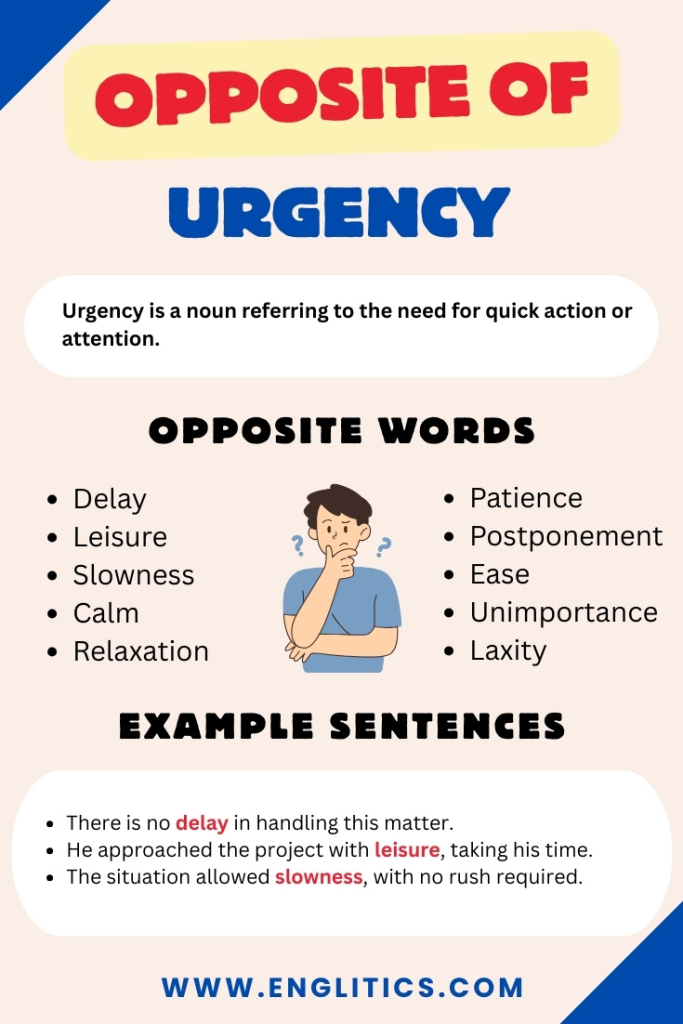
Antonyms for urgency can be classified into several categories, each representing a different aspect of the absence of urgency. These categories help to refine our understanding of the various ways we can express the opposite of needing immediate action.
Delay and Postponement
This category includes words that suggest a deliberate slowing down or putting off of an action. These words imply that the task is not time-sensitive and can be handled at a later time.
Calmness and Leisure
These antonyms highlight a relaxed and unhurried approach. They suggest an atmosphere where there is no pressure to act quickly and where one can take their time.
Unimportance and Triviality
This category focuses on the lack of significance or consequence associated with the task. These words imply that the action is not essential and does not require immediate attention.
Inefficiency and Slowness
These antonyms describe a lack of speed or effectiveness in completing a task. While not always intentional, they result in a lack of urgency due to the slow pace of progress.
Examples of Antonyms for Urgency
The following tables provide examples of antonyms for urgency, categorized by their primary meaning. Each table includes a word or phrase, its part of speech, and example sentences to illustrate its usage.
Table 1: Antonyms Denoting Delay and Postponement
The table below presents words and phrases that suggest postponing or delaying action, directly contrasting with the concept of urgency.
| Antonym | Part of Speech | Example Sentence |
|---|---|---|
| Delay | Noun/Verb | The delay in processing the application caused frustration. |
| Postponement | Noun | The postponement of the meeting was announced this morning. |
| Deferment | Noun | He requested a deferment of his student loan payments. |
| Reschedule | Verb | We need to reschedule the appointment for next week. |
| Hold off | Phrasal Verb | Let’s hold off on making a decision until we have more information. |
| Put off | Phrasal Verb | Don’t put off until tomorrow what you can do today… unless it’s not urgent. |
| Procrastinate | Verb | I tend to procrastinate on tasks I don’t enjoy. |
| Stall | Verb | The negotiations stalled due to disagreements on key issues. |
| Suspend | Verb | The project was suspended due to lack of funding. |
| Adjourn | Verb | The meeting was adjourned until the following week. |
| Remand | Verb | The case was remanded to a lower court for further review. |
| Shelve | Verb | The proposal was shelved due to budget constraints. |
| Table | Verb | The discussion was tabled until the next meeting. |
| Slow down | Phrasal Verb | We decided to slow down the pace of the project to ensure quality. |
| Take a break | Phrase | Let’s take a break before tackling the next task. |
| Take one’s time | Phrase | There’s no rush; take your time and do it right. |
| At leisure | Phrase | You can review the documents at your leisure. |
| Later | Adverb | We can discuss this later when we have more time. |
| Eventually | Adverb | We will address the issue eventually, but not immediately. |
| In due course | Phrase | The matter will be resolved in due course. |
| Sometime | Adverb | We should meet sometime next week. |
| One day | Phrase | One day, I’ll get around to cleaning the garage. |
| Down the line | Phrase | We can consider that option down the line. |
| In the future | Phrase | In the future, we should plan these events more carefully. |
| When the time is right | Phrase | We’ll launch the product when the time is right. |
Table 2: Antonyms Denoting Calmness and Leisure
This table showcases words that convey a sense of peace and unhurriedness, contrasting the agitated state of urgency.
| Antonym | Part of Speech | Example Sentence |
|---|---|---|
| Calm | Adjective | The situation is under control; there’s no need to be anxious, remain calm. |
| Peaceful | Adjective | The atmosphere in the library was quiet and peaceful. |
| Relaxed | Adjective | She felt relaxed after her vacation. |
| Leisurely | Adjective/Adverb | They took a leisurely stroll through the park. |
| Tranquil | Adjective | The lake was tranquil in the early morning light. |
| Serene | Adjective | Her face had a serene expression. |
| Unrushed | Adjective | The pace of life in the countryside is pleasantly unrushed. |
| Easygoing | Adjective | He has an easygoing attitude towards life. |
| Composed | Adjective | She remained composed despite the stressful situation. |
| Collected | Adjective | He gave a collected speech, showing no signs of nervousness. |
| Patient | Adjective | You need to be patient when teaching someone a new skill. |
| Slow | Adjective/Adverb | The traffic was moving at a slow pace. |
| Steady | Adjective/Adverb | She walked at a steady pace, not rushing at all. |
| Gentle | Adjective | He spoke in a gentle voice, trying to soothe her. |
| Mild | Adjective | The weather was mild and pleasant. |
| Placid | Adjective | The lake was placid, reflecting the blue sky. |
| Restful | Adjective | She spent a restful weekend in the mountains. |
| Soothing | Adjective | The music had a soothing effect on her nerves. |
| At ease | Phrase | He felt completely at ease in her company. |
| Without haste | Phrase | She completed the task without haste, ensuring accuracy. |
| In no hurry | Phrase | They were in no hurry to leave the beach. |
| Take it easy | Phrase | Just take it easy and don’t stress about the deadline. |
| Chill out | Phrase | Chill out, everything will be alright. |
| Keep calm | Phrase | Keep calm and carry on! |
| Take a breather | Phrase | Let’s take a breather before we start the next project. |
Table 3: Antonyms Denoting Unimportance and Triviality
This table lists words and phrases that suggest a lack of significance or importance, contrasting with the critical nature of urgency.
| Antonym | Part of Speech | Example Sentence |
|---|---|---|
| Insignificant | Adjective | The error was insignificant and did not affect the outcome. |
| Trivial | Adjective | They argued over a trivial matter. |
| Unimportant | Adjective | The details are unimportant at this stage. |
| Minor | Adjective | It was a minor issue that was easily resolved. |
| Petty | Adjective | He got upset over a petty complaint. |
| Negligible | Adjective | The impact of the change was negligible. |
| Irrelevant | Adjective | That information is irrelevant to the discussion. |
| Immaterial | Adjective | The cost is immaterial compared to the benefits. |
| Meaningless | Adjective | The gesture seemed meaningless to her. |
| Pointless | Adjective | It’s pointless to argue about it now. |
| Worthless | Adjective | The old painting turned out to be worthless. |
| Inconsequential | Adjective | The delay was inconsequential; it didn’t affect the project timeline. |
| Nonessential | Adjective | These features are nonessential and can be removed. |
| Of no consequence | Phrase | The decision is of no consequence to the overall plan. |
| Not a big deal | Phrase | It’s not a big deal; we can fix it easily. |
| No problem | Phrase | “Can you help me with this?” “No problem!” |
| Forget about it | Phrase | Forget about it; it’s not worth worrying about. |
| Never mind | Phrase | Never mind, I’ll do it myself. |
| It doesn’t matter | Phrase | It doesn’t matter what he thinks. |
| Of little importance | Phrase | The issue is of little importance at this time. |
| Paltry | Adjective | The sum was paltry and not worth the effort. |
| Frivolous | Adjective | The lawsuit was dismissed as frivolous. |
| Superficial | Adjective | Their relationship was superficial and lacked depth. |
| Empty | Adjective | His promises felt empty and insincere. |
| Idle | Adjective | They spent an idle afternoon by the pool. |
Table 4: Antonyms Denoting Inefficiency and Slowness
The table below presents words that describe a lack of speed or effectiveness, resulting in a reduced sense of urgency.
| Antonym | Part of Speech | Example Sentence |
|---|---|---|
| Inefficient | Adjective | The process was inefficient and took too long. |
| Sluggish | Adjective | The economy was sluggish and growth was slow. |
| Lethargic | Adjective | He felt lethargic and had no energy. |
| Dilatory | Adjective | His dilatory tactics delayed the project’s completion. |
| Lackadaisical | Adjective | His lackadaisical attitude annoyed his colleagues. |
| Tardy | Adjective | The student was tardy for class. |
| Laggard | Noun | The company was a laggard in adopting new technologies. |
| Dawdling | Verb | They were dawdling along the path, enjoying the scenery. |
| Loitering | Verb | The police told them to stop loitering in the park. |
| Crawling | Verb | The traffic was crawling on the highway. |
| Creeping | Verb | The fog was creeping in from the sea. |
| Puttering | Verb | He spent the afternoon puttering around in the garden. |
| Strolling | Verb | They were strolling along the beach at sunset. |
| Sauntering | Verb | He was sauntering down the street, whistling a tune. |
| Lagging | Verb | The team was lagging behind schedule. |
| Behind schedule | Phrase | The project is behind schedule due to unforeseen delays. |
| Behind time | Phrase | We are running behind time, so we need to speed up. |
| Off pace | Phrase | The runner was off pace in the early stages of the race. |
| Slack | Adjective | Business was slack during the summer months. |
| Inert | Adjective | The old machine was inert, gathering dust in the corner. |
| Passive | Adjective | He took a passive role in the discussion, not offering any opinions. |
| Unproductive | Adjective | The meeting was largely unproductive, with little accomplished. |
| Fruitless | Adjective | Their efforts to find a solution proved fruitless. |
| Futile | Adjective | It was futile to resist the inevitable. |
| Vain | Adjective | Their attempts to revive the project were in vain. |
Usage Rules for Antonyms of Urgency
Using antonyms of urgency correctly depends on the context and the specific nuance you want to convey. Here are some general rules to follow:
- Choose the right antonym: Consider the specific meaning you want to express. “Delay” implies a planned postponement, while “calmness” suggests a relaxed state.
- Pay attention to tone: Some antonyms, like “trivial,” can sound dismissive or condescending. Use them carefully to avoid offending your audience.
- Consider the grammatical role: Ensure that the antonym you choose fits grammatically within the sentence. For example, use an adjective to describe a state and a verb to describe an action.
- Use context clues: The surrounding words and sentences should provide clues about the intended meaning of the antonym.
Common Mistakes When Using Antonyms of Urgency
Here are some common mistakes to avoid when using antonyms of urgency:
Mistake 1: Using “slow” when “delayed” is more appropriate.
Incorrect: The train was slow because of the weather.
Correct: The train was delayed because of the weather.
Mistake 2: Using “unimportant” when “minor” is more accurate.
Incorrect: The mistake was unimportant, causing a major problem.
Correct: The mistake was minor, but it caused a major problem.
Mistake 3: Using “calm” when referring to a planned postponement.
Incorrect: The meeting was calm until next week.
Correct: The meeting was postponed until next week.
Mistake 4: Mismatching the part of speech.
Incorrect: He acted with unimportant.
Correct: He acted with unimportance.
Mistake 5: Using a negative form of “urgent” incorrectly.
Incorrect: The matter is not urgentful.
Correct: The matter is not urgent.
Practice Exercises
Test your understanding of antonyms for urgency with the following exercises.
Exercise 1: Choose the best antonym for the underlined word.
Instructions: Select the most appropriate antonym for the underlined word in each sentence from the options provided.
| Question | Options | Answer |
|---|---|---|
| 1. The situation requires urgent attention. | a) immediate b) delayed c) hasty d) critical | b) delayed |
| 2. We need to address this issue promptly. | a) quickly b) slowly c) immediately d) urgently | b) slowly |
| 3. The matter is of critical importance. | a) essential b) trivial c) vital d) significant | b) trivial |
| 4. The decision needs to be made expeditiously. | a) rapidly b) leisurely c) swiftly d) quickly | b) leisurely |
| 5. The task is time-sensitive. | a) urgent b) unimportant c) indifferent d) critical | b) unimportant |
| 6. The project is on a tight schedule. | a) flexible b) strict c) rigid d) demanding | a) flexible |
| 7. The response should be immediate. | a) instant b) delayed c) rapid d) quick | b) delayed |
| 8. The action must be swift. | a) fast b) slow c) quick d) rapid | b) slow |
| 9. This is a pressing issue. | a) urgent b) trivial c) important d) critical | b) trivial |
| 10. They reacted decisively. | a) resolutely b) hesitantly c) firmly d) promptly | b) hesitantly |
Exercise 2: Fill in the blanks with an appropriate antonym of urgency.
Instructions: Complete each sentence by filling in the blank with a suitable antonym for urgency. Choose from the words and phrases provided in the tables above.
| Question | Answer |
|---|---|
| 1. Due to the lack of funding, the project was __________. | shelved |
| 2. There’s no need to rush; you can review the documents __________. | at your leisure |
| 3. He has an __________ attitude towards deadlines. | easygoing |
| 4. The impact of the change was __________, so we didn’t worry about it. | negligible |
| 5. The traffic was __________ on the highway, making the commute longer. | crawling |
| 6. They decided to __________ the meeting until everyone was available. | reschedule |
| 7. She felt __________ after spending the day at the spa. | relaxed |
| 8. We will address the issue __________, but not right now. | eventually |
| 9. His __________ tactics delayed the project’s completion significantly. | dilatory |
| 10. The matter is __________ and does not require immediate attention. | unimportant |
Exercise 3: Rewrite sentences to convey the opposite of urgency.
Instructions: Rewrite each sentence to express the opposite of urgency, using antonyms from the tables above.
| Original Sentence | Rewritten Sentence |
|---|---|
| 1. We need to submit the report urgently. | We can submit the report later. |
| 2. The situation demands immediate action. | The situation does not require immediate action. |
| 3. He made a prompt decision. | He made a hesitant decision. |
| 4. The task is time-critical. | The task is not time-sensitive. |
| 5. They are working at a rapid pace. | They are working at a leisurely pace. |
| 6. It’s imperative to address this issue now. | It’s not important to address this issue now. |
| 7. The response required was swift. | The response required was slow. |
| 8. We need to act decisively. | We can afford to act indecisively. |
| 9. The matter is pressing. | The matter is trivial. |
| 10. She handled the situation expeditiously. | She handled the situation leisurely. |
Advanced Topics: Nuances and Context
Beyond basic definitions, understanding the subtle nuances of antonyms for urgency requires considering the context in which they are used. The choice of antonym can significantly alter the tone and meaning of a sentence.
For example, “apathy” can act as an antonym for urgency in situations where action is needed but not taken due to a lack of concern. “Equanimity”, on the other hand, suggests a calm and balanced approach even in situations that might otherwise warrant urgency.
Exploring these subtleties allows for more precise and effective communication.
Frequently Asked Questions
Here are some frequently asked questions about antonyms for urgency.
Q1: What is the difference between “delay” and “postponement”?
A1: Both “delay” and “postponement” refer to putting something off, but “postponement” often implies a more formal or planned rescheduling, while “delay” can be more general and may refer to an unplanned hold-up. For example, a flight can be delayed due to bad weather, or a meeting can be postponed to accommodate a speaker’s schedule.
Q2: Can “calmness” always be used as an antonym for “urgency”?
A2: While “calmness” generally implies the absence of urgency, it’s not always a direct antonym. It depends on the context.
In situations where action is needed, “calmness” might suggest a positive, collected approach, but in other cases, it could imply a lack of necessary action. For example, staying calm during an emergency is good, but remaining calm when action is required is not useful.
Q3: How do I choose the best antonym for “urgency” in a sentence?
A3: Choose the antonym that best reflects the specific meaning you want to convey. Consider the context, the tone, and the grammatical role of the word.
If you want to emphasize a planned rescheduling, “postponement” might be best. If you want to highlight a lack of importance, “trivial” might be more appropriate.
If you are looking to convey a sense of peace, consider using words like “serene”, “tranquil” or “placid”.
Q4: Are there any situations where there is no true antonym for “urgency”?
A4: In some extreme situations where immediate action is absolutely critical for survival or safety, there may not be a true antonym. In these rare cases, any delay or lack of urgency could have severe consequences, making it difficult to find a word that accurately conveys the opposite without diminishing the gravity of the situation.
Q5: Is it ever appropriate to use a double negative to express urgency?
A5: While grammatically correct, using a double negative (e.g., “It’s not unurgent”) can be confusing and less effective than using a direct expression of urgency. It’s generally better to use a positive statement to emphasize the need for immediate action.
Q6: How can understanding antonyms of urgency improve my writing?
A6: Knowing antonyms of urgency allows you to express a wider range of ideas and emotions in your writing. You can use them to create contrast, add nuance, and avoid repetition.
By carefully choosing the right antonym, you can make your writing more precise and engaging.
Q7: Can the same word sometimes be an antonym and sometimes not, depending on context?
A7: Yes, absolutely. Take the word “slow,” for instance.
If something *requires* urgency, then “slow” is an antonym. However, if someone is being urged to panic, telling them to “slow down” could be advice, not an antonym.
The context is key.
Q8: What role do prefixes and suffixes play in creating antonyms for “urgency”?
A8: Prefixes like “un-,” “in-,” and “non-” can be added to words related to urgency to negate their meaning. For example, “urgent” becomes “unurgent,” “important” becomes “unimportant,” and “essential” becomes “nonessential.” Suffixes can also change the part of speech and, indirectly, create antonyms.
For instance, changing “urgent” (adjective) to “urgently” (adverb) doesn’t create a direct antonym, but it shifts the focus to the manner in which something is done, allowing for antonyms like “leisurely” or “slowly” to be used in contrast.
Conclusion
Mastering antonyms for urgency is a valuable skill for anyone seeking to improve their English vocabulary and communication abilities. By understanding the nuances of words like “delay,” “calmness,” and “unimportance,” you can express a wider range of ideas and emotions with greater precision.
Remember to consider the context, tone, and grammatical role of each word to ensure accurate and effective usage.
Continue practicing with the examples and exercises provided in this article to solidify your understanding. With continued effort, you’ll be able to confidently use antonyms for urgency in your writing and conversation, enhancing your overall command of the English language.
Keep expanding your vocabulary and exploring the subtle differences between words to become a more effective communicator.