Vague means something is unclear, hard to understand, or not specific. When a message, idea, or answer is vague, it leaves people confused or unsure of what it really means. It’s like trying to see through fog—you get the general idea, but not the full picture. In situations where clear thinking, exact words, or strong details matter, the opposite of vague is more useful.
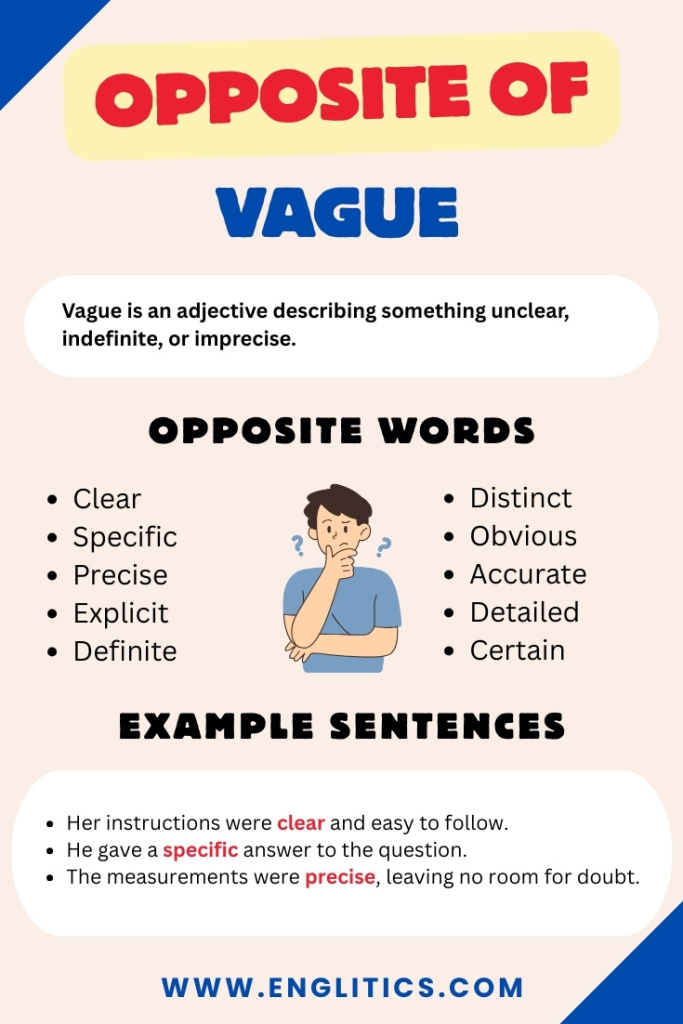
The opposite of vague includes words like clear, specific, detailed, exact, and definite. These words show that something is easy to understand or fully explained. Whether you’re giving directions, writing an essay, or sharing an idea, using the opposite of vague helps others follow along without guessing or being confused.
Definition of ‘Vague’
The word “vague” is an adjective that describes something lacking clarity, precision, or detail. It implies a lack of distinctness, making it difficult to understand or interpret accurately.
A vague statement is ambiguous, open to multiple interpretations, and lacks a clear focus. A vague memory is hazy and indistinct, lacking sharp details.
Understanding the nuances of “vague” is crucial for identifying its antonyms, which represent the opposite qualities of clarity, precision, and detail.
In the context of language, “vague” often refers to statements, descriptions, or instructions that are not specific enough. For example, saying “Go over there” is vague because it doesn’t specify where “there” is.
Similarly, a vague explanation might lack sufficient detail to be fully understood. The term can also apply to concepts or ideas that are ill-defined or lack a clear boundary.
Structural Breakdown of Vagueness
The concept of vagueness can be broken down into several key structural elements. These elements contribute to the overall sense of lack of clarity and precision.
Understanding these elements helps in identifying and using effective antonyms.
- Lack of Specificity: Vague statements often lack concrete details or specific information. They refer to generalities rather than specifics.
- Ambiguity: Vagueness often leads to ambiguity, where a statement can be interpreted in multiple ways. This lack of a single, clear meaning creates uncertainty.
- Indistinctness: Vague descriptions are often indistinct, lacking sharp outlines or clear boundaries. This makes it difficult to form a clear mental image or understanding.
- Lack of Focus: Vague arguments or explanations often lack a clear focus or central point. They may wander aimlessly without a clear direction.
- Open to Interpretation: Because of the lack of specific details, vague statements are open to a range of interpretations, making it difficult to ascertain the speaker’s or writer’s intended meaning.
When aiming for clarity, one must address these structural elements. Antonyms for “vague” directly counter these issues by providing specificity, eliminating ambiguity, creating distinctness, establishing focus, and limiting interpretation.
Types of Antonyms for ‘Vague’
Antonyms, or words with opposite meanings, can be classified into several types. Understanding these types helps in choosing the most appropriate antonym for “vague” in different contexts.
The main types of antonyms are absolute, gradable, complementary, and relational.
Absolute Antonyms
Absolute antonyms, also known as contradictory antonyms, are pairs of words where there is no middle ground. If one word applies, the other cannot.
For example, “alive” and “dead” are absolute antonyms. While absolute antonyms for “vague” are less common, “defined” can sometimes function in this way when referring to a term or concept.
Gradable Antonyms
Gradable antonyms represent opposite ends of a spectrum. There are intermediate degrees between the two words.
For example, “hot” and “cold” are gradable antonyms, as something can be warm or cool. Many antonyms for “vague” fall into this category, such as “clear” and “unclear,” or “precise” and “imprecise.” These allow for varying degrees of clarity and specificity.
Complementary Antonyms
Complementary antonyms are similar to absolute antonyms in that they offer no middle ground. However, they often function as a pair that defines a set.
If something is not one, it must be the other. An example is “on” and “off.” While less direct, “understandable” and “incomprehensible” can act as complementary antonyms to “vague” in certain contexts.
Relational Antonyms
Relational antonyms describe a relationship from opposite perspectives. One word implies the other.
For example, “teacher” and “student” are relational antonyms. While not a perfect fit, “source” and “interpretation” can be considered relational antonyms in the context of vagueness.
A vague source might lead to varied interpretations, while a precise source leads to a clear interpretation.
Examples of Antonyms for ‘Vague’
Several words can serve as antonyms for “vague,” depending on the specific context. Here are some of the most common and effective antonyms, along with examples illustrating their usage.
Clear
“Clear” is a common and versatile antonym for “vague.” It implies that something is easily understood, without ambiguity or confusion. A clear explanation is straightforward and leaves no room for doubt.
The table below provides examples of how “clear” can be used as an antonym for “vague” in various sentences.
| Vague Sentence | Clear Sentence |
|---|---|
| The instructions were vague. | The instructions were clear. |
| He gave a vague answer. | He gave a clear answer. |
| The meaning was vague. | The meaning was clear. |
| Her intentions were vague. | Her intentions were clear. |
| The outline was vague. | The outline was clear. |
| The policy was vague. | The policy was clear. |
| The details were vague. | The details were clear. |
| The image was vague. | The image was clear. |
| The sound was vague. | The sound was clear. |
| The message was vague. | The message was clear. |
| The definition was vague. | The definition was clear. |
| The description was vague. | The description was clear. |
| The concept was vague. | The concept was clear. |
| The rules were vague. | The rules were clear. |
| The boundaries were vague. | The boundaries were clear. |
| The goals were vague. | The goals were clear. |
| The procedure was vague. | The procedure was clear. |
| The explanation was vague. | The explanation was clear. |
| The guidelines were vague. | The guidelines were clear. |
| The purpose was vague. | The purpose was clear. |
| The directions were vague. | The directions were clear. |
| The requirements were vague. | The requirements were clear. |
Specific
“Specific” implies a focus on particular details and a lack of generality. It is an excellent antonym for “vague” when you want to emphasize precision and avoid ambiguity.
A specific instruction leaves no room for misinterpretation.
The following table illustrates the use of “specific” as an antonym for “vague” in different contexts.
| Vague Sentence | Specific Sentence |
|---|---|
| He gave a vague description. | He gave a specific description. |
| The details were vague. | The details were specific. |
| The requirements were vague. | The requirements were specific. |
| The instructions were vague. | The instructions were specific. |
| The examples were vague. | The examples were specific. |
| The plan was vague. | The plan was specific. |
| The objectives were vague. | The objectives were specific. |
| The criteria were vague. | The criteria were specific. |
| The questions were vague. | The questions were specific. |
| The tasks were vague. | The tasks were specific. |
| The goals were vague. | The goals were specific. |
| The targets were vague. | The targets were specific. |
| The deadlines were vague. | The deadlines were specific. |
| The information was vague. | The information was specific. |
| The evidence was vague. | The evidence was specific. |
| The terms were vague. | The terms were specific. |
| The purpose was vague. | The purpose was specific. |
| The areas were vague. | The areas were specific. |
| The roles were vague. | The roles were specific. |
| The steps were vague. | The steps were specific. |
| The methods were vague. | The methods were specific. |
| The approach was vague. | The approach was specific. |
Precise
“Precise” indicates accuracy and exactness. It is an ideal antonym for “vague” when you want to emphasize the correctness and accuracy of information or measurements.
A precise measurement leaves no room for error.
The table below provides examples of how “precise” can be used as an antonym for “vague” in various sentences.
| Vague Sentence | Precise Sentence |
|---|---|
| The measurements were vague. | The measurements were precise. |
| The calculations were vague. | The calculations were precise. |
| The timing was vague. | The timing was precise. |
| The location was vague. | The location was precise. |
| The figures were vague. | The figures were precise. |
| The definition was vague. | The definition was precise. |
| The wording was vague. | The wording was precise. |
| The details were vague. | The details were precise. |
| The instructions were vague. | The instructions were precise. |
| The explanation was vague. | The explanation was precise. |
| The report was vague. | The report was precise. |
| The boundaries were vague. | The boundaries were precise. |
| The analysis was vague. | The analysis was precise. |
| The estimate was vague. | The estimate was precise. |
| The prediction was vague. | The prediction was precise. |
| The data was vague. | The data was precise. |
| The formula was vague. | The formula was precise. |
| The method was vague. | The method was precise. |
| The model was vague. | The model was precise. |
| The specification was vague. | The specification was precise. |
| The assessment was vague. | The assessment was precise. |
| The evaluation was vague. | The evaluation was precise. |
Explicit
“Explicit” means clearly and fully expressed, leaving nothing implied. It serves as a strong antonym for “vague” when you want to emphasize that something is stated directly and without any ambiguity.
The following table shows examples of “explicit” used as an antonym for “vague.”
| Vague Sentence | Explicit Sentence |
|---|---|
| The rules were vague. | The rules were explicit. |
| The instructions were vague. | The instructions were explicit. |
| The agreement was vague. | The agreement was explicit. |
| The terms were vague. | The terms were explicit. |
| The details were vague. | The details were explicit. |
| The conditions were vague. | The conditions were explicit. |
| The expectations were vague. | The expectations were explicit. |
| The requirements were vague. | The requirements were explicit. |
| The guidelines were vague. | The guidelines were explicit. |
| The boundaries were vague. | The boundaries were explicit. |
| The policy was vague. | The policy was explicit. |
| The statement was vague. | The statement was explicit. |
| The message was vague. | The message was explicit. |
| The purpose was vague. | The purpose was explicit. |
| The goals were vague. | The goals were explicit. |
| The criteria were vague. | The criteria were explicit. |
| The procedures were vague. | The procedures were explicit. |
| The directions were vague. | The directions were explicit. |
| The reasons were vague. | The reasons were explicit. |
| The standards were vague. | The standards were explicit. |
| The limitations were vague. | The limitations were explicit. |
| The scope was vague. | The scope was explicit. |
Definite
“Definite” means clearly defined or determined; not vague or doubtful. This antonym emphasizes certainty and a lack of ambiguity.
It’s useful when you want to highlight that something is established and not subject to interpretation.
The table below provides examples of how “definite” can be used as an antonym for “vague” in various sentences.
| Vague Sentence | Definite Sentence |
|---|---|
| The plans were vague. | The plans were definite. |
| The decision was vague. | The decision was definite. |
| The outcome was vague. | The outcome was definite. |
| The answer was vague. | The answer was definite. |
| The possibility was vague. | The possibility was definite. |
| The commitment was vague. | The commitment was definite. |
| The timeline was vague. | The timeline was definite. |
| The schedule was vague. | The schedule was definite. |
| The agreement was vague. | The agreement was definite. |
| The result was vague. | The result was definite. |
| The conclusion was vague. | The conclusion was definite. |
| The terms were vague. | The terms were definite. |
| The conditions were vague. | The conditions were definite. |
| The rules were vague. | The rules were definite. |
| The guidelines were vague. | The guidelines were definite. |
| The objective was vague. | The objective was definite. |
| The purpose was vague. | The purpose was definite. |
| The intention was vague. | The intention was definite. |
| The direction was vague. | The direction was definite. |
| The route was vague. | The route was definite. |
| The approach was vague. | The approach was definite. |
| The strategy was vague. | The strategy was definite. |
Usage Rules
When using antonyms for “vague,” it’s important to consider the context and the specific nuance you want to convey. While “clear,” “specific,” “precise,” “explicit,” and “definite” can often be used interchangeably, they have slightly different connotations.
- Use “clear” when you want to emphasize that something is easily understood.
- Use “specific” when you want to highlight the presence of particular details and the absence of generality.
- Use “precise” when you want to emphasize accuracy and exactness.
- Use “explicit” when you want to stress that something is stated directly and without implication.
- Use “definite” when you want to indicate that something is clearly defined and not doubtful.
Also, be mindful of the grammatical structure of the sentence. Ensure that the antonym you choose fits grammatically and maintains the intended meaning.
For instance, you might need to adjust the sentence structure slightly to accommodate the antonym effectively.
Common Mistakes
One common mistake is using an antonym that doesn’t quite fit the context. For example, using “precise” when “specific” would be more appropriate, or vice versa.
Another mistake is simply using the wrong word altogether due to a misunderstanding of its meaning. A third mistake is failing to adjust the sentence structure to properly incorporate the antonym.
Here are some examples of common mistakes and their corrections:
| Incorrect Sentence | Correct Sentence | Explanation |
|---|---|---|
| The vague instructions were precise. | The vague instructions were unclear. | “Precise” implies accuracy, which doesn’t fit the context of vague instructions. “Unclear” is a more suitable antonym. |
| He gave a vague specific description. | He gave a specific description. | Using both “vague” and “specific” together is contradictory. |
| The vague plan was definitely. | The vague plan was definite. | “Definitely” is an adverb, while “definite” is an adjective needed to describe the plan. |
| The vague idea became clearity. | The vague idea became clear. | “Clarity” is a noun, while “clear” is the adjective needed here. |
| The vague rules were explicitly defined. | The rules were explicit. | While not strictly incorrect, “explicit” already implies being clearly defined, so “explicitly defined” is redundant. |
Practice Exercises
Test your understanding of antonyms for “vague” with these exercises.
Exercise 1: Multiple Choice
Choose the best antonym for “vague” in each sentence.
| Question | Options | Answer |
|---|---|---|
| The instructions were vague. The new instructions are _____. | (a) confusing (b) clear (c) complex (d) long | (b) clear |
| His description of the event was vague. A more _____ account is needed. | (a) general (b) specific (c) broad (d) simple | (b) specific |
| The measurements were vague. We need _____ measurements. | (a) approximate (b) rough (c) precise (d) estimated | (c) precise |
| The rules were vague and open to interpretation. The revised rules are _____. | (a) implied (b) explicit (c) suggested (d) hinted | (b) explicit |
| The plans for the project were vague. Now, the plans are _____. | (a) uncertain (b) indefinite (c) definite (d) possible | (c) definite |
| The terms of the contract were vague. The new terms are _____. | (a) ambiguous (b) unclear (c) explicit (d) implied | (c) explicit |
| The information provided was vague. We need _____ data. | (a) general (b) approximate (c) specific (d) rough | (c) specific |
| The explanation was vague and confusing. A _____ explanation is necessary. | (a) complex (b) detailed (c) unclear (d) lengthy | (b) detailed |
| The objectives of the study were vague. The new objectives are _____. | (a) broad (b) general (c) specific (d) wide | (c) specific |
| The criteria for selection were vague. The updated criteria are _____. | (a) undefined (b) explicit (c) suggested (d) implied | (b) explicit |
Exercise 2: Sentence Completion
Fill in the blank with the best antonym for “vague.”
| Question | Answer |
|---|---|
| Instead of giving a vague answer, please be more _____. | specific |
| The report was too vague; it needs to be more _____ and detailed. | precise |
| The contract needs to be rewritten to make the terms more _____. | explicit |
| The teacher asked the student to provide a more _____ explanation of the concept. | clear |
| After several revisions, the plan became much more _____. | definite |
| To avoid confusion, the instructions must be _____. | clear |
| The scientist provided _____ evidence to support his hypothesis. | specific |
| The lawyer ensured that the agreement was _____ and left no room for misinterpretation. | explicit |
| The manager set _____ goals for the team to achieve. | definite |
| The engineer provided _____ measurements for the construction project. | precise |
Exercise 3: Rewriting Sentences
Rewrite each sentence, replacing the word “vague” with a suitable antonym.
| Original Sentence | Rewritten Sentence |
|---|---|
| The instructions were vague, leading to confusion. | The instructions were clear, preventing confusion. |
| His explanation of the process was vague and unhelpful. | His explanation of the process was specific and helpful. |
| The measurements provided were vague, so we couldn’t proceed. | The measurements provided were precise, allowing us to proceed. |
| The terms of the agreement were vague and open to interpretation. | The terms of the agreement were explicit and left no room for interpretation. |
| The plan was vague, and we needed more details. | The plan was definite, and we had all the necessary details. |
| The guidelines were vague, making it difficult to follow them. | The guidelines were clear, making it easy to follow them. |
| The description was vague, leaving us unsure of what to expect. | The description was specific, giving us a clear idea of what to expect. |
| The conditions were vague, creating uncertainty about the outcome. | The conditions were explicit, ensuring certainty about the outcome. |
| The purpose of the meeting was vague, so attendance was low. | The purpose of the meeting was definite, so attendance was high. |
| The figures were vague, making it difficult to analyze the data. | The figures were precise, making it easy to analyze the data. |
Advanced Topics
For advanced learners, exploring the philosophical implications of vagueness can be enriching. Vagueness is a topic of considerable debate in philosophy, particularly in logic and epistemology.
Consider the “sorites paradox,” which questions the point at which a heap of sand ceases to be a heap as grains are removed one by one. This paradox highlights the inherent vagueness of many everyday concepts.
Furthermore, analyzing how vagueness is used intentionally in literature and rhetoric can provide deeper insights. Writers often employ vagueness to create ambiguity, mystery, or to allow for multiple interpretations.
Understanding these techniques can enhance both your analytical and creative writing skills.
FAQ
- What is the difference between “vague” and “ambiguous”?While both terms relate to a lack of clarity, “vague” implies a lack of detail or precision, while “ambiguous” means something can be interpreted in multiple ways. A statement can be vague without being ambiguous, and vice versa. For example, “Meet me later” is vague because the time is not specified. “I saw her duck” is ambiguous because “duck” could be a noun or a verb.
- How do I avoid being vague in my writing?To avoid vagueness, use specific details, provide concrete examples, and avoid generalizations. Define your terms clearly and ensure your sentences have a clear focus. Review your writing carefully and ask yourself if each statement is as precise and unambiguous as possible.
- Is it ever acceptable to be vague?Yes, there are situations where vagueness might be intentional or even desirable. In creative writing, vagueness can create a sense of mystery or allow readers to interpret the text in their own way. In certain social situations, vagueness might be used to avoid being overly direct or confrontational. However, in most professional and academic contexts, clarity and precision are preferred.
- How can I improve my vocabulary of antonyms for “vague”?Read widely and pay attention to how different words are used in context. Use a thesaurus to explore synonyms and antonyms. Practice using new words in your writing and speaking. Consider keeping a vocabulary journal to record new words and their meanings.
- What are some other words related to “vague” that I should know?Some related words include: ambiguous, obscure, indistinct, nebulous, hazy, imprecise, indefinite, and unclear. Understanding these words and their nuances can further enhance your vocabulary and improve your ability to communicate effectively.
- How does context affect the best antonym to use for “vague”?Context is crucial. If you’re talking about measurements, “precise” is best. If you’re discussing instructions, “clear” or “specific” might be more appropriate. The key is to choose the antonym that most accurately reflects the opposite quality you want to emphasize in that particular situation.
- Can “detailed” be considered an antonym for “vague”?Yes, “detailed” can often function as an antonym for “vague,” especially when the vagueness stems from a lack of specific information. A detailed explanation fills in the gaps left by a vague one.
- Are there any situations where using “vague” is a literary technique?Absolutely. In poetry and some forms of prose, vagueness can be used to evoke a mood, create a sense of mystery, or allow the reader to project their own interpretations onto the text. It can also mirror the speaker’s uncertainty or confusion.
Conclusion
Mastering the antonyms for “vague” is essential for effective communication. By understanding the nuances of words like “clear,” “specific,” “precise,” “explicit,” and “definite,” you can express your thoughts with greater accuracy and impact.
This knowledge will enhance your writing, speaking, and overall communication skills, enabling you to convey your message with confidence and precision.
Continue to practice using these antonyms in various contexts, and pay attention to how others use them. The more you practice, the more natural and intuitive it will become to choose the right word for the right situation.
Embrace the power of precise language and watch your communication skills flourish.