The opposite of valuable is something that holds little worth, is easily replaced, or is not appreciated. While valuable refers to something important, useful, or high in worth, its opposites reflect low importance or lack of usefulness.
Antonyms for valuable include words like worthless, useless, insignificant, cheap, and unimportant. These words help describe objects, ideas, or actions that don’t hold much meaning or benefit. In this post, you’ll learn how to use these opposite words in different situations, with simple examples to make their meaning clear.
Definition of Valuable and Antonyms
The word “valuable” describes something that is considered to be of great worth, importance, or usefulness. It can refer to material possessions, abstract qualities, or even personal relationships.
Understanding its antonyms requires exploring words that express the opposite – something of little or no worth, importance, or usefulness.
Antonyms are words that have opposite meanings. They help us express contrasting ideas, provide balance in our language, and add depth to our communication.
When considering antonyms for “valuable,” we need to think about the context in which the word is used. For example, if we are talking about a valuable painting, the antonym might be “worthless.” But if we are talking about a valuable lesson, the antonym might be “insignificant” or “trivial.” This context-dependent nature of antonyms makes understanding them essential for precise language use.
Structural Breakdown of Antonyms
Antonyms can be formed in several ways, and understanding these structural elements can help you identify and use them effectively. Here are some common structural patterns:
- Prefixes: Adding prefixes like un-, in-, im-, dis-, or non- can create antonyms. For example, “valuable” doesn’t directly form an antonym with a prefix, but understanding this process helps with other words.
- Root Words: Identifying the root word and finding a word with an opposite root meaning. In the case of “valuable,” this involves finding words that negate the idea of worth or importance.
- Completely Different Words: Some antonyms are simply different words with opposite meanings that have evolved over time. For example, “good” and “bad” are antonyms with no shared root or prefix.
The formation of antonyms often depends on the specific word and its etymology. Recognizing these patterns can aid in expanding your vocabulary and understanding the nuances of language.
Opposite of Valuable
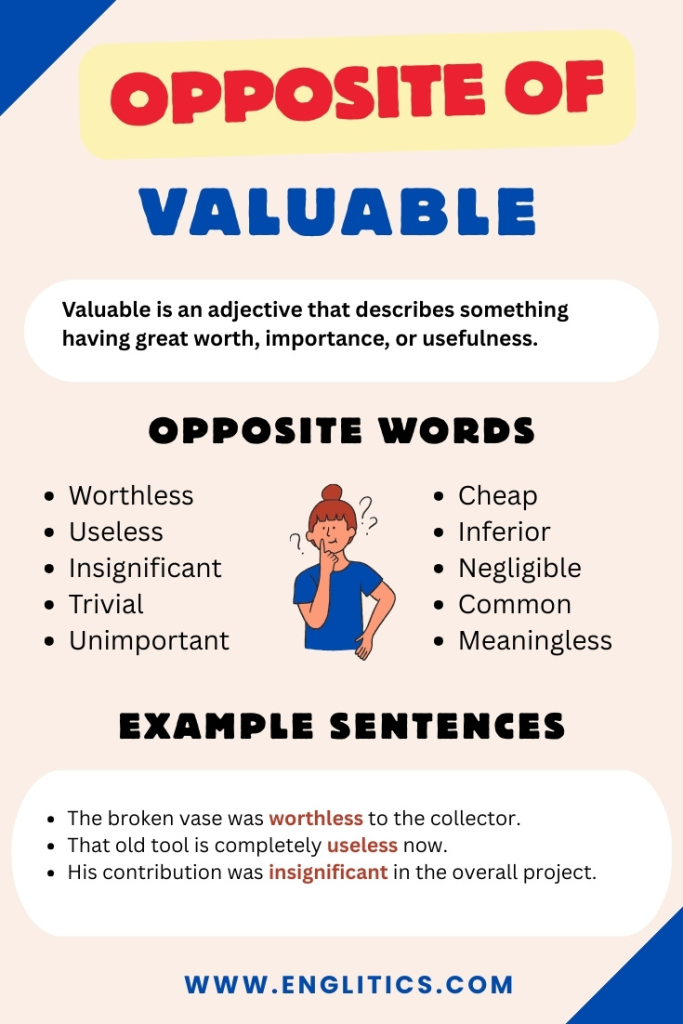
There isn’t one single perfect antonym for “valuable.” The best choice depends on the specific context. Here are several common antonyms, categorized by their specific nuance of meaning:
Worthless
“Worthless” is perhaps the most direct antonym of “valuable” when referring to material possessions or monetary value. It implies a complete lack of worth or usefulness.
Something that is worthless has no financial value and is not considered important.
Cheap
“Cheap” indicates something that has a low price or is of poor quality. While not a perfect antonym for “valuable,” it suggests a significantly lower value compared to something considered valuable.
It often implies a lack of durability or quality.
Useless
“Useless” describes something that has no practical purpose or cannot be used effectively. It focuses on the lack of utility rather than monetary value.
An item might be expensive but still be considered useless if it doesn’t serve its intended purpose.
Insignificant
“Insignificant” suggests that something is unimportant or has little impact. This antonym is often used when referring to abstract concepts, ideas, or contributions.
It implies a lack of importance or consequence.
Trivial
“Trivial” describes something that is of little value or importance; it is similar to “insignificant” but often carries a connotation of being frivolous or petty. A trivial matter is not worth serious consideration.
Invaluable vs. Worthless
It’s important to note the distinction between “invaluable” and “worthless.” While “invaluable” might seem like it should be an antonym for “valuable,” it actually means something is so valuable that its worth cannot be measured. Therefore, its true antonym is “worthless”.
Examples of Antonyms in Sentences
To illustrate the usage of these antonyms, here are several examples in sentences. These examples are categorized to show the nuances of each antonym and how they fit in different contexts.
The following table provides examples using “Worthless” as an antonym for “Valuable”:
| Sentence with “Valuable” | Sentence with “Worthless” |
|---|---|
| The antique vase was incredibly valuable. | The broken vase was now worthless. |
| His advice was valuable to my career. | His advice turned out to be worthless. |
| The company’s assets are quite valuable. | After the scandal, the company’s reputation was worthless. |
| The information he provided was valuable for the investigation. | The information he provided was worthless and misleading. |
| A good education is valuable for future success. | Without skills, the diploma is worthless. |
| The painting was a valuable piece of art. | The forgery was a worthless imitation. |
| The old coin was valuable to collectors. | The damaged coin was worthless to collectors. |
| Her experience was valuable to the team. | Her lack of experience made her contribution worthless. |
| The land is valuable due to its location. | The swamp land was considered worthless. |
| His time is valuable, so don’t waste it. | His time was worthless since he wasn’t being productive. |
| This data is valuable for our research. | This data is worthless because it’s corrupted. |
| The company considers employee feedback valuable. | The management considered employee feedback worthless. |
| The old car had valuable parts. | The wrecked car was worthless. |
| The company’s patents are valuable assets. | The expired patents were worthless. |
| The expert’s opinion was valuable to the case. | The witness’s testimony was worthless and unreliable. |
| The ancient artifact was valuable to historians. | The broken piece of pottery was worthless. |
| The company found the market analysis valuable. | The outdated market analysis was worthless. |
| The training course was valuable for skill development. | The unaccredited course was worthless for career advancement. |
| The gold necklace was valuable. | The fake gold necklace was worthless. |
| The software license was valuable to the company. | The pirated software was worthless. |
| The rare book was valuable and sought after. | The damaged copy of the book was worthless. |
The following table provides examples using “Cheap” as an antonym for “Valuable”:
| Sentence with “Valuable” | Sentence with “Cheap” |
|---|---|
| He invested in valuable art. | He bought cheap imitations. |
| The valuable watch was a family heirloom. | The cheap watch broke after a week. |
| Valuable materials were used in the construction. | Cheap materials were used to cut costs. |
| The valuable fabric was silk. | The cheap fabric was polyester. |
| The valuable furniture was antique. | The cheap furniture was mass-produced. |
| The valuable camera took high-quality photos. | The cheap camera produced blurry images. |
| The valuable tool lasted for years. | The cheap tool broke after a few uses. |
| The valuable car was a luxury model. | The cheap car was an economy model. |
| The valuable jewelry was made of gold and diamonds. | The cheap jewelry was made of plastic and glass. |
| The valuable shoes were made of leather. | The cheap shoes were made of synthetic material. |
| The valuable electronics were high-end. | The cheap electronics were low-end. |
| The valuable wine was from a renowned vineyard. | The cheap wine was from a grocery store. |
| The valuable clothes were designer brands. | The cheap clothes were from a discount store. |
| He collected valuable stamps. | He collected cheap, common stamps. |
| The valuable instrument was a Stradivarius violin. | The cheap instrument was a beginner’s model. |
| The valuable software was professionally developed. | The cheap software was poorly coded. |
| The valuable service was provided by experts. | The cheap service was provided by amateurs. |
| The valuable product was made with precision. | The cheap product was shoddily made. |
| The valuable resource was carefully managed. | The cheap resource was wasted and poorly used. |
| The valuable lessons were taught by experienced teachers. | The cheap lessons were taught by inexperienced tutors. |
| The valuable ingredients were organic and fresh. | The cheap ingredients were processed and artificial. |
| The valuable course was certified and accredited. | The cheap course was uncertified and not recognized. |
The following table provides examples using “Useless” as an antonym for “Valuable”:
| Sentence with “Valuable” | Sentence with “Useless” |
|---|---|
| The tool was valuable for fixing the machine. | The tool was useless because it was broken. |
| His knowledge was valuable in solving the problem. | His knowledge was useless because it was outdated. |
| The map was valuable for navigating the city. | The map was useless because it was inaccurate. |
| The training was valuable for improving skills. | The training was useless because it was poorly designed. |
| The advice was valuable for making a decision. | The advice was useless because it was irrelevant. |
| The information was valuable for understanding the situation. | The information was useless because it was incomplete. |
| The software was valuable for increasing productivity. | The software was useless because it was incompatible. |
| The research was valuable for advancing science. | The research was useless because it was flawed. |
| The experience was valuable for career development. | The experience was useless because it was unrelated. |
| The resource was valuable for achieving the goal. | The resource was useless because it was depleted. |
| The connection was valuable for networking. | The connection was useless because it was unreliable. |
| The feedback was valuable for improving performance. | The feedback was useless because it was vague. |
| The support was valuable for overcoming challenges. | The support was useless because it was ineffective. |
| The idea was valuable for generating innovation. | The idea was useless because it was impractical. |
| The skill was valuable for completing the task. | The skill was useless because it was not needed. |
| The data was valuable for making predictions. | The data was useless because it was inaccurate. |
| The method was valuable for solving the equation. | The method was useless because it was too complex. |
| The insight was valuable for understanding the issue. | The insight was useless because it was obvious. |
| The tool was valuable for repairing the device. | The tool was useless because it was the wrong size. |
| The explanation was valuable for clarifying the concept. | The explanation was useless because it was confusing. |
| The manual was valuable for operating the equipment. | The manual was useless because it was poorly written. |
The following table provides examples using “Insignificant” as an antonym for “Valuable”:
| Sentence with “Valuable” | Sentence with “Insignificant” |
|---|---|
| His contribution to the project was valuable. | His contribution to the project was insignificant. |
| The discovery was valuable to the scientific community. | The discovery was insignificant to the scientific community. |
| The role she played was valuable to the team’s success. | The role she played was insignificant to the team’s success. |
| The historical event was valuable for understanding the present. | The historical event was insignificant in shaping the future. |
| His advice was valuable in navigating the situation. | His advice was insignificant in resolving the conflict. |
| The research provided valuable insights. | The research provided insignificant findings. |
| The data collected was valuable for analysis. | The data collected was insignificant for reaching conclusions. |
| His role in the company was valuable. | His role in the company was insignificant. |
| The details were valuable for understanding the case. | The details were insignificant for affecting the outcome. |
| The lesson learned was valuable for future endeavors. | The lesson learned was insignificant for career growth. |
| The feedback provided was valuable for improvement. | The feedback provided was insignificant for motivating change. |
| The information shared was valuable for decision-making. | The information shared was insignificant for influencing choices. |
| The support given was valuable during the crisis. | The support given was insignificant in alleviating the problem. |
| The skill he possessed was valuable for the project. | The skill he possessed was insignificant to the project’s objective. |
| The experience she gained was valuable for her career. | The experience she gained was insignificant for her promotion. |
| The element he added was valuable to the play. | The element he added was insignificant to the play’s success. |
| The change he made was valuable for the functionality. | The change he made was insignificant for improving the functionality. |
| The contribution she made to the company was valuable. | The contribution she made to the company was insignificant. |
| The knowledge she had was valuable in the meeting. | The knowledge she had was insignificant in the meeting. |
The following table provides examples using “Trivial” as an antonym for “Valuable”:
| Sentence with “Valuable” | Sentence with “Trivial” |
|---|---|
| The historical facts were valuable for understanding the context. | The historical facts were trivial for understanding the context. |
| The details of the contract were valuable for ensuring compliance. | The details of the contract were trivial for ensuring compliance. |
| The research findings were valuable for making informed decisions. | The research findings were trivial for making informed decisions. |
| The skills he acquired were valuable for his career advancement. | The skills he acquired were trivial for his career advancement. |
| The information provided was valuable for solving the puzzle. | The information provided was trivial for solving the puzzle. |
| The experience she gained was valuable for her personal growth. | The experience she gained was trivial for her personal growth. |
| The lessons learned were valuable for preventing future mistakes. | The lessons learned were trivial for preventing future mistakes. |
| The insights shared were valuable for improving the process. | The insights shared were trivial for improving the process. |
| The feedback given was valuable for enhancing the performance. | The feedback given was trivial for enhancing the performance. |
| The suggestions made were valuable for refining the proposal. | The suggestions made were trivial for refining the proposal. |
| The contributions offered were valuable for achieving the goal. | The contributions offered were trivial for achieving the goal. |
| The concerns raised were valuable for addressing the issues. | The concerns raised were trivial for addressing the issues. |
| The resources provided were valuable for supporting the project. | The resources provided were trivial for supporting the project. |
| The effort put in was valuable for ensuring the success. | The effort put in was trivial for ensuring the success. |
| The knowledge shared was valuable for broadening the awareness. | The knowledge shared was trivial for broadening the awareness. |
| The consideration given was valuable for making a fair judgment. | The consideration given was trivial for making a fair judgment. |
| The attention paid was valuable for avoiding the problems. | The attention paid was trivial for avoiding the problems. |
| The support received was valuable for overcoming the obstacles. | The support received was trivial for overcoming the obstacles. |
| The time invested was valuable for achieving the results. | The time invested was trivial for achieving the results. |
Usage Rules for Antonyms of Valuable
Using antonyms correctly requires understanding the specific context and the nuances of each word. Here are some guidelines:
- Context is Key: The best antonym depends on the specific meaning of “valuable” in the sentence. Consider whether you are referring to monetary value, usefulness, or importance.
- Avoid Absolutes: Sometimes, a word with a less extreme meaning might be more appropriate. For example, instead of “worthless,” consider “inexpensive” or “unimportant.”
- Consider the Audience: Choose antonyms that are appropriate for your audience and the overall tone of your communication.
- Pay Attention to Connotations: Some antonyms have negative connotations. Be mindful of these connotations and choose words that accurately reflect your intended meaning.
Common Mistakes When Using Antonyms
Here are some common mistakes to avoid when using antonyms of “valuable”:
| Incorrect | Correct | Explanation |
|---|---|---|
| The valuable information was useless. | The information was useless. | “Valuable” and “useless” are contradictory in this context. |
| The valuable painting was cheap. | The painting was cheap. | “Valuable” and “cheap” are contradictory when describing an expensive piece of art. |
| His valuable advice was insignificant. | His advice was insignificant. | “Valuable” and “insignificant” are contradictory descriptions of advice. |
| The valuable lesson was trivial. | The lesson was trivial. | “Valuable” and “trivial” are contradictory descriptions of a lesson. |
| The antique was valuable and worthless. | The antique was a valuable, but damaged. | Something cannot be both valuable and worthless at the same time. |
Practice Exercises
Test your understanding of antonyms for “valuable” with these exercises.
Exercise 1: Choose the best antonym for “valuable” in each sentence.
| Question | Options | Answer |
|---|---|---|
| The antique car was very valuable. The old toy car, however, was ______. | a) cheap b) worthless c) useless d) insignificant | b) worthless |
| Her advice was valuable in helping me make the decision. His advice, on the other hand, was ______. | a) cheap b) worthless c) useless d) insignificant | c) useless |
| The diamond necklace was valuable. The plastic beads were ______. | a) cheap b) worthless c) useless d) insignificant | a) cheap |
| The historical document provided valuable information. The rumor, however, was ______. | a) cheap b) worthless c) useless d) insignificant | d) insignificant |
| The lesson she learned was valuable for her future. The small detail was ______. | a) cheap b) worthless c) useless d) trivial | d) trivial |
| The rare book was valuable and sought after by collectors. The common paperback was ________. | a) cheap b) worthless c) useless d) insignificant | a) cheap |
| The expert’s opinion was valuable for the case. The amateur’s opinion was ________. | a) cheap b) worthless c) useless d) insignificant | c) useless |
| The company’s assets were valuable and contributed to their success. The company’s debts were ________. | a) cheap b) worthless c) useless d) insignificant | b) worthless |
| The training course was valuable for skill development. The online tutorial was ________. | a) cheap b) worthless c) useless d) insignificant | d) insignificant |
| The data collected was valuable for making better decisions. The outdated data was ________. | a) cheap b) worthless c) useless d) trivial | c) useless |
Exercise 2: Rewrite the following sentences, replacing the word “valuable” with an appropriate antonym.
| Question | Answer |
|---|---|
| The antique vase was a valuable addition to her collection. | The chipped teacup was a worthless addition to her collection. |
| His experience was valuable to the team’s success. | His experience was insignificant to the team’s success. |
| The tool was valuable for completing the task. | The tool was useless for completing the task. |
| The information she provided was valuable for the investigation. | The information she provided was trivial for the investigation. |
| The materials used were valuable and long-lasting. | The materials used were cheap and flimsy. |
| The resource was valuable for achieving the goal. | The resource was useless for achieving the goal. |
| The feedback was valuable for improving the performance. | The feedback was insignificant for improving the performance. |
| The coins he collected were valuable and rare. | The coins he collected were cheap and common. |
| The software was valuable for increasing productivity. | The software was useless for increasing productivity. |
| The lesson learned was valuable for future endeavors. | The lesson learned was trivial for future endeavors. |
Advanced Topics: Nuances and Context
For advanced learners, it’s essential to understand the subtle nuances and contextual variations in the use of antonyms. The choice of the most appropriate antonym often depends on the specific shade of meaning you want to convey.
Consider these points:
- Figurative Language: Antonyms can be used in figurative language to create irony, sarcasm, or understatement.
- Formal vs. Informal: Some antonyms are more formal than others. Choose words that are appropriate for the context and audience.
- Emotional Impact: Some antonyms have a stronger emotional impact than others. Be mindful of the emotional connotations of the words you choose.
Frequently Asked Questions (FAQ)
Here are some frequently asked questions about antonyms for “valuable”:
- What is the most common antonym for “valuable”?The most common antonym is “worthless,” especially when referring to material possessions or monetary value. However, the best choice depends on the context.
- Is “invaluable” an antonym for “valuable”?No, “invaluable” means something is so valuable that its worth cannot be measured. The true antonym is “worthless.”
- When should I use “useless” instead of “worthless”?Use “useless” when referring to something that has no practical purpose or cannot be used effectively, rather than focusing on its monetary value.
- What is the difference between “insignificant” and “trivial”?“Insignificant” suggests something is unimportant or has little impact, while “trivial” describes something of little value or importance, often carrying a connotation of being frivolous or petty.
- Can “cheap” be an antonym for “valuable”?Yes, “cheap” can be an antonym when referring to the low price or poor quality of something, suggesting a significantly lower value.
- How can understanding antonyms improve my English skills?Understanding antonyms expands your vocabulary, improves your ability to express contrasting ideas, and adds depth and nuance to your communication, making you a more effective writer and speaker.
- Are there any other words similar to “valuable” that have different antonyms?Yes, words like “precious,” “important,” and “useful” are similar to “valuable” but may have slightly different antonyms depending on the specific context. For example, the antonym of “important” might be “unimportant,” while the antonym of “useful” might be “unhelpful.”
Conclusion
Mastering antonyms for “valuable” is a significant step in expanding your English vocabulary and enhancing your communication skills. By understanding the nuances of words like “worthless,” “cheap,” “useless,” “insignificant,” and “trivial,” you can express a wider range of ideas with greater precision.
Remember to consider the context, avoid absolutes, and pay attention to connotations to use these words effectively.
Continue practicing with these antonyms in different contexts to solidify your understanding. Explore other related vocabulary and delve deeper into the nuances of the English language.
With consistent effort, you’ll become more confident and proficient in your use of antonyms, enriching your writing and speaking abilities.