The opposite of victim is someone who takes control, defends themselves, or avoids being harmed. While a victim is often someone who suffers harm, loss, or unfair treatment, its opposites show strength, power, or success in avoiding trouble.
Antonyms for victim include words like survivor, champion, defender, oppressor, and victor. These words can describe people who overcome challenges, fight back, or are in a position of strength rather than harm. In this article, you’ll learn how to use these opposite words with examples that fit real-life situations.
Definition of “Victim”
A victim is a person who suffers harm or loss as a result of a crime, accident, or other event. This harm can be physical, emotional, or financial. The term often implies a lack of control or agency in the situation, highlighting the individual’s vulnerability and the negative impact of external forces.
The word “victim” can also describe someone who is deceived or tricked, even if they don’t experience physical harm. In this context, they are victims of fraud or manipulation.
Understanding this broader definition is crucial for identifying appropriate antonyms.
Essentially, a victim is characterized by the experience of being negatively affected by someone or something else, often without having the power to prevent it.
Structural Breakdown
The word “victim” is a noun, and its grammatical structure is relatively simple. It is typically used as the subject or object of a sentence.
For example:
- The victim of the robbery was traumatized. (subject)
- The police offered support to the victim. (object)
The word can also be used attributively, modifying another noun, as in “victim support group.” It’s important to note that “victim” can sometimes be used as a verb, although this is less common. For instance, “He was victimized by the scam.”
Understanding the grammatical role of “victim” helps in identifying antonyms that can function similarly within a sentence. The antonyms must also be nouns or words that can take on a similar grammatical role.
Opposite of Victim
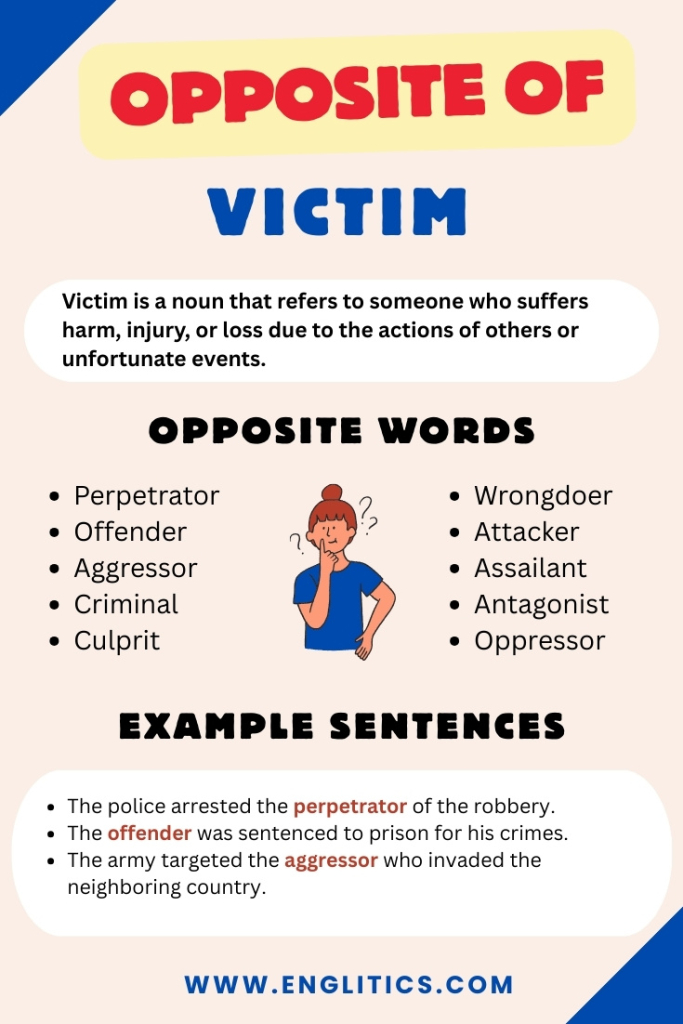
Finding direct antonyms for “victim” is challenging because the word encompasses a complex set of experiences. Instead, we can identify words that represent roles or states that contrast with the helplessness and suffering associated with victimhood.
Here are some key categories:
Perpetrator
The perpetrator is the individual or entity that inflicts harm on the victim. This is perhaps the most direct antonym, representing the active agent of the negative action. The perpetrator is the cause of the victim’s suffering.
Survivor
A survivor is someone who has endured a traumatic experience and lived through it. This term emphasizes resilience and the ability to overcome adversity. While a survivor may have been a victim initially, the term highlights their strength and ability to move forward.
Rescuer
The rescuer is the person who saves the victim from harm or danger. This term highlights the act of intervention and protection. The rescuer actively prevents the victim from experiencing further suffering.
Beneficiary
A beneficiary is someone who gains an advantage or benefit from a situation, often while others are harmed. While not a direct antonym in all contexts, it represents someone who profits from circumstances that create victims.
Victor
A victor is someone who wins or triumphs over an opponent or challenge. This term signifies success and overcoming adversity, contrasting with the defeat and helplessness of a victim. The victor actively overcomes obstacles.
Thriver
A thriver is someone who not only survives but also flourishes and grows stronger after a challenging experience. This term emphasizes personal growth and resilience beyond mere survival. A thriver transforms adversity into an opportunity for positive change.
Agent
An agent is someone who acts on their own behalf and has control over their own actions and destiny. This term emphasizes the individual’s capacity to make choices and shape their own life, in contrast to the victim’s lack of agency. The agent is proactive and self-directed.
Examples of Antonyms in Use
Understanding the nuances of these antonyms requires seeing them in context. The following examples illustrate how each word can be used in sentences to contrast with the concept of “victim.”
Perpetrator Examples
The perpetrator is the one who caused the harm, the direct opposite of the victim in terms of action. Here are examples:
The following table contains 30 examples of sentences using “perpetrator” to contrast with the concept of “victim.”
| # | Sentence |
|---|---|
| 1 | The police apprehended the perpetrator of the crime. |
| 2 | The perpetrator was brought to justice after a long trial. |
| 3 | Identifying the perpetrator is the first step in solving the case. |
| 4 | The perpetrator’s motives remained unclear. |
| 5 | Witnesses described the perpetrator to the authorities. |
| 6 | The perpetrator acted alone, according to the investigation. |
| 7 | The perpetrator showed no remorse for their actions. |
| 8 | The perpetrator’s identity was initially unknown. |
| 9 | The court sentenced the perpetrator to a lengthy prison term. |
| 10 | The perpetrator had a history of similar offenses. |
| 11 | The news focused on the perpetrator and their background. |
| 12 | Investigators sought to understand the perpetrator’s mindset. |
| 13 | The perpetrator attempted to evade capture. |
| 14 | The perpetrator’s actions had devastating consequences. |
| 15 | The perpetrator was eventually caught and charged. |
| 16 | The community demanded justice for the perpetrator’s crimes. |
| 17 | The perpetrator’s lawyer argued for a lesser sentence. |
| 18 | The perpetrator was found guilty on all counts. |
| 19 | The perpetrator’s family expressed shock and disbelief. |
| 20 | The perpetrator was a known figure in the criminal underworld. |
| 21 | Forensic evidence linked the perpetrator to the scene. |
| 22 | The perpetrator planned the crime meticulously. |
| 23 | The perpetrator’s behavior was erratic leading up to the event. |
| 24 | The perpetrator confessed to the crime. |
| 25 | The perpetrator showed no empathy for the victim. |
| 26 | The perpetrator was motivated by greed. |
| 27 | The perpetrator’s actions caused widespread fear. |
| 28 | The perpetrator was a danger to society. |
| 29 | The perpetrator was finally brought to justice. |
| 30 | The perpetrator’s name will forever be associated with the crime. |
Survivor Examples
The survivor embodies resilience and overcoming adversity. Here are examples:
The following table contains 30 examples of sentences using “survivor” to contrast with the concept of “victim.”
| # | Sentence |
|---|---|
| 1 | The survivor shared their story of hope and resilience. |
| 2 | She is a survivor of domestic violence. |
| 3 | The survivors of the earthquake received aid from around the world. |
| 4 | He considers himself a survivor after battling cancer. |
| 5 | The survivor’s strength inspired others. |
| 6 | The support group helped the survivors cope with their trauma. |
| 7 | The survivor emerged stronger from the experience. |
| 8 | The survivor refused to be defined by their past. |
| 9 | The survivor dedicated their life to helping others. |
| 10 | The survivor testified in court. |
| 11 | The survivor wrote a book about their ordeal. |
| 12 | The survivor became an advocate for change. |
| 13 | The survivor found peace through therapy. |
| 14 | The survivor’s story is a testament to the human spirit. |
| 15 | The survivor rebuilt their life from scratch. |
| 16 | The survivor learned to forgive. |
| 17 | The survivor embraced their new reality. |
| 18 | The survivor discovered their inner strength. |
| 19 | The survivor found meaning in their suffering. |
| 20 | The survivor became a beacon of hope. |
| 21 | The survivor refused to give up. |
| 22 | The survivor channeled their pain into purpose. |
| 23 | The survivor found solace in community. |
| 24 | The survivor’s resilience is admirable. |
| 25 | The survivor moved forward with courage. |
| 26 | The survivor learned to love again. |
| 27 | The survivor found joy in everyday moments. |
| 28 | The survivor’s journey is inspiring. |
| 29 | The survivor is a true hero. |
| 30 | The survivor embodies the power of the human spirit. |
Rescuer Examples
The rescuer is someone who actively saves a victim from harm. Here are examples:
The following table contains 30 examples of sentences using “rescuer” to contrast with the concept of “victim.”
| # | Sentence |
|---|---|
| 1 | The firefighter acted as the rescuer, pulling people from the burning building. |
| 2 | The rescuer’s bravery saved many lives. |
| 3 | The lifeguard was a rescuer, pulling the swimmer to safety. |
| 4 | The rescuer risked their own life to help others. |
| 5 | The community hailed the rescuer as a hero. |
| 6 | The rescuer provided first aid to the injured. |
| 7 | The rescuer worked tirelessly to find the missing child. |
| 8 | The rescuer was trained in emergency response. |
| 9 | The rescuer acted quickly and decisively. |
| 10 | The rescuer‘s actions prevented a tragedy. |
| 11 | The rescuer received an award for their heroism. |
| 12 | The rescuer inspired others to act. |
| 13 | The rescuer was a volunteer firefighter. |
| 14 | The rescuer used their skills to save lives. |
| 15 | The rescuer was a true embodiment of selflessness. |
| 16 | The rescuer‘s courage was remarkable. |
| 17 | The rescuer was a neighbor who stepped in to help. |
| 18 | The rescuer acted instinctively. |
| 19 | The rescuer was a trained medical professional. |
| 20 | The rescuer‘s quick thinking saved the day. |
| 21 | The rescuer was a member of the search and rescue team. |
| 22 | The rescuer used specialized equipment to reach the victim. |
| 23 | The rescuer worked in challenging conditions. |
| 24 | The rescuer’s efforts were crucial to the success of the mission. |
| 25 | The rescuer was a first responder. |
| 26 | The rescuer provided comfort to the victim. |
| 27 | The rescuer‘s dedication was unwavering. |
| 28 | The rescuer was a true hero in the eyes of the community. |
| 29 | The rescuer‘s actions demonstrated extraordinary bravery. |
| 30 | The rescuer was honored for their courageous act. |
Beneficiary Examples
The beneficiary gains from a situation, sometimes at the expense of others. Here are examples:
The following table contains 30 examples of sentences using “beneficiary” to contrast with the concept of “victim.”
| # | Sentence |
|---|---|
| 1 | The company was the beneficiary of the economic downturn. |
| 2 | She was the beneficiary of her grandfather’s will. |
| 3 | The charity is the beneficiary of the fundraising event. |
| 4 | He became the beneficiary of the insurance policy. |
| 5 | The project’s beneficiaries are the local residents. |
| 6 | The beneficiary received a large inheritance. |
| 7 | The program’s beneficiaries are low-income families. |
| 8 | The beneficiary was grateful for the unexpected windfall. |
| 9 | The beneficiaries of the new law are small businesses. |
| 10 | The beneficiary used the money wisely. |
| 11 | The beneficiary was a close friend of the deceased. |
| 12 | The beneficiaries of the grant are local schools. |
| 13 | The beneficiary was surprised by the generosity. |
| 14 | The beneficiaries of the scholarship are talented students. |
| 15 | The beneficiary invested the money in their future. |
| 16 | The beneficiaries of the new policy are homeowners. |
| 17 | The beneficiary felt a sense of responsibility. |
| 18 | The beneficiaries of the program are unemployed workers. |
| 19 | The beneficiary donated a portion of the inheritance to charity. |
| 20 | The beneficiaries of the project are the entire community. |
| 21 | The beneficiary used the funds to start a business. |
| 22 | The beneficiaries of the research are future generations. |
| 23 | The beneficiary was humbled by the opportunity. |
| 24 | The beneficiaries of the new technology are consumers. |
| 25 | The beneficiary made the most of the situation. |
| 26 | The beneficiaries of the environmental policy are the planet and its inhabitants. |
| 27 | The company became the beneficiary of a competitor’s failure. |
| 28 | The beneficiary was able to achieve their dreams. |
| 29 | The beneficiaries of the peace treaty are the two nations involved. |
| 30 | The beneficiary expressed their gratitude to all those who made it possible. |
Victor Examples
The victor is someone who achieves victory and triumphs. Here are examples:
The following table contains 30 examples of sentences using “victor” to contrast with the concept of “victim.”
| # | Sentence |
|---|---|
| 1 | The victor of the competition was crowned with glory. |
| 2 | The victor celebrated their hard-earned victory. |
| 3 | The team emerged as the victor after a grueling season. |
| 4 | The victor delivered a humble speech. |
| 5 | The victor’s strategy proved to be successful. |
| 6 | The victor raised the trophy in triumph. |
| 7 | The victor was cheered by the crowd. |
| 8 | The victor had trained for years to achieve this moment. |
| 9 | The victor‘s determination was unwavering. |
| 10 | The victor dedicated their win to their supporters. |
| 11 | The victor showed grace and sportsmanship. |
| 12 | The victor‘s performance was outstanding. |
| 13 | The victor had overcome many obstacles. |
| 14 | The victor’s victory was well-deserved. |
| 15 | The victor inspired others to pursue their dreams. |
| 16 | The victor‘s name will be remembered for years to come. |
| 17 | The victor remained humble despite their success. |
| 18 | The victor dedicated their life to their craft. |
| 19 | The victor‘s journey was filled with challenges. |
| 20 | The victor never gave up on their goals. |
| 21 | The victor demonstrated exceptional skill and talent. |
| 22 | The victor’s hard work paid off. |
| 23 | The victor served as an example to aspiring athletes. |
| 24 | The victor’s victory was celebrated worldwide. |
| 25 | The victor maintained their composure under pressure. |
| 26 | The victor consistently pushed their limits. |
| 27 | The victor’s achievement was extraordinary. |
| 28 | The victor received a hero’s welcome. |
| 29 | The victor‘s humility was admirable. |
| 30 | The victor‘s legacy will endure for generations. |
Thriver Examples
The thriver not only survives but flourishes and grows. Here are examples:
The following table contains 30 examples of sentences using “thriver” to contrast with the concept of “victim.”
| # | Sentence |
|---|---|
| 1 | Despite the challenges, she emerged as a thriver, inspiring others. |
| 2 | He transformed from a victim to a thriver through sheer determination. |
| 3 | The organization helps individuals become thrivers by providing resources and support. |
| 4 | She is a thriver who has overcome adversity and achieved great success. |
| 5 | He learned to not only survive but to thrive in his new environment. |
| 6 | The program aims to empower individuals to become thrivers in their communities. |
| 7 | She is a thriver who has dedicated her life to helping others. |
| 8 | He is a thriver who has turned his past challenges into opportunities for growth. |
| 9 | The community is full of thrivers who are working together to build a better future. |
| 10 | She is a thriver who has overcome obstacles and achieved her dreams. |
| 11 | He became a thriver by focusing on his strengths and pursuing his passions. |
| 12 | The support system helped her transform into a thriver. |
| 13 | He’s a thriver in the business world, always innovating and adapting. |
| 14 | She’s a thriver, turning personal loss into a powerful advocacy platform. |
| 15 | Despite a difficult childhood, he became a thriver, earning advanced degrees. |
| 16 | The course is designed to help students become thrivers in their academic pursuits. |
| 17 | She’s a thriver in her career, consistently exceeding expectations. |
| 18 | He’s a thriver, always seeking new challenges and opportunities to learn. |
| 19 | The organization empowers women to become thrivers in their communities. |
| 20 | She’s a thriver, using her experiences to mentor others. |
| 21 | He is a thriver, constantly learning and improving. |
| 22 | She is a thriver, demonstrating resilience and determination. |
| 23 | He is a thriver, always looking for ways to give back to the community. |
| 24 | She is a thriver, inspiring others to reach their full potential. |
| 25 | He is a thriver, thriving in a challenging environment. |
| 26 | She is a thriver, overcoming obstacles with grace and determination. |
| 27 | He is a thriver, transforming adversity into strength. |
| 28 | She is a thriver, consistently achieving her goals. |
| 29 | He is a thriver, finding purpose and meaning in his life. |
| 30 | She is a thriver, embracing life with passion and enthusiasm. |
Agent Examples
The agent takes action and has control. Here are examples:
The following table contains 30 examples of sentences using “agent” to contrast with the concept of “victim.”
| # | Sentence |
|---|---|
| 1 | She became an agent of change in her community. |
| 2 | He acted as an agent for the company in the negotiations. |
| 3 | The government is an agent of the people. |
| 4 | She took control of her life and became an agent of her own destiny. |
| 5 | He is a real estate agent. |
| 6 | The secret agent completed the mission successfully. |
| 7 | She worked as a talent agent for aspiring actors. |
| 8 | He became an agent for positive social change. |
| 9 | She acted as an agent of reconciliation between the two groups. |
| 10 | He served as an agent of peace in the region. |
| 11 | She is an agent in the fight against climate change. |
| 12 | He became an agent for innovation in the company. |
| 13 | She is an agent pushing for policy reform. |
| 14 | He acted as an agent of transparency within the organization. |
| 15 | She became an agent of empowerment for women. |
| 16 | He is a literary agent. |
| 17 | She became the agent of her own success. |
| 18 | He acted as an agent for promoting sustainable practices. |
| 19 | She is an agent in the fight against poverty. |
| 20 | He became an agent of progress in the field. |
| 21 | She embraced her role as an agent of influence. |
| 22 | She is an agent for environmental conservation. |
| 23 | He acted as a booking agent for the band. |
| 24 | She is an agent of hope for the underprivileged. |
| 25 | He became an agent of awareness, educating the public. |
| 26 | She is an agent of transformation, helping others find their path. |
| 27 | He worked as a sports agent, representing athletes. |
| 28 | She is an agent of inspiration, motivating others to achieve greatness. |
| 29 | He acted as an agent, connecting people with resources. |
| 30 | She is an agent of change, creating a better world. |
Usage Rules and Considerations
When selecting an antonym for “victim,” consider the specific context. Each of the words discussed above carries its own connotations and is appropriate in different situations.
- Use “perpetrator” when you want to focus on the person responsible for the harm.
- Use “survivor” when you want to highlight resilience and the ability to overcome adversity.
- Use “rescuer” when you want to emphasize the act of saving someone from harm.
- Use “beneficiary” when you want to point out someone who gains an advantage, sometimes unfairly.
- Use “victor” when you want to celebrate triumph and success over challenges.
- Use “thriver” when you want to emphasize personal growth and flourishing after a difficult experience.
- Use “agent” when you want to highlight someone’s capacity to take control and shape their own life.
Be mindful of the emotional impact of your word choice. Using the wrong antonym can trivialize someone’s suffering or misrepresent their experience.
Common Mistakes
A common mistake is using “aggressor” interchangeably with “perpetrator.” While they are similar, “aggressor” implies a more direct and overt act of aggression, whereas “perpetrator” can encompass a broader range of harmful actions.
Another mistake is using “lucky” as an antonym. While a victim may have experienced bad luck, “lucky” doesn’t capture the active role or state that contrasts with victimhood.
It’s more about circumstance than agency or action.
Avoid using terms that minimize the victim’s experience, such as “complainer” or “attention-seeker.” These words are insensitive and fail to acknowledge the harm suffered.
Practice Exercises
Exercise 1: Choose the Best Antonym
Select the most appropriate antonym for “victim” in each sentence:
- The bank robbery left several people traumatized, but the police quickly apprehended the _____. (survivor, perpetrator, rescuer)
- After the devastating hurricane, the community focused on supporting the _____. (perpetrators, beneficiaries, survivors)
- The firefighter was hailed as a _____ for saving the family from the burning house. (victim, rescuer, perpetrator)
Answers: 1. perpetrator, 2. survivors, 3. rescuer
Exercise 2: Sentence Completion
Complete the following sentences using an appropriate antonym for “victim”:
- Instead of remaining a victim of circumstance, she became an _____ of her own destiny.
- While many suffered during the economic crisis, a few _____ managed to profit from the situation.
- After years of struggling with adversity, he emerged not just as a survivor, but as a _____.
Answers: 1. agent, 2. beneficiaries, 3. thriver
Advanced Topics
The concept of victimhood is complex and has been explored extensively in various fields, including psychology, sociology, and law. Understanding the psychological impact of trauma on victims is crucial for providing effective support and promoting healing.
Sociological perspectives examine the social structures and power dynamics that contribute to victimhood. This includes analyzing how certain groups are disproportionately affected by crime and violence.
In law, the rights of victims are increasingly recognized and protected. This includes the right to be informed about the progress of the case, the right to attend court proceedings, and the right to restitution.
Frequently Asked Questions
Is there a single perfect antonym for “victim”?
No, there is no single perfect antonym. The best word to use depends on the specific context and the aspect of victimhood you want to contrast.
Can someone be both a victim and an antonym of a victim at different times?
Yes, absolutely. For example, someone might be a victim of a crime but later become a rescuer, helping others who have experienced similar harm.
Why is it important to understand antonyms for “victim”?
Understanding these antonyms allows for more nuanced and accurate communication. It enables us to recognize and celebrate strength, resilience, and agency in the face of adversity.
Conclusion
Exploring antonyms for “victim” enriches our understanding of language and empowers us to express a wider range of human experiences. By recognizing the roles of perpetrators, survivors, rescuers, beneficiaries, victors, thrivers, and agents, we can move beyond simple labels and appreciate the complexities of human interaction.
This deeper understanding fosters empathy, promotes resilience, and encourages us to recognize and celebrate the strength and agency that exists even in the face of adversity. Use this knowledge to communicate more effectively and thoughtfully in all aspects of your life.