The opposite of vigilant is being careless, unaware, or not paying attention to what’s going on. While vigilant means staying alert and watchful—especially to avoid danger—its opposites describe a lack of focus or concern.
Antonyms for vigilant include words like careless, negligent, distracted, unaware, and inattentive. These words are often used when someone misses important details, overlooks risks, or fails to stay alert. In this article, you’ll find clear examples and easy explanations to help you use these opposite words correctly.
Definition of Vigilant
The word vigilant describes a state of being keenly watchful to detect danger; alertly watchful especially to avoid danger. It implies a proactive and attentive stance, ready to respond to potential threats or problems. Vigilance is often associated with responsibility, duty, and a strong sense of awareness.
In essence, to be vigilant is to be on guard, observant, and ready to act. It’s a state of heightened awareness and preparedness, often in anticipation of something negative.
The term can apply to individuals, groups, or even systems designed to maintain security and order.
Structural Breakdown of Vigilant
The word “vigilant” originates from the Latin word vigilans, which is the present participle of vigilare, meaning “to watch.” This etymological root highlights the core meaning of the word: the act of watching and remaining alert.
Structurally, “vigilant” functions primarily as an adjective. It modifies nouns, describing their characteristic of being watchful.
It can also be used adverbially in some contexts, although this is less common (e.g., “He stood vigilant”).
The word’s structure reinforces its meaning. The root “vigil” suggests watchfulness, and the suffix “-ant” indicates a state of being or doing.
Thus, “vigilant” describes someone who is actively watching.
Opposite of Vigilant
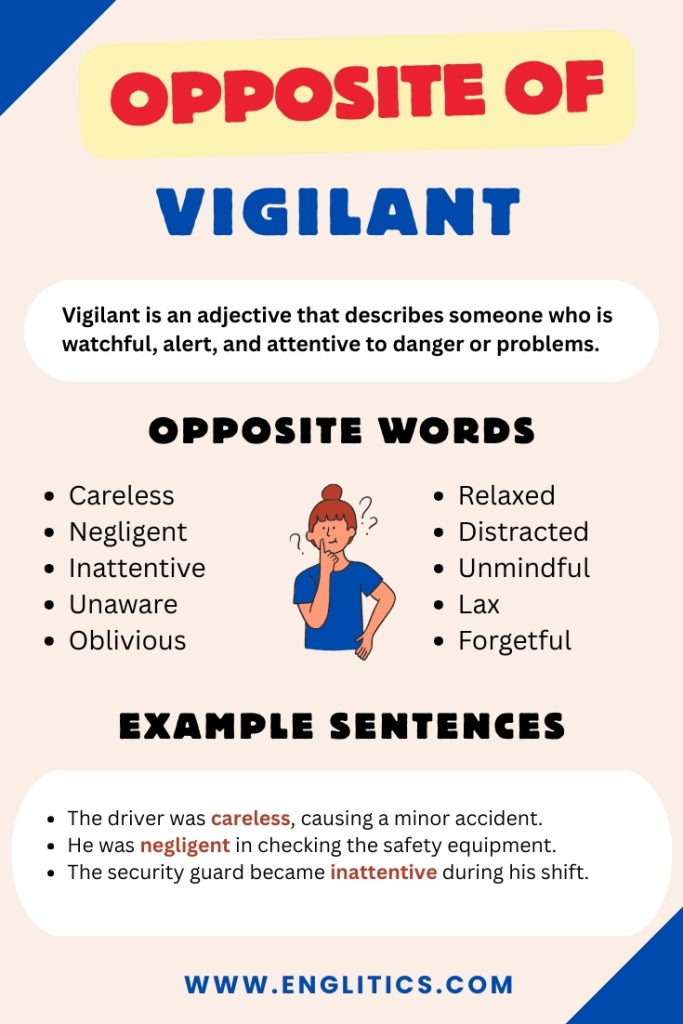
Antonyms for “vigilant” can be categorized into several types, each representing a different aspect of the opposite of watchfulness. These categories include:
1. Lack of Awareness
These antonyms describe a state of being unaware or oblivious to potential dangers or problems. Examples include: oblivious, unaware, unconscious, insensible.
2. Carelessness and Negligence
This category includes words that suggest a lack of attention or concern for potential risks. Examples include: careless, negligent, reckless, remiss, lax.
3. Inattentiveness and Distraction
These antonyms describe a state of being easily distracted or not paying attention to one’s surroundings. Examples include: inattentive, distracted, preoccupied, absent-minded.
4. Complacency and Apathy
This category includes words that suggest a feeling of self-satisfaction and a lack of concern for potential problems. Examples include: complacent, apathetic, indifferent, unconcerned.
5. Passivity and Inaction
These antonyms describe a state of being inactive or unwilling to take action, even in the face of danger. Examples include: passive, inactive, inert, languid.
Examples of Antonyms in Use
The following tables provide examples of antonyms for “vigilant” used in sentences, categorized by the types described above. These examples illustrate how the different antonyms can be used to convey various shades of meaning.
Table 1: Antonyms Representing Lack of Awareness
This table showcases antonyms that represent a lack of awareness, such as ‘oblivious’, ‘unaware’, ‘unconscious’, and ‘insensible’. Each example provides a sentence demonstrating the antonym in context, highlighting its meaning and proper usage.
| Antonym | Example Sentence |
|---|---|
| Oblivious | He was oblivious to the danger signs, walking straight into the trap. |
| Unaware | She was unaware of the approaching storm until the first raindrops fell. |
| Unconscious | The security guard was unconscious of the breach in the perimeter. |
| Insensible | He was insensible to the needs of his team, focusing only on his own goals. |
| Ignorant | The politician was ignorant of the plight of the homeless. |
| Clueless | He was completely clueless about the company’s financial problems. |
| Naive | She was naive about the dangers of the city. |
| Unsuspecting | The tourists were unsuspecting of the pickpockets in the crowd. |
| Blind | He was blind to the flaws in his own plan. |
| Deaf | She was deaf to the warnings of her friends. |
| Unmindful | He was unmindful of the consequences of his actions. |
| Absent | His mind was absent during the important meeting. |
| Vacant | His eyes were vacant, showing no sign of understanding. |
| Nescient | The child was nescient of the complexities of the adult world. |
| Uninformed | The public was uninformed about the new regulations. |
| Benighted | The villagers were benighted due to the lack of education. |
| Unenlightened | The company remained unenlightened about the latest technology. |
| Purblind | He was purblind to the suffering of others. |
| Shortsighted | Their decision was shortsighted and had negative consequences. |
| Near-sighted | He was near-sighted in his approach to the problem. |
| Myopic | The company’s vision was myopic, focusing only on short-term gains. |
| Tunnel-visioned | He was tunnel-visioned and unable to see the bigger picture. |
| Ingorant | He was ignorant of the local customs. |
| Innocent | She was innocent of any wrongdoing. |
| Artless | He was artless in his dealings with others. |
| Unsophisticated | Their approach was unsophisticated but effective. |
| Guileless | She was guileless and trusting. |
| Unworldly | He was unworldly and unfamiliar with the ways of the world. |
Table 2: Antonyms Representing Carelessness and Negligence
This table provides examples of antonyms that signify carelessness and negligence, such as ‘careless’, ‘negligent’, ‘reckless’, and ‘remiss’. Each example sentence demonstrates how these words are used to describe a lack of attention or responsibility.
| Antonym | Example Sentence |
|---|---|
| Careless | His careless driving caused the accident. |
| Negligent | The negligent parent left the child unattended. |
| Reckless | Her reckless behavior put everyone at risk. |
| Remiss | He was remiss in his duties, failing to complete the assigned tasks. |
| Lax | The security was lax, allowing unauthorized access to the building. |
| Slack | He was slack in his work performance. |
| Slipshod | The work was done in a slipshod manner. |
| Sloppy | His work was sloppy and full of errors. |
| Indifferent | He was indifferent to the suffering of the animals. |
| Nonchalant | She was nonchalant about the test results. |
| Offhand | He gave an offhand response to the important question. |
| Casual | His attitude was too casual for the serious situation. |
| Perfunctory | He gave a perfunctory greeting as he walked by. |
| Cursory | He gave the report a cursory glance. |
| Hasty | His hasty decision led to problems. |
| Rash | It was a rash decision to quit his job. |
| Imprudent | It was imprudent to invest all his money in one stock. |
| Unthinking | His unthinking remarks hurt her feelings. |
| Heedless | He was heedless of the warnings. |
| Inconsiderate | It was inconsiderate of him to talk during the movie. |
| Thoughtless | Her thoughtless actions caused a lot of trouble. |
| Forgetful | He was forgetful and often misplaced his keys. |
| Unmindful | She was unmindful of the needs of others. |
| Heedless | He was heedless of the danger. |
| Inadvertent | It was an inadvertent mistake. |
| Accidental | The damage was accidental. |
| Unintentional | The insult was unintentional. |
| Unwitting | He was an unwitting accomplice. |
Table 3: Antonyms Representing Inattentiveness and Distraction
This table illustrates antonyms representing inattentiveness and distraction, such as ‘inattentive’, ‘distracted’, ‘preoccupied’, and ‘absent-minded’. The example sentences show how these words describe a lack of focus and concentration.
| Antonym | Example Sentence |
|---|---|
| Inattentive | The inattentive student failed the exam. |
| Distracted | She was distracted by the noise outside. |
| Preoccupied | He was preoccupied with his own thoughts and didn’t notice her enter. |
| Absent-minded | The absent-minded professor forgot his keys again. |
| Scatterbrained | She was scatterbrained and often lost things. |
| Forgetful | He was becoming increasingly forgetful in his old age. |
| Daydreaming | She was daydreaming instead of paying attention to the lecture. |
| Dreamy | He had a dreamy look in his eyes. |
| Lost in thought | He was lost in thought and didn’t hear me call his name. |
| Unfocused | He was unfocused and unable to complete the task. |
| Wandering | His mind was wandering during the meeting. |
| Rambling | His thoughts were rambling and difficult to follow. |
| Digressive | His speech was digressive and went off on tangents. |
| Desultory | His efforts were desultory and lacked direction. |
| Fitful | He had a fitful sleep. |
| Sporadic | Her attendance was sporadic. |
| Intermittent | There was intermittent rain throughout the day. |
| Irregular | His heartbeat was irregular. |
| Chaotic | The office was chaotic. |
| Disorganized | His desk was disorganized. |
| Muddled | His thoughts were muddled. |
| Confused | He was confused by the instructions. |
| Bewildered | She was bewildered by the sudden change of plans. |
| Perplexed | He was perplexed by the complex problem. |
| Puzzled | She was puzzled by his strange behavior. |
Table 4: Antonyms Representing Complacency and Apathy
This table presents antonyms that represent complacency and apathy, such as ‘complacent’, ‘apathetic’, ‘indifferent’, and ‘unconcerned’. The example sentences demonstrate how these words describe a lack of motivation and interest.
| Antonym | Example Sentence |
|---|---|
| Complacent | The team became complacent after their early success. |
| Apathetic | The voters were apathetic and didn’t bother to vote. |
| Indifferent | He was indifferent to the suffering of others. |
| Unconcerned | She seemed unconcerned about the potential consequences. |
| Lackadaisical | His lackadaisical attitude annoyed his boss. |
| Listless | He was listless and had no energy. |
| Lethargic | She felt lethargic and didn’t want to get out of bed. |
| Enervated | The heat made him feel enervated. |
| Torpid | The snake was torpid in the cold. |
| Stolid | He maintained a stolid expression. |
| Impassive | She was impassive during the trial. |
| Expressionless | His face was expressionless. |
| Emotionless | He seemed emotionless. |
| Phlegmatic | He had a phlegmatic temperament. |
| Dull | The meeting was dull and uninteresting. |
| Monotonous | The job was monotonous. |
| Tedious | The task was tedious. |
| Wearisome | The journey was wearisome. |
| Tiresome | His constant complaining was tiresome. |
| Boring | The movie was boring. |
| Humdrum | Life had become humdrum. |
| Mundane | The tasks were mundane. |
| Prosaic | His writing was prosaic. |
| Uninspired | The performance was uninspired. |
| Spiritless | He gave a spiritless performance. |
Table 5: Antonyms Representing Passivity and Inaction
This table provides examples of antonyms that signify passivity and inaction, such as ‘passive’, ‘inactive’, ‘inert’, and ‘languid’. The example sentences demonstrate how these words describe a lack of activity and initiative.
| Antonym | Example Sentence |
|---|---|
| Passive | He took a passive role in the discussion. |
| Inactive | The volcano had been inactive for centuries. |
| Inert | The body lay inert on the floor. |
| Languid | She moved with a languid grace. |
| Sluggish | The economy was sluggish. |
| Dormant | The seeds remained dormant until the spring. |
| Quiescent | The city was quiescent at night. |
| Still | The water was still and calm. |
| Motionless | He stood motionless. |
| Static | The population remained static. |
| Fixed | His gaze was fixed on the horizon. |
| Immobile | The patient was immobile after the accident. |
| Paralyzed | He was paralyzed with fear. |
| Frozen | He was frozen in place. |
| Petrified | She was petrified by the sight of the snake. |
| Stagnant | The water in the pond was stagnant. |
| Torpid | The economy was torpid. |
| Vegetative | The patient was in a vegetative state. |
| Idle | He was idle and did nothing all day. |
| Unemployed | He was unemployed and looking for work. |
| Out of work | She was out of work after the company closed. |
| Workless | The town was workless after the factory shut down. |
| Resting | He was resting after a long day. |
| Relaxing | She was relaxing on the beach. |
| Leisured | He lived a leisured life. |
Usage Rules for Antonyms of Vigilant
The correct usage of antonyms for “vigilant” depends on the specific context and the intended meaning. Here are some general rules to consider:
- Choose the antonym that best reflects the specific aspect of lacking vigilance. For example, if you want to emphasize a lack of awareness, use “unaware” or “oblivious.” If you want to emphasize carelessness, use “careless” or “negligent.”
- Consider the connotations of the antonym. Some antonyms may have negative connotations, while others may be more neutral. Choose the word that aligns with the overall tone of your writing.
- Pay attention to the grammatical context. Ensure that the antonym fits grammatically within the sentence. For example, if “vigilant” is used as an adjective, its antonym should also be an adjective.
It is also important to understand that the degree of opposition can vary. Some antonyms are direct opposites, while others represent a weaker contrast.
For example, “careless” is a stronger antonym than “inattentive” in some contexts.
Careful consideration of these nuances will help you choose the most appropriate antonym and effectively communicate your intended meaning.
Common Mistakes When Using Antonyms of Vigilant
One common mistake is using an antonym that doesn’t quite capture the intended meaning. For example, using “lazy” when you really mean “inattentive.” Here are some examples of common mistakes and their corrections:
| Incorrect | Correct | Explanation |
|---|---|---|
| The security guard was lazy and didn’t notice the intruder. | The security guard was inattentive and didn’t notice the intruder. | “Inattentive” is more accurate because it describes a lack of watchfulness, while “lazy” implies a lack of effort. |
| She was relaxed about the potential dangers. | She was complacent about the potential dangers. | “Complacent” suggests a sense of self-satisfaction and a lack of concern, which is a more precise antonym for “vigilant” in this context. |
| He was quiet to the risks involved. | He was oblivious to the risks involved. | “Oblivious” means unaware or unconscious of surroundings, and is more applicable. |
| The system was slow in detecting the threat. | The system was negligent in detecting the threat. | “Negligent” means failure to take proper care in doing something, and is more applicable. |
| She was still to the concerns of her teammates. | She was indifferent to the concerns of her teammates. | “Indifferent” means having no particular interest or sympathy, and is more applicable. |
Another common mistake is using an antonym that is grammatically incorrect. For example, using an adjective when an adverb is required.
Always double-check the grammatical structure of your sentence to ensure that the antonym fits correctly.
Practice Exercises
Test your understanding of the antonyms of “vigilant” with these practice exercises. Choose the best antonym for “vigilant” to complete each sentence.
Exercise 1: Multiple Choice
Choose the best antonym for ‘vigilant’ in each sentence.
| Question | Options | Answer |
|---|---|---|
| 1. The cat was ________, sleeping soundly while the mouse ran by. | (a) vigilant (b) inattentive (c) alert (d) watchful | (b) inattentive |
| 2. Due to the ________ security measures, the thief easily gained access to the building. | (a) strict (b) lax (c) careful (d) attentive | (b) lax |
| 3. He was ________ to the needs of his employees, focusing only on profits. | (a) sensitive (b) aware (c) indifferent (d) responsive | (c) indifferent |
| 4. The driver was ________, causing a collision with another car. | (a) alert (b) careful (c) reckless (d) attentive | (c) reckless |
| 5. The guard was ________ of the danger, standing idly by as the situation escalated. | (a) cognizant (b) aware (c) oblivious (d) mindful | (c) oblivious |
| 6. The government was ________ in enforcing the new regulations. | (a) diligent (b) remiss (c) assiduous (d) conscientious | (b) remiss |
| 7. She was ________ about her health, ignoring all the warning signs. | (a) concerned (b) watchful (c) unconcerned (d) attentive | (c) unconcerned |
| 8. He was so ________ in his work that he didn’t notice the time passing. | (a) distracted (b) focused (c) engrossed (d) absorbed | (a) distracted |
| 9. The dog was ________, sleeping peacefully despite the loud noises outside. | (a) alert (b) watchful (c) passive (d) vigilant | (c) passive |
| 10. The company became ________ after years of success, leading to a decline in performance. | (a) proactive (b) vigilant (c) complacent (d) attentive | (c) complacent |
Exercise 2: Fill in the Blanks
Fill in the blanks with the most appropriate antonym of ‘vigilant’.
| Question | Answer |
|---|---|
| 1. The ________ student failed to notice the important announcement. | inattentive |
| 2. Due to ________ security, the valuable painting was stolen. | lax |
| 3. He was ________ to the feelings of his colleagues, causing them to feel unappreciated. | indifferent |
| 4. Her ________ driving resulted in a serious accident. | reckless |
| 5. The soldier was ________ of the enemy’s presence, leading to a surprise attack. | oblivious |
| 6. The manager was ________ in addressing the complaints of the customers. | remiss |
| 7. She was ________ about the potential risks of the investment. | unconcerned |
| 8. He was ________ by the noise and couldn’t concentrate on his work. | distracted |
| 9. The security system was ________, failing to detect the intrusion. | passive |
| 10. The company became ________ and stopped innovating, losing its competitive edge. | complacent |
Exercise 3: Sentence Completion
Complete each sentence using an antonym of ‘vigilant’ that makes sense in the context.
| Question | Answer |
|---|---|
| 1. Unlike the hawk, which is always vigilant, the field mouse is often ________ and easily caught by predators. | unaware |
| 2. The company’s profits declined because its management became ________ and failed to adapt to changing market conditions. | complacent |
| 3. Despite the warnings, he remained ________ to the dangers of swimming alone in the ocean. | oblivious |
| 4. The accident was caused by the driver’s ________ disregard for traffic laws. | reckless |
| 5. The teacher was ________ in grading the assignments, resulting in several errors. | remiss |
| 6. Because she was ________, she didn’t notice the pickpocket stealing her wallet. | distracted |
| 7. The ________ security guard slept through his shift, allowing the burglars to enter undetected. | inattentive |
| 8. The team’s ________ performance in the final match cost them the championship. | passive |
| 9. The government’s ________ response to the crisis angered many citizens. | indifferent |
| 10. Because of the ________ border control, illegal immigrants were able to cross into the country undetected. | lax |
Advanced Topics: Nuances in Meaning
The choice of antonym for “vigilant” often depends on subtle nuances in meaning. For example, “careless” implies a lack of attention due to negligence, while “oblivious” suggests a complete lack of awareness, regardless of the reason.
Understanding these subtle differences is crucial for precise communication.
Furthermore, the context in which the word is used can also influence the choice of antonym. For instance, in a formal setting, “negligent” might be more appropriate than “careless.” In a more informal setting, “clueless” or “oblivious” might be suitable.
Exploring synonyms and related terms can also enhance your understanding of the nuances of meaning. For example, consider the relationship between “complacent” and “smug.” While both words suggest a sense of self-satisfaction, “smug” implies a more arrogant and self-righteous attitude.
Frequently Asked Questions
Here are some frequently asked questions about antonyms for “vigilant”:
- What is the best antonym for “vigilant” in general?There isn’t a single “best” antonym, as the most appropriate choice depends on the specific context. However, “inattentive” and “careless” are often good starting points.
- How do I choose the right antonym for “vigilant”?Consider the specific aspect of lacking vigilance that you want to emphasize. Are you focusing on a lack of awareness, carelessness, inattentiveness, complacency, or passivity? Choose the antonym that best reflects that aspect.
- Are there any antonyms for “vigilant” that have negative connotations?Yes, many antonyms for “vigilant” have negative connotations, such as “negligent,” “reckless,” and “apathetic.” Be mindful of these connotations when choosing an antonym.
- Can “vigilant” have positive connotations?Yes, “vigilant” can have positive connotations, as it suggests responsibility, duty, and a strong sense of awareness. However, it can also imply a sense of paranoia or excessive caution in some contexts.
- Is there a difference between “unaware” and “oblivious”?“Unaware” simply means not knowing about something, while “oblivious” suggests a complete lack of awareness, often to the point of being unaware of one’s surroundings. “Oblivious” is stronger than “unaware.”
- What is the difference between “careless” and “negligent”?“Careless” implies a lack of attention, while “negligent” suggests a failure to take reasonable care, often resulting in harm or
damage. “Negligent” is a more serious charge than “careless.”
- Are “relaxed” and “vigilant” antonyms?While “relaxed” can be an antonym for “vigilant,” it depends on the context. If “vigilant” implies excessive tension or anxiety, then “relaxed” can be a suitable antonym. However, if “vigilant” simply means watchful and attentive, then “relaxed” may not be the best choice.
- Is “trusting” an antonym for “vigilant”?In some contexts, yes. If “vigilant” implies suspicion or distrust, then “trusting” can be an antonym. However, it’s important to consider the specific nuances of the situation. A healthy level of vigilance doesn’t necessarily preclude trust.
- How can I improve my understanding of antonyms in general?Read widely, pay attention to the context in which words are used, and use a thesaurus to explore synonyms and antonyms. Practice using new words in your writing and speaking.
- Are there online resources that can help me find antonyms?Yes, many online dictionaries and thesauruses can help you find antonyms. Some popular options include Merriam-Webster, Thesaurus.com, and Oxford Dictionaries.
Conclusion
Mastering the antonyms of “vigilant” is a valuable step towards enhancing your English vocabulary and improving your communication skills. By understanding the nuances of words like “inattentive,” “careless,” “oblivious,” “complacent,” and “passive,” you can express yourself with greater precision and clarity.
Remember to consider the specific context, connotations, and grammatical structure when choosing an antonym. Practice using these words in your writing and speaking to solidify your understanding.
With consistent effort, you can expand your vocabulary and communicate more effectively.