In today’s world, communication is everything. Whether you’re giving a presentation, chatting with a friend, or attending a job interview, good communication skills can make a big difference. That’s why practicing dialogues about communication skills is so valuable for English learners.
A conversation between two friends about communication skills helps students build speaking fluency, understand natural English expressions, and explore ways to express thoughts clearly and confidently. This type of role-play dialogue allows learners to develop both their listening and speaking skills, while exploring how people really talk in everyday situations.
In this article, we’ll explore a lively dialogue between two friends discussing how to improve their communication. You’ll learn useful phrases, vocabulary, and tips to make your own conversations sound natural and effective in English.
Key Vocabulary and Phrases
Phrases Commonly Used by Friend A (the one giving advice)
| Phrase | Meaning |
|---|---|
| “You’re actually pretty good at expressing yourself.” | Giving encouragement and feedback |
| “Just be confident when you speak.” | Advising someone to trust their communication abilities |
| “Try to maintain eye contact.” | Giving a practical tip for body language and interaction |
| “It’s okay to pause and think.” | Reassuring that hesitation is natural |
| “You could try joining a speaking club.” | Suggesting ways to improve communication skills |
Phrases Commonly Used by Friend B (the one asking for help)
| Phrase | Meaning |
|---|---|
| “I get nervous when I talk to people.” | Expressing anxiety or fear in conversation |
| “I don’t know what to say sometimes.” | Sharing difficulty with spontaneous speaking |
| “Do you have any tips for me?” | Asking for advice |
| “I want to improve my speaking skills.” | Stating a goal or intention |
| “It’s hard to speak fluently under pressure.” | Describing a challenge related to communication |
Bonus Vocabulary (Topic-Related Terms)
- Fluency – The ability to speak smoothly and without hesitation
- Body language – Non-verbal communication through gestures and posture
- Confidence – Belief in your ability to do something well
- Eye contact – Looking into someone’s eyes when talking
- Public speaking – Talking in front of a group of people
- Listening skills – The ability to actively pay attention to what others say
- Tone of voice – The way your voice sounds when speaking (friendly, nervous, etc.)
Sample Conversation between Two Friends about Communication Skills
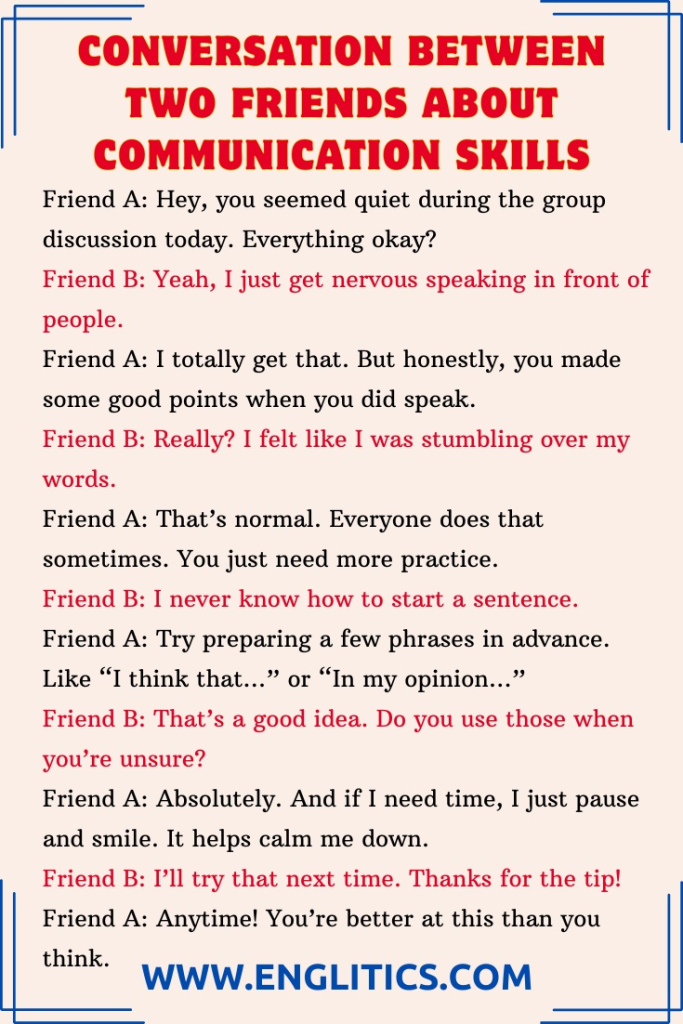
Dialogue 1: Discussing Nervousness in Speaking
Friend A: Hey, you seemed quiet during the group discussion today. Everything okay?
Friend B: Yeah, I just get nervous speaking in front of people.
Friend A: I totally get that. But honestly, you made some good points when you did speak.
Friend B: Really? I felt like I was stumbling over my words.
Friend A: That’s normal. Everyone does that sometimes. You just need more practice.
Friend B: I never know how to start a sentence.
Friend A: Try preparing a few phrases in advance. Like “I think that…” or “In my opinion…”
Friend B: That’s a good idea. Do you use those when you’re unsure?
Friend A: Absolutely. And if I need time, I just pause and smile. It helps calm me down.
Friend B: I’ll try that next time. Thanks for the tip!
Friend A: Anytime! You’re better at this than you think.
Dialogue 2: Helping a Friend Prepare for a Presentation
Friend B: I have to give a short talk in class tomorrow. I’m terrified!
Friend A: What’s the topic?
Friend B: Communication barriers in relationships.
Friend A: That’s interesting. Want to practice with me?
Friend B: Would you? That would help so much.
Friend A: Sure! Let’s start with your opening. What’s your first line?
Friend B: “Good morning, everyone. Today, I’ll be talking about…”
Friend A: That’s a great start. Just remember to speak slowly and clearly.
Friend B: I always rush through it because I’m nervous.
Friend A: Take deep breaths. And remember: the audience wants you to do well.
Friend B: Thanks! You’re really calming me down.
Friend A: You’ll do great. Just picture it as a conversation.
Dialogue 3: Talking About Improving English Speaking
Friend A: Hey, how’s your English class going?
Friend B: It’s okay. I understand grammar, but speaking is hard for me.
Friend A: Why’s that?
Friend B: I think too much before I speak. I’m afraid of making mistakes.
Friend A: Everyone makes mistakes. That’s how we learn.
Friend B: True. But sometimes I can’t find the right words.
Friend A: Try listening to English podcasts or YouTube videos. It helps with vocabulary and flow.
Friend B: That’s smart. Do you have any channel recommendations?
Friend A: Yeah, I like “Speak English with Emma” and “BBC Learning English.”
Friend B: I’ll check those out. I really want to speak fluently one day.
Friend A: You will. Just keep practicing every day.
Dialogue 4: After a Speaking Workshop
Friend B: That workshop today was intense!
Friend A: Yeah, but it was super helpful. I loved the part about tone of voice.
Friend B: Me too. I didn’t realize how monotone I sound sometimes.
Friend A: Same here. I’m going to start practicing with more emotion.
Friend B: And body language! Did you notice how much it matters?
Friend A: Totally. Standing tall and making eye contact really changes how people see you.
Friend B: I need to work on that. I always look down when I speak.
Friend A: Start small. Try practicing in the mirror.
Friend B: That’s a good idea. Want to practice together tomorrow?
Friend A: Sure thing. Let’s keep building our skills.
Friend B: Deal!
Dialogue 5: Talking About a Speaking Club
Friend A: Guess what? I joined a speaking club last week!
Friend B: Really? That sounds scary but interesting.
Friend A: I thought it would be terrifying, but it’s actually fun.
Friend B: What do you guys do?
Friend A: We meet once a week and practice short talks or debates.
Friend B: Sounds like a good way to build confidence.
Friend A: Definitely. You should join. They’re really welcoming.
Friend B: I don’t know… What if I mess up?
Friend A: No one cares. Everyone is learning. That’s the best part.
Friend B: Okay, maybe I’ll come with you next time.
Friend A: Awesome! You’ll love it.
Dialogue Writing Tips
Writing effective dialogues in English is one of the best ways to improve fluency, grammar, and real-world communication. Whether you’re chatting about daily life or deep topics like confidence and personal growth, great dialogue should sound natural, friendly, and realistic.
Here are 6 simple tips to help you write better English dialogues between friends:
1. Start with a Clear Setting
Before writing your conversation, decide:
- Where is the dialogue happening? (At a café? During a walk?)
- What’s the topic or problem? (Fear of public speaking? Asking for help?)
- What’s the goal of the conversation? (To encourage? To give tips?)
Example:
Two friends are sitting in the library after class. One is nervous about an upcoming English presentation.
2. Use Natural, Everyday Language
Skip the textbook style. Write like people actually talk in casual settings.
| Instead of… | Try saying… |
|---|---|
| “I am unable to speak fluently.” | “I have trouble speaking fluently.” |
| “Kindly provide me with guidance.” | “Do you have any tips for me?” |
Pro Tip: Listen to real conversations or watch English shows. Notice how people use simple, clear phrases.
3. Keep the Tone Friendly and Relaxed
Friends usually talk in a casual, relaxed way. Use contractions (like I’m, you’ll, don’t) and add a warm tone.
Example:
❌ “I find your advice extremely useful.”
✅ “That’s really helpful—thanks a lot!”
Let your characters sound like real friends.
4. Give the Dialogue a Clear Flow
Every good conversation has three parts:
- Beginning – Greeting, setting, or problem
- Middle – Main discussion, questions, and advice
- End – Resolution or plan
Example:
• “Hey, can we talk about something?”
• “Sure. What’s on your mind?”
• “I’m nervous about public speaking. Got any advice?”
5. Use Topic-Related Vocabulary
Include relevant words like:
- confidence, nervous, tone, fluency, gestures, feedback, listening skills, anxiety
Example Sentences:
- “I lose confidence when too many people are watching.”
- “Using gestures makes you seem more confident.”
This helps learners build vocabulary and understand key expressions.
6. Add Emotion and Personality
Great dialogue shows how people feel—nervous, excited, unsure, curious. Use short emotional responses, like:
- “Wow, really?”
- “I totally get that.”
- “That sounds tough.”
- “You’ll be amazing!”
Emotion makes your dialogue sound human and relatable.
Practice Exercises
Exercise 1: Fill in the Blanks
Use the word bank to complete the sentences below:
Word Bank: (confidence, nervous, advice, practice, fluently, conversation, gestures, eye contact, tone, speak)
- I always feel __________ before presentations.
- You need more __________ if you want to sound natural.
- Good speakers use their hands and __________ when talking.
- I want to __________ English more __________.
- Making __________ helps your listener feel connected.
- Can you give me some __________ on how to improve?
- His __________ was friendly and calm—it made a big difference.
- I lost my __________ when everyone stared at me.
- We had a great __________ about public speaking.
- Just relax and __________ like you’re talking to a friend.
Answer Key:
- nervous
- practice
- gestures
- speak, fluently
- eye contact
- advice
- tone
- confidence
- conversation
- speak
Exercise 2: Sentence Rewriting
Rewrite these sentences in natural, friendly English:
- “I am very bad at communication.”
- “Please inform me how to improve speaking.”
- “My tone was acceptable, correct?”
- “I always commit errors while talking.”
- “Your guidance will be appreciated.”
- “It is difficult to engage in fluent dialogue.”
- “I shall avoid public speaking.”
- “Kindly suggest some techniques.”
- “I find it hard to express myself vocally.”
- “Could you assist in this regard?”
Sample Rewritten Answers:
- “I’m not great at communication.”
- “Can you tell me how to improve my speaking?”
- “Was my tone okay?”
- “I always mess up when I talk.”
- “Thanks, your tips would really help.”
- “It’s hard to have a fluent conversation.”
- “I think I’ll avoid public speaking.”
- “Got any tips you can share?”
- “It’s tough for me to speak clearly.”
- “Could you help me with this?”
Exercise 3: Multiple Choice Questions
Choose the best response:
- “I always feel nervous before I speak.”
a) You should stay quiet.
b) That’s normal. Want some tips?
c) Why are you so scared? - “What can I do to improve my speaking?”
a) Stop talking.
b) Just practice every day.
c) Try not to speak in public. - “I keep forgetting what to say.”
a) Plan a few phrases before you speak.
b) You don’t need to talk.
c) That’s just bad memory. - “Do gestures really help?”
a) Not at all.
b) Definitely—they make you look confident.
c) Only if you sing. - “I don’t like speaking in big groups.”
a) Then don’t go out.
b) You’ll get used to it with time.
c) Hide behind someone.
Answer Key:
- b
- b
- a
- b
- b
Exercise 4: Dialogue Building
Complete each short conversation naturally:
- A: “You looked nervous during your speech.”
B: “_______________________________”
A: “You still did a great job!” - A: “I want to improve my English speaking.”
B: “_______________________________”
A: “Thanks! I’ll try to do that every day.” - A: “My hands shake when I talk in public.”
B: “_______________________________”
A: “I’ll try to stay calm next time.” - A: “Do you think I speak clearly?”
B: “_______________________________”
A: “That’s great to hear.” - A: “Sometimes I go blank mid-sentence.”
B: “_______________________________”
A: “Good idea. I’ll use that trick.”
Answer Key (sample):
- “I was! But I tried to stay calm.”
- “Start by practicing with a friend or recording yourself.”
- “Try deep breaths and smile—it helps relax you.”
- “Yes, your voice was clear and easy to understand.”
- “It helps to pause and think for a moment.”
Conclusion
Improving communication skills isn’t just about using perfect grammar—it’s about connecting with others, sharing ideas clearly, and building confidence in your own voice. By practicing dialogues between friends, you get a realistic, friendly setting to explore how English is used in real conversations. It’s one of the most effective ways to strengthen your spoken English, build fluency, and express yourself naturally.
Whether you’re preparing for a presentation, nervous about speaking in public, or simply trying to have better conversations, practicing these kinds of role-play dialogues will help you grow. Keep expanding your vocabulary, focusing on tone of voice, using body language, and most importantly—keep speaking. Communication is a skill, and like all skills, it gets better the more you use it.
Remember: every sentence you speak brings you one step closer to confidence.