Vegetable shopping is a daily routine for millions of people around the world—and it’s also one of the most useful situations to practice real-life English conversations. Whether you’re visiting a local market, a small shop, or a grocery stall, knowing how to communicate with a seller is essential for smooth, polite interactions.
This article focuses on a realistic dialogue between a shopkeeper and a customer buying vegetables. Through these natural exchanges, English learners can improve their spoken English, learn useful phrases for asking prices, discussing freshness, placing orders, and even bargaining. These dialogues also help build vocabulary around weights, vegetables, quantities, and payments.
Practicing this kind of conversation in English will boost your confidence and help you speak fluently in everyday shopping situations. Let’s get started!
Key Vocabulary and Phrases
Here are some useful expressions and topic-related words used in vegetable market conversations:
Phrases Commonly Used by the Shopkeeper
| Phrase | Meaning |
|---|---|
| “What would you like today?” | Starting the conversation and offering help |
| “These are fresh—picked this morning.” | Assuring customer about freshness |
| “How many kilos do you need?” | Asking about the required quantity |
| “That will be [amount].” | Giving the total price |
| “Would you like a bag?” | Offering to pack the items |
Phrases Commonly Used by the Customer
| Phrase | Meaning |
|---|---|
| “Are these tomatoes fresh?” | Asking about quality |
| “How much for a kilo of onions?” | Asking about price |
| “Give me half a kilo of carrots.” | Placing an order |
| “Can you make it a bit cheaper?” | Requesting a discount |
| “That’s all for today, thank you.” | Ending the purchase politely |
Bonus Vocabulary (Vegetable Shopping Terms)
- Weighing scale – Tool to measure vegetable weight
- Per kilo – Price for one kilogram
- Seasonal – Grown during a particular time of year
- Organic – Grown without chemicals
- Spoiled – Not fresh or damaged produce
- Bundle – A group of items tied together (e.g., spinach bundle)
- Fresh stock – Recently delivered vegetables
Dialogues Between Shopkeeper and Customer Buying Vegetables
These dialogues feature common situations between a shopkeeper and a customer buying vegetables. Each conversation uses natural, polite English and is ideal for learners practicing real-life shopping conversations.
Dialogue 1: Buying Common Vegetables
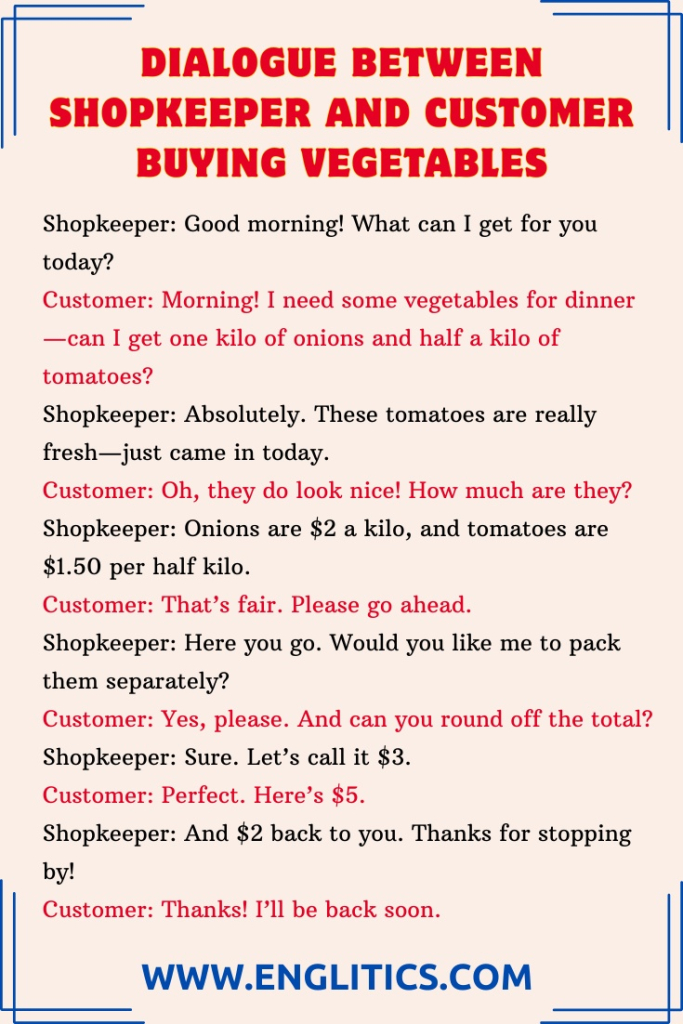
Shopkeeper: Good morning! What can I get for you today?
Customer: Morning! I need some vegetables for dinner—can I get one kilo of onions and half a kilo of tomatoes?
Shopkeeper: Absolutely. These tomatoes are really fresh—just came in today.
Customer: Oh, they do look nice! How much are they?
Shopkeeper: Onions are $2 a kilo, and tomatoes are $1.50 per half kilo.
Customer: That’s fair. Please go ahead.
Shopkeeper: Here you go. Would you like me to pack them separately?
Customer: Yes, please. And can you round off the total?
Shopkeeper: Sure. Let’s call it $3.
Customer: Perfect. Here’s $5.
Shopkeeper: And $2 back to you. Thanks for stopping by!
Customer: Thanks! I’ll be back soon.
Dialogue 2: Asking About Prices and Freshness
Customer: Hello there! These beans look great—are they fresh?
Shopkeeper: Yes, ma’am. Picked early this morning from the farm.
Customer: That’s good to know. What’s the price per kilo?
Shopkeeper: $3 per kilo today.
Customer: I’ll take half a kilo, please. And how about cucumbers?
Shopkeeper: Cucumbers are $1.20 per kilo. Nice and crunchy.
Customer: I’ll take one kilo of those too. Anything on discount today?
Shopkeeper: Potatoes are $1.80 per kilo if you’re interested.
Customer: I’ve got enough for now. What’s the total?
Shopkeeper: $2.70 altogether.
Customer: Here’s $3—keep the change.
Shopkeeper: Thank you! Have a great day.
Customer: You too. See you again!
Dialogue 3: Bargaining in a Local Market
Customer: Hi! How much are the potatoes today?
Shopkeeper: $2.50 a kilo. They’re really good quality.
Customer: I see. If I take 3 kilos, can you lower the price a bit?
Shopkeeper: For 3 kilos… I can do $2.20 per kilo. Fair enough?
Customer: Sounds good. Please give me 3 kilos.
Shopkeeper: Here you go. Want to double-check the weight?
Customer: No need. I trust you.
Shopkeeper: That’ll be $6.60 in total.
Customer: Here’s $10. Can I get change?
Shopkeeper: Of course. $3.40 back. Do you need a bag?
Customer: Yes, please. Thanks for the deal!
Shopkeeper: Anytime! Come by tomorrow—we’ll have fresh carrots.
Dialogue 4: Buying Leafy Vegetables
Customer: Do you have fresh spinach today?
Shopkeeper: Yes, ma’am. It’s very fresh—just brought in this morning.
Customer: Great. Give me two bundles, please.
Shopkeeper: Sure. Anything else you’d like?
Customer: Hmm… Do you have coriander?
Shopkeeper: Yes, we have fresh bunches—still smelling earthy!
Customer: Perfect. Add one bunch of that too.
Shopkeeper: All packed. The total is $1.80.
Customer: Do you take mobile payments?
Shopkeeper: Yes, just scan this code.
Customer: Done! Thanks for your help.
Shopkeeper: You’re welcome. Hope to see you again soon!
Customer: Definitely!
Dialogue 5: Buying for a Family Dinner
Shopkeeper: Hello again! Planning something big today?
Customer: Yes, having a family dinner tonight. I need a few veggies.
Shopkeeper: I’ve got plenty in stock. What are you looking for?
Customer: 1 kilo of carrots, 2 kilos of potatoes, and 1 kilo of green bell peppers.
Shopkeeper: Got it. Anything leafy—like spinach or lettuce?
Customer: Hmm… Yes, add a small cabbage and a few garlic bulbs too.
Shopkeeper: No problem. Want me to pack them separately?
Customer: Yes, please. That makes it easier for me.
Shopkeeper: All set. Your total comes to $10.50.
Customer: That’s reasonable. I’ll pay by card.
Shopkeeper: Tap here, please… Payment received.
Customer: Thanks for the quick service!
Shopkeeper: Always a pleasure. Have a delicious dinner!
Dialogue Writing Tips
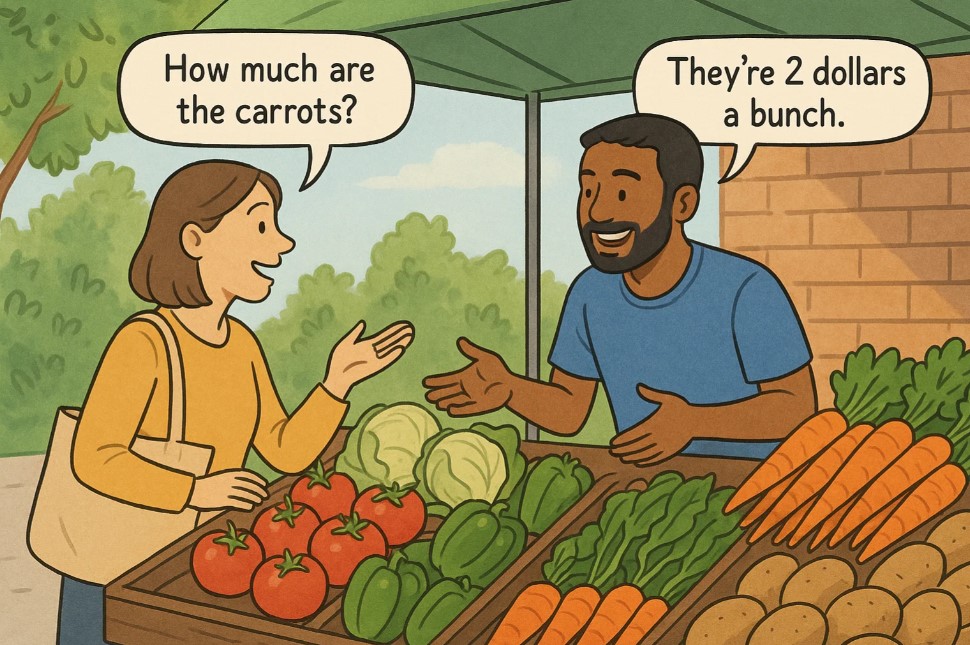
Writing clear, realistic dialogues is one of the best ways for English learners to improve their fluency and communication skills. A simple conversation between a shopkeeper and customer buying vegetables teaches practical language, polite expressions, and useful vocabulary.
Here are 6 easy tips to help you write better shopping dialogues:
1. Set a Clear Scene
Before writing, imagine where the conversation is happening. Is it at a market stall? A grocery store? A roadside shop? This helps choose the right words and tone.
Ask yourself:
- Who is the customer? (A busy mom? A student cooking dinner?)
- What do they need? (A few veggies? A full grocery list?)
- How formal or casual is the setting?
Example:
A young man visits a vegetable stall after work to buy ingredients for soup.
2. Use Natural, Spoken English
Real people speak simply and casually when shopping. Avoid textbook phrases. Use friendly, short sentences and questions.
| Instead of… | Try Saying… |
|---|---|
| “I would like to purchase…” | “I’d like to buy…” |
| “Kindly hand me those carrots.” | “Can I have those carrots, please?” |
| “The item appears to be subpar.” | “These don’t look fresh.” |
3. Keep the Tone Polite and Helpful
Both the shopkeeper and customer should sound respectful and cooperative, even when bargaining or asking questions.
Examples:
- “How much are these?”
- “Would you like anything else?”
- “Thanks! I’ll come again.”
Politeness makes the dialogue feel real and culturally appropriate.
4. Use a Simple Structure (Beginning → Middle → End)
Just like a short story, every good dialogue has three parts:
- Beginning: Greeting and reason for visit
- Middle: Product selection, prices, quantity
- End: Payment, thanks, and farewell
Example:
- “Good morning! Do you have fresh beans?”
- “Yes. How much would you like?”
- “Half a kilo, please. Thanks!”
5. Add Topic-Related Vocabulary
Use terms that match the vegetable market setting: weights, prices, freshness, etc. This builds strong, useful vocabulary and improves realism.
Examples:
- “Is this per kilo?”
- “Please give me one bundle of spinach.”
- “Do you take mobile payments?”
6. Add Emotion and Human Reactions
Even in short shopping conversations, a bit of emotion—like hesitation, friendliness, or appreciation—makes the dialogue sound natural.
Examples:
- “Hmm… those cucumbers look really good!”
- “Oh no, I forgot garlic again!”
- “That’s too much. Can you make it a bit cheaper?”
These touches show real-world language in action.
Dialogue Practice Exercises
These exercises help learners master real-life shopping expressions, build strong vocabulary, and practice sentence structure used in vegetable market conversations.
Exercise 1: Fill in the Blanks
Word Bank: (bundle, fresh, kilo, discount, total, change, spinach, mobile payment, per kilo, onions)
- How much are the carrots ______?
- Can I get a ______ on these tomatoes?
- I’d like one ______ of coriander, please.
- Is this ______? It looks very good.
- Give me two kilos of ______.
- What’s the ______ for all this?
- Do you accept ______?
- Please pack one ______ of spinach.
- These potatoes are $3 ______.
- Here’s $5. Can I get my ______?
Answer Key:
- per kilo
- discount
- bundle
- fresh
- onions
- total
- mobile payment
- bundle
- per kilo
- change
Exercise 2: Sentence Rewriting
Instruction: Make each sentence more polite and natural for a customer-shopkeeper conversation.
- “Give me onions.”
- “This is bad. Show me another.”
- “Too much. Make it cheap.”
- “You have cabbage or not?”
- “I want tomatoes. Fast.”
- “No bag. I don’t want it.”
- “Why is this expensive?”
- “Pack this and don’t talk.”
- “Give discount now.”
- “You slow. Hurry up.”
Sample Rewritten Answers:
- Could I have some onions, please?
- These don’t look fresh. Can I see another?
- That’s a bit pricey. Can you lower it?
- Do you have any cabbage today?
- I’d like some tomatoes, please.
- No bag needed, thank you.
- Is there a reason this costs more?
- Please pack this for me.
- Can you offer a discount on this?
- Sorry, I’m in a hurry—can we speed it up?
Exercise 3: Multiple Choice Questions
Choose the most appropriate or polite response.
- “How much for a kilo of beans?”
a) What do you care?
b) $2.50 per kilo.
c) Take it or leave it. - “Are these fresh?”
a) No, they’re old.
b) Yes, they just arrived this morning.
c) Buy if you want. - “Can I get a bag, please?”
a) Take one yourself.
b) No.
c) Of course, here you go. - “Do you accept mobile payments?”
a) Yes, scan this QR code.
b) Go to another shop.
c) Cash only, loser. - “Give me half a kilo of carrots.”
a) No.
b) Sure. Anything else?
c) Why? - “That price is high. Can you reduce it?”
a) You poor?
b) Okay, I can give you a small discount.
c) Go away. - “Thanks for the help!”
a) I know.
b) Whatever.
c) You’re welcome. Come again! - “Do you have any garlic today?”
a) Yes, we just restocked.
b) None of your business.
c) I don’t know. - “Please give me 2 bundles of spinach.”
a) Done. Here you go.
b) Buy something else.
c) Go now. - “Can I get change for $10?”
a) No money here.
b) Yes, here’s your change.
c) Don’t talk to me.
Answer Key:
- b
- b
- c
- a
- b
- b
- c
- a
- a
- b
Exercise 4: Dialogue Building
Complete each short dialogue with 1–2 polite, natural lines.
- Customer: “How much for these cucumbers?”
Shopkeeper: __________________________
Customer: “Okay, I’ll take one kilo.” - Shopkeeper: “Would you like anything else?”
Customer: __________________________
Shopkeeper: “Sure, I’ll add them.” - Customer: “Can I pay with UPI?”
Shopkeeper: __________________________
Customer: “Great. Let me scan.” - Shopkeeper: “Do you need a bag?”
Customer: __________________________
Shopkeeper: “Here you go.” - Customer: “That’s too expensive for cabbage.”
Shopkeeper: __________________________
Customer: “Thanks, I appreciate the discount.” - Shopkeeper: “This came in fresh this morning.”
Customer: __________________________
Shopkeeper: “Would you like some?” - Customer: “Give me two kilos of tomatoes.”
Shopkeeper: __________________________
Customer: “Yes, that’s fine.” - Shopkeeper: “That’s $7.50 in total.”
Customer: __________________________
Shopkeeper: “Thank you. Have a nice day!” - Customer: “Do you have organic vegetables?”
Shopkeeper: __________________________
Customer: “Perfect. I’ll take a bunch.” - Shopkeeper: “Thanks for visiting!”
Customer: __________________________
Shopkeeper: “Hope to see you again soon.”
Sample Answers:
- “They’re $1.80 per kilo.”
- “Yes, please add some green chilies too.”
- “Yes, we accept UPI and Paytm.”
- “Yes, please. That would be helpful.”
- “Okay, I’ll reduce it by 50 cents.”
- “Oh, it looks great. Really fresh!”
- “Here you go. Is this amount okay?”
- “Here’s $10.”
- “Yes, they’re in the back—no pesticides used.”
- “Thanks! I’ll be back tomorrow.”
Conclusion
Conversations like those between a shopkeeper and customer buying vegetables are essential in everyday life—and they’re a perfect opportunity for English learners to improve their spoken fluency, real-world vocabulary, and communication confidence. Through these dialogues, you learn how to ask for prices, express politeness, request specific quantities, and interact respectfully with others.
By practicing the sample dialogues, vocabulary, and exercises in this guide, you’ll feel more prepared to speak naturally in market situations. Whether you’re role-playing with a partner or shopping in an English-speaking country, these expressions will help you sound clear, friendly, and confident. Keep practicing—and enjoy every conversation as a step toward better English!