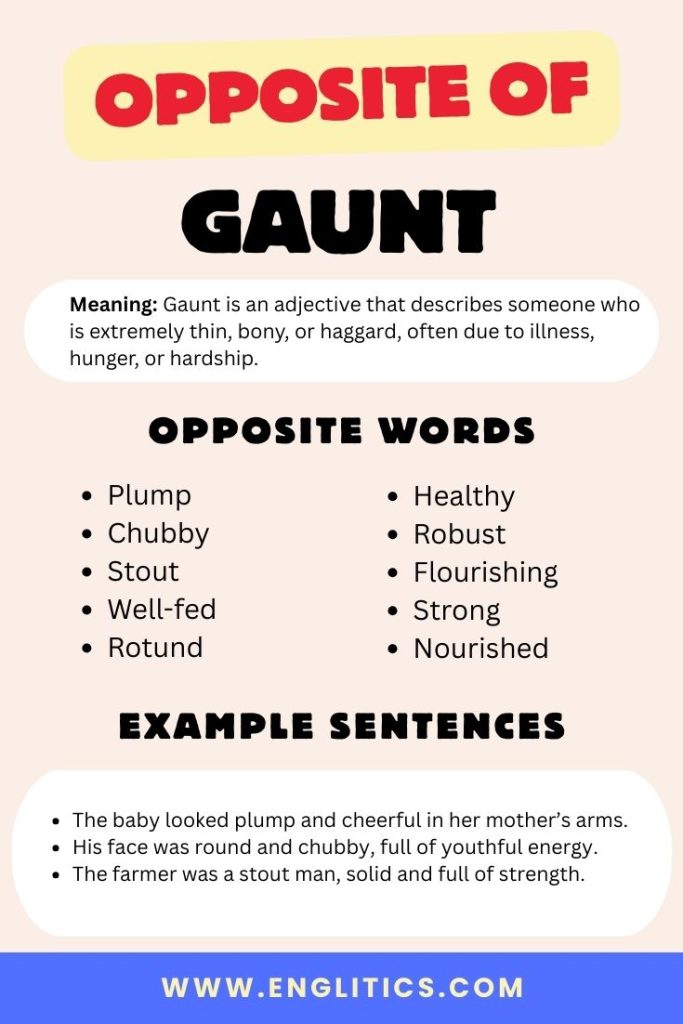
Gaunt describes someone who looks very thin, bony, or worn out—often because of illness, stress, or lack of food. The Opposite of Gaunt refers to someone who appears healthy, well-fed, or full in figure. These opposite words are helpful when you want to describe a person’s appearance in a more positive, vibrant way.
Common Antonyms for Gaunt include plump, well-fed, healthy, robust, and chubby. For example, instead of saying someone looks gaunt after an illness, you might say they now look healthy and full of energy. These words give you a better way to talk about body appearance and physical recovery.
Definition of Gaunt
The word “gaunt” is an adjective that describes someone or something that is extremely thin and bony, often to the point of looking unhealthy or emaciated. It typically implies a negative condition, such as illness, starvation, or exhaustion.
The term can also be used metaphorically to describe landscapes or objects that are bleak, desolate, or bare.
Key Characteristics of “Gaunt”:
- Extreme thinness
- Bony appearance
- Association with suffering, hunger, or age
- Negative connotation
Understanding the nuances of “gaunt” is essential for identifying its true antonyms. Antonyms should reflect the opposite of these key characteristics, indicating health, fullness, and vitality.
Structural Breakdown of Meaning
To fully grasp the antonyms of “gaunt,” it’s helpful to analyze its structural components. The word often carries both a descriptive and an emotional weight.
The descriptive aspect refers to the physical appearance of being thin and bony, while the emotional aspect conveys a sense of suffering or deprivation.
Therefore, antonyms for “gaunt” must address both of these aspects. They should describe a physical state that is not thin and bony, but rather healthy, well-fed, or even plump.
Furthermore, they should evoke a sense of well-being and vitality, rather than suffering or deprivation.
Deconstructing “Gaunt”:
- Physical: Thin, bony, emaciated
- Emotional: Suffering, deprived, unhealthy
Antonyms should counter these elements by representing the opposite qualities:
- Physical: Full, fleshy, robust
- Emotional: Healthy, well-nourished, vigorous
Opposite of Gaunt
Antonyms are words that have opposite meanings. There are several types of antonyms, and understanding these types can help us identify the most appropriate antonyms for “gaunt.”
Complementary Antonyms
Complementary antonyms are pairs of words where the presence of one implies the absence of the other. For example, “alive” and “dead” are complementary antonyms.
In the context of “gaunt,” a complementary antonym might be a word that suggests a healthy or well-nourished state.
Gradable Antonyms
Gradable antonyms are pairs of words that exist on a continuum. They represent opposite ends of a spectrum, but there are intermediate states between them.
For example, “hot” and “cold” are gradable antonyms. For “gaunt,” gradable antonyms might include words like “thin,” “average,” and “plump,” representing different points on the spectrum of body weight.
Relational Antonyms
Relational antonyms are pairs of words that describe a relationship from opposite perspectives. For example, “teacher” and “student” are relational antonyms.
While relational antonyms are less directly applicable to “gaunt,” understanding this type of antonym can broaden our understanding of opposition in language.
Examples of Antonyms for Gaunt
The following sections provide examples of antonyms for “gaunt,” categorized by their specific connotations. Each category includes a table with numerous examples to illustrate the range of possible antonyms.
Healthy and Well-fed
These antonyms emphasize a state of good health and adequate nourishment, contrasting with the suffering and deprivation implied by “gaunt.” They suggest a positive physical condition and overall well-being.
The table below offers a variety of terms that suggest health and good nourishment, offering alternatives to describing someone as “gaunt.”
| Antonym | Example Sentence |
|---|---|
| Healthy | After months of recovery, she looked healthy and vibrant. |
| Well-fed | The horses were well-fed and energetic. |
| Nourished | The child was finally nourished after weeks of malnourishment. |
| Flourishing | The plants were flourishing in the rich soil. |
| Thriving | The business was thriving despite the economic downturn. |
| Vigorous | He maintained a vigorous exercise routine. |
| Blooming | She looked blooming with health and happiness. |
| Fit | He was fit and ready for the marathon. |
| Strong | The athlete was strong and powerful. |
| Robust | The old tree was robust and weathered. |
| Hearty | He had a hearty appetite. |
| Sound | The doctor declared him sound of mind and body. |
| In good shape | She was in good shape after her training. |
| Full of life | She was full of life and energy. |
| Energetic | The children were energetic and playful. |
| Lively | The party was lively and fun. |
| Animated | He was animated during the discussion. |
| Radiant | She looked radiant on her wedding day. |
| Glowing | Her skin was glowing with health. |
| Buoyant | He was buoyant and optimistic. |
| Resilient | She was resilient and bounced back from adversity. |
| In the pink | After a good rest, she was in the pink. |
| Hale | He remained hale and hearty into his nineties. |
| Blooming | She looked blooming after her vacation. |
| Flourishing | The garden was flourishing in the sunshine. |
Plump and Chubby
These antonyms focus on a fuller, more rounded physique, directly contrasting with the thinness associated with “gaunt.” They suggest a comfortable and well-nourished appearance, often with a positive or neutral connotation.
Below is a table of words that indicate a fuller figure, offering alternatives to describing someone as “gaunt” by emphasizing a more rounded appearance.
| Antonym | Example Sentence |
|---|---|
| Plump | The baby had plump cheeks. |
| Chubby | The toddler was chubby and adorable. |
| Fleshy | He had a fleshy face and a warm smile. |
| Rounded | Her figure was rounded and feminine. |
| Stout | The man was stout but strong. |
| Full-figured | She was a full-figured woman with confidence. |
| Curvy | The model had a curvy silhouette. |
| Portly | The portly gentleman enjoyed a good meal. |
| Overweight | He was slightly overweight but healthy. |
| Well-built | The athlete was well-built and muscular. |
| Ample | She had an ample bosom. |
| Buxom | The buxom woman had a hearty laugh. |
| Hefty | The hefty man was a gentle giant. |
| Substantial | He had a substantial build. |
| Thickset | The wrestler was thickset and powerful. |
| Stocky | The farmer was stocky and strong. |
| Broad | He had broad shoulders. |
| Big-boned | She was big-boned but graceful. |
| Solid | He had a solid build. |
| Corpulent | The corpulent king enjoyed his feasts. |
| Obese | He was clinically obese and needed to lose weight. |
| Paunchy | The man had a paunchy stomach. |
| Rotund | The rotund gentleman was jolly. |
| Tubby | The child was tubby and cheerful. |
| Fattened | The cattle were fattened for slaughter. |
Robust and Vigorous
These antonyms highlight strength, energy, and vitality, contrasting with the weakness and frailty associated with “gaunt.” They suggest a resilient and active state of being.
The subsequent table lists terms that describe vigor and strength, offering alternatives to describing someone or something as “gaunt” by emphasizing vitality.
| Antonym | Example Sentence |
|---|---|
| Robust | The robust plant survived the winter. |
| Vigorous | He had a vigorous approach to life. |
| Strong | The bridge was strong enough to hold the weight. |
| Powerful | The engine was powerful and efficient. |
| Hardy | The hardy flowers bloomed in the spring. |
| Resilient | She was resilient and overcame many challenges. |
| Durable | The furniture was durable and long-lasting. |
| Sturdy | The table was sturdy and well-made. |
| Tough | He was a tough competitor. |
| Tenacious | She was tenacious and never gave up. |
| Dynamic | The company had a dynamic leader. |
| Energetic | The children were energetic and playful. |
| Lively | The music was lively and upbeat. |
| Vivacious | She was a vivacious and charming woman. |
| Spirited | The horse was spirited and full of energy. |
| Exuberant | He was exuberant about his new job. |
| Bouncing | The baby was bouncing with health. |
| Flourishing | The business was flourishing under new management. |
| Thriving | The plants were thriving in the garden. |
| Prosperous | The town was prosperous and growing. |
| Sound | The building was structurally sound. |
| In good condition | The car was in good condition. |
| In fine fettle | He was in fine fettle after his vacation. |
| Blooming | The flowers were blooming in the spring. |
| Radiant | She looked radiant with happiness. |
Bloated and Swollen
While seemingly negative, these antonyms contrast “gaunt” by indicating fullness, even if it’s due to an unnatural or unhealthy condition. They emphasize the presence of volume and mass, rather than the absence of it.
The following table includes terms that suggest swelling or bloating, offering alternatives to describing someone as “gaunt” by focusing on increased volume, even if unhealthy.
| Antonym | Example Sentence |
|---|---|
| Bloated | His stomach was bloated after the rich meal. |
| Swollen | Her ankle was swollen after the injury. |
| Puffy | Her eyes were puffy from crying. |
| Distended | His abdomen was distended due to the illness. |
| Inflated | The balloon was inflated to its maximum size. |
| Turgid | The plant’s leaves were turgid with water. |
| Gorged | The snake was gorged after eating its prey. |
| Stuffed | He was stuffed after the Thanksgiving dinner. |
| Overfull | The container was overfull and spilling. |
| Congested | The city streets were congested with traffic. |
| Surcharged | The battery was surcharged with electricity. |
| Replete | The library was replete with books. |
| Packed | The stadium was packed with fans. |
| Teeming | The river was teeming with fish. |
| Rife | The area was rife with rumors. |
| Laden | The trees were laden with fruit. |
| Burgeoning | The city had a burgeoning population. |
| Expanding | The company was expanding its operations. |
| Increasing | There was an increasing demand for the product. |
| Amplifying | The speaker was amplifying his voice. |
| Augmenting | The team was augmenting its resources. |
| Escalating | The conflict was escalating rapidly. |
| Accumulating | He was accumulating wealth over time. |
| Amassing | The museum was amassing a large collection. |
| Building up | He was building up his strength. |
Usage Rules and Context
When choosing an antonym for “gaunt,” it’s important to consider the specific context and the intended meaning. The most appropriate antonym will depend on what aspect of “gaunt” you want to contrast – its physical appearance, its association with suffering, or its overall negative connotation.
Contextual Considerations:
- Formal vs. Informal: Some antonyms, like “corpulent,” are more formal than others, like “chubby.”
- Positive vs. Neutral: Some antonyms, like “healthy,” have a positive connotation, while others, like “overweight,” are more neutral.
- Specific vs. General: Some antonyms, like “plump,” refer specifically to body weight, while others, like “robust,” have a broader meaning.
Examples in Context:
- Instead of: “The prisoners looked gaunt and starved.”
Consider: “The prisoners looked emaciated and starved.” (Synonym, emphasizing the negative condition)
- Instead of: “After the illness, she was gaunt and weak.”
Consider: “After the illness, she was recovering and gaining strength.” (Focuses on the process of regaining health)
- Instead of: “The stray dog was gaunt and bony.”
Consider: “The stray dog was scrawny and bony.” (Synonym, emphasizing the thinness)
- Instead of: “The model had a gaunt face.”
Consider: “The model had a sculpted face.” (Changes the connotation to something aesthetically pleasing)
Common Mistakes to Avoid
Using antonyms incorrectly can lead to miscommunication and awkward phrasing. Here are some common mistakes to avoid when choosing antonyms for “gaunt.”
Mistake 1: Choosing an antonym that focuses only on physical appearance, ignoring the emotional connotation.
- Incorrect: “The patient was gaunt and depressed, but now he is merely overweight.” (Focuses only on weight, ignoring the depression)
- Correct: “The patient was gaunt and depressed, but now he is healthy and cheerful.” (Addresses both physical and emotional well-being)
Mistake 2: Using an antonym that is too general or vague.
- Incorrect: “The gaunt man looked better after eating.” (Too vague; doesn’t specify the improvement)
- Correct: “The gaunt man looked healthier and more energetic after eating.” (More specific and descriptive)
Mistake 3: Using an antonym that is inappropriate for the context.
- Incorrect: “The gaunt tree was now corpulent.” (Inappropriate use of “corpulent,” which is usually applied to people)
- Correct: “The gaunt tree was now flourishing with leaves.” (More appropriate for describing a tree)
Table of Common Mistakes:
| Incorrect | Correct | Explanation |
|---|---|---|
| The gaunt child was now obese. | The gaunt child was now healthy and well-fed. | “Obese” focuses only on weight and can be negative. |
| The gaunt patient was now big. | The gaunt patient was now robust and strong. | “Big” is too general; “robust” and “strong” are more descriptive. |
| The gaunt building was now plump. | The gaunt building was now sturdy and well-maintained. | “Plump” is inappropriate for a building. |
Practice Exercises
Test your understanding of antonyms for “gaunt” with the following exercises. Choose the best antonym from the options provided to complete each sentence.
Exercise 1: Multiple Choice
Choose the best antonym for “gaunt” in each sentence.
| Question | Options | Answer |
|---|---|---|
| 1. After months of starvation, the rescued dog was no longer gaunt, but rather _____. | a) skinny b) plump c) emaciated d) bony | b) plump |
| 2. The gaunt patient regained his health and became _____. | a) frail b) weak c) vigorous d) thin | c) vigorous |
| 3. Instead of appearing gaunt and ill, she looked _____ after her vacation. | a) pale b) sickly c) radiant d) wan | c) radiant |
| 4. The once gaunt tree was now _____ with leaves and fruit. | a) bare b) desolate c) flourishing d) withered | c) flourishing |
| 5. The gaunt refugee was finally _____ and able to regain his strength. | a) deprived b) malnourished c) nourished d) hungry | c) nourished |
| 6. The _____ athlete was the picture of health, a stark contrast to his gaunt appearance last year. | a) feeble b) scrawny c) robust d) lanky | c) robust |
| 7. After a long winter, the gaunt landscape transformed into a _____ meadow. | a) barren b) bleak c) lively d) sparse | c) lively |
| 8. The _____ appearance of the child was a welcome change from her previous gaunt state. | a) wasted b) cadaverous c) chubby d) skeletal | c) chubby |
| 9. The gaunt stray cat was taken in and became a _____ member of the family. | a) unhealthy b) sickly c) thriving d) weak | c) thriving |
| 10. Instead of a gaunt look, she now possesses a _____ complexion. | a) pallid b) sallow c) glowing d) ashen | c) glowing |
Exercise 2: Fill in the Blanks
Fill in the blanks with an appropriate antonym for “gaunt.”
| Question | Answer |
|---|---|
| 1. After the surgery, he was no longer gaunt, but looked remarkably ___________. | healthy |
| 2. The once gaunt fields were now __________ with crops. | laden |
| 3. Instead of appearing gaunt and tired, she looked _________ and refreshed. | radiant |
| 4. The ___________ child was a stark contrast to the gaunt figure he once was. | plump |
| 5. The stray dog, once gaunt and weak, was now _________ and full of energy. | vigorous |
| 6. From a gaunt, skeletal figure, he transformed into a __________ athlete. | muscular |
| 7. After a hearty meal, the formerly gaunt man looked much more __________. | nourished |
| 8. Instead of a gaunt and lifeless presence, she was now __________ and animated. | lively |
| 9. The land, once gaunt and barren, was now ___________ and thriving. | flourishing |
| 10. The patient’s face, once gaunt and drawn, was now ___________ with health. | blooming |
Advanced Topics
For advanced learners, exploring the etymology and historical usage of “gaunt” and its antonyms can provide a deeper understanding of their meanings and connotations. Additionally, analyzing literary examples where “gaunt” is used can reveal subtle nuances and cultural associations.
Further Exploration:
- Etymology: Research the origins of “gaunt” and its related words to understand how its meaning has evolved over time.
- Literary Analysis: Examine how authors use “gaunt” and its antonyms to create specific effects in their writing.
- Cultural Context: Investigate how cultural attitudes towards body weight and health influence the perception and usage of “gaunt” and its antonyms.
Nuances of Meaning:
- Consider the emotional weight of “gaunt.” It often carries connotations of suffering, deprivation, and even death.
- Explore the subtle differences between antonyms like “plump,” “stout,” and “corpulent.” Each word has a slightly different shade of meaning and may be more appropriate in certain contexts.
Frequently Asked Questions
Here are some frequently asked questions about antonyms for “gaunt.”
- What is the best antonym for “gaunt” in general?The “best” antonym depends on the context. If you want to emphasize health and well-being, “healthy” or “vigorous” might be suitable. If you want to focus on a fuller physique, “plump” or “stout” might be more appropriate.
- Are there any negative antonyms for “gaunt”?Yes, words like “bloated” or “swollen” can be considered antonyms in the sense that they describe a state of fullness, but they also carry negative connotations. These words emphasize the presence of volume, even if it’s due to an unhealthy condition, contrasting with the lack of volume implied by “gaunt.” They should be used carefully and deliberately.
- Can “fat” be considered an antonym for “gaunt”?While “fat” does describe a state of having excess body weight, it can be a sensitive term with negative connotations. Depending on the context, “plump,” “stout,” or “full-figured” might be more appropriate alternatives.
- How do I choose the right antonym for “gaunt” in my writing?Consider the specific aspect of “gaunt” you want to contrast. Are you emphasizing health, physical appearance, or overall well-being? Choose an antonym that directly addresses that aspect and fits the tone and context of your writing.
- Are there any regional variations in the usage of antonyms for “gaunt”?Yes, some words, like “stout,” might be more common in certain regions or dialects. Be aware of these regional variations and choose words that are appropriate for your target audience.
- Is “gaunt” always a negative word?Yes, “gaunt” almost always carries a negative connotation, implying suffering, deprivation, or ill health. While it can be used to describe landscapes or objects, it still typically evokes a sense of bleakness or desolation.
- Can I use “gaunt” to describe an object?Yes, “gaunt” can be used to describe objects, typically landscapes or structures, that appear bleak, desolate, or bare. For example, “The gaunt silhouette of the mountain loomed against the sky.” In these cases, the antonyms would focus on words suggesting fullness, vibrancy, or richness, such as “lush” or “verdant.”
- What’s the difference between “gaunt” and “skinny”?“Skinny” simply describes someone who is thin, while “gaunt” implies an unhealthy or emaciated thinness, often due to suffering or deprivation. Therefore, antonyms for “skinny” might include words like “average” or “well-built,” while antonyms for “gaunt” focus on health and fullness.
Conclusion
Mastering antonyms for “gaunt” enhances your ability to express contrasting ideas with precision and clarity. By understanding the nuances of words like “healthy,” “plump,” “robust,” and even “bloated,” you can paint vivid pictures with your language and communicate more effectively.
Remember to consider the context, connotation, and specific aspect of “gaunt” you want to contrast when choosing the most appropriate antonym.
Continue to expand your vocabulary by exploring synonyms, related terms, and real-world examples. The more you practice, the more confident you’ll become in using language to its fullest potential.
Embrace the richness and complexity of the English language, and enjoy the journey of continuous learning and discovery.